

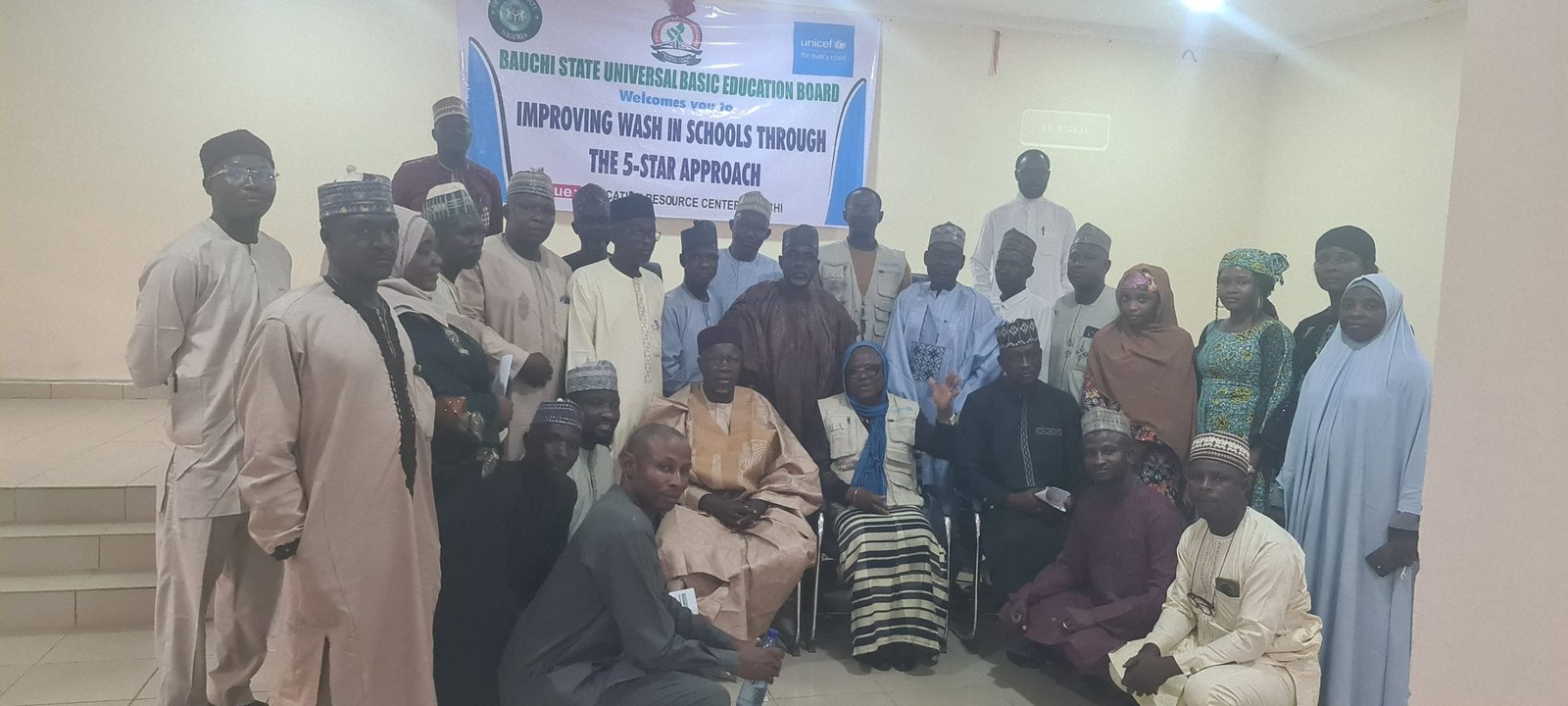
The United Nations Children’s Fund (UNICEF) has lamented that about 60 per cent of schools in Bauchi State lack functional Water, Sanitation, and Hygiene (WASH) facilities, stressing the need for urgent interventions to ensure that every child enjoys the right to safe water, sanitation, and proper hygiene.
The assertion was made by the Chief of Field Office, UNICEF Bauchi Field Office, Dr. Nuzhat Rafique, during the inception meeting to unveil a new Water, Sanitation, and Hygiene (WASH) intervention aimed at improving learning conditions and promoting sustainable hygiene practices in basic schools across the state. The meeting was organized by the Bauchi State Universal Basic Education Board (SUBEB), with technical support from the UNICEF Nigeria Bauchi Field Office (BFO).
Represented by WASH Specialist Mrs. Stella Okafor Terver, Dr. Rafique described access to functional WASH facilities in schools as a fundamental right of every child.
She explained that the inception meeting was organized to identify existing gaps in school WASH services and to develop strategies for improving children’s health, hygiene, and the overall learning environment in Bauchi State.
She called on all stakeholders involved in the 5-Star Approach initiative to demonstrate commitment and work collectively toward addressing WASH challenges in schools, making Bauchi State a model for improved school sanitation and hygiene.
The UNICEF Chief also identified persistent challenges in sustaining school WASH facilities, weak ownership and accountability, inadequate hygiene practices, and the need for durable, scalable handwashing facilities as some of the key factors necessitating the intervention.
She said the initiative seeks to improve the sustainability of WASH services and promote healthy hygiene behaviours in schools and their host communities.
Its objectives include strengthening hygiene practices, building capacity for the operation and maintenance of facilities, enhancing community ownership, institutionalising WASH governance, promoting inclusion and climate resilience, and ensuring long-term sustainability and scalability.
Dr. Rafique listed the expected outcomes to include the attainment of one- to five-star certification by participating schools, improved handwashing and sanitation practices, functional WASH facilities, stronger community participation, and increased government ownership of school WASH services.
The intervention, titled Improving WASH in Schools Through the 5-Star Approach, will be implemented in five local government areas—Alkaleri, Bauchi, Toro, Ningi, and Dambam—under a broader initiative to integrate WASH, climate resilience, and menstrual hygiene management in educational institutions.
Speaking at the inception meeting, the Executive Chairman of SUBEB, Abubakar Isa Baba, said the initiative was designed to address critical gaps affecting effective service delivery at the basic education level.
Represented by a SUBEB official, Abubakar Mansur Abdu, the Chairman noted that improved access to functional WASH facilities would help create a more conducive learning environment, potentially contribute to reducing the number of out-of-school children, and improve pupils’ transition from primary to junior secondary education.
He commended UNICEF and other development partners for their sustained support toward improving the quality and accessibility of basic education in the state, while urging WASH and education officers from the selected local government areas to demonstrate commitment and actively participate in implementing the intervention.
WATCH TOP VIDEOS FROM NIGERIAN TRIBUNE TV