


Every missed call in a medical practice is a patient who may not call back. New patient bookings, follow-up appointments, and prescription refill requests slip into voicemail every day, and top AI voice agents for missed-call recovery in medical practices exist precisely to stop that from happening. The five platforms below take meaningfully different approaches to the same core problem.
What Separates The Best Voice Agents From Simpler Automation
A phone tree that reads a menu isn’t the same thing as a voice agent. The distinction matters when a patient calls after hours with an urgent question or a new patient is choosing between two practices.
The platforms worth considering share a handful of traits: they hold a real conversation rather than pushing callers through a menu, they capture usable caller data, and they hand off to staff gracefully whenever the situation demands it. HIPAA compliance is the baseline. It’s not a differentiator. What actually separates these tools is the depth of EHR integration, deployment speed, pricing model, and whether the system was built specifically for healthcare or adapted from a generic call-center product.
Use case matters, too. A solo neurologist’s call patterns look nothing like those of a 50-physician multi-specialty group. Practice size and volume should drive the decision more than any feature checklist.
- Best for: Small and mid-sized medical practices with missed or after-hours calls
- Standout feature: Trains on the practice’s own website content; customizable at any time at no added cost
- EHR integration: Multiple calendar and EHR systems supported; data syncs with the EHR
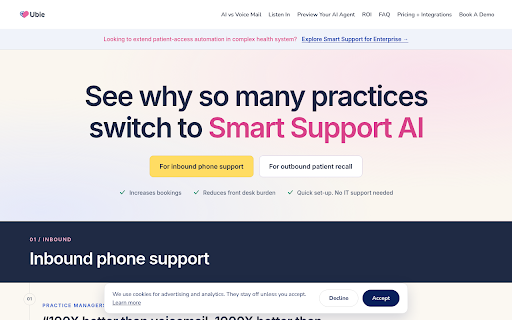
Smart Support by Ubie is a 24/7 AI phone agent that answers missed and after-hours patient calls in a conversational voice, captures the caller’s name, callback number, urgency level, and preferred contact time, then guides the patient toward booking. It works with the practice’s existing phone number, calls forward only when missed, so there’s no new system to install and no staff training required.
Pricing runs a flat $850 per month, which the company breaks down to roughly $1.16 per hour of coverage. For a practice watching new patients slip away to voicemail on nights and weekends, that’s a concrete number to weigh against front-desk overtime or an answering service contract. Ubie reports that typical practices see a 30 to 40 percent reduction in missed calls within the first month, though those figures are labeled illustrative.
The agent pulls from the practice’s site content and escalates to staff when a call needs a human, emergency routing included. It’s designed for overflow and after-hours coverage, not to replace the front desk or field complex clinical questions. Practices that want to hear it before committing can build a preview from their practice URL and listen to a sample call. The platform was qualified by the Mayo Clinic Platform on 08/12/2026, following evaluation of its intended use and clinical performance.
2. Hyro.ai
- Best for: Large and enterprise health systems automating high-volume patient communications
- Standout feature: Generative AI voice and chat assistants that deploy out-of-the-box with no training data required
- EHR integration: Epic EMR and Salesforce, with automated patient record identification and appointment scheduling
Founded in 2018 at Cornell Tech, Hyro serves 45 large healthcare organizations including Intermountain Healthcare, Bon Secours Mercy Health, and Hackensack Meridian Health. The platform replaces traditional IVR systems with adaptive AI agents across voice, web, SMS, mobile apps, and patient portals, all HIPAA-compliant.
What sets Hyro apart is deployment speed. The company claims a 60x faster time-to-value compared to traditional virtual assistants, largely because its generative AI approach doesn’t require training data before going live. The agents handle over 85% of routine patient inquiries, covering appointment scheduling, prescription support, and patient record identification. Hyro closed a $45 million funding round led by Healthier Capital, bringing total raised to $95 million, and was named to the 2026 New York Digital Health 100.
The platform is built for scale. Practices evaluating it should expect an enterprise sales process; there’s no published per-seat pricing. It’s a strong fit for large health systems but may be more infrastructure than a small practice actually needs.
3. Parakeet Health
- Best for: Healthcare organizations focused on revenue impact and operational cost reduction
- Standout feature: Performance-based pricing, charges only on verified lift above a locked baseline
- EHR integration: Connects with existing EHR, practice management, VoIP, and telephony systems; no rip-and-replace required
Parakeet Health takes an unusual commercial stance: practices don’t pay for software seats, they pay only on verified contribution to revenue and EBITDA above a locked baseline. That model removes the usual risk of buying software that underperforms.
The platform automates inbound and outbound workflows across voice, SMS, fax, and email. It’s healthcare-native from the ground up, not a generic call-center tool retrofitted for clinical settings. Deployment takes 4 to 6 weeks and requires fewer than six hours of staff time, and the system follows individual scheduling rules and provider preferences at the practice level.
The company publishes performance metrics from a 4-week head-to-head pilot against two legacy vendors: 38% more appointments booked, 6x outbound conversion, 42% more calls answered, and a 60% reduction in call center operating costs. A $10 million Series A followed 10x growth. The platform holds HIPAA, SOC 2, and TCPA compliance certifications. Year founded, headquarters, and team size aren’t publicly listed.
4. Phreesia
- Best for: Physician groups and specialty practices wanting to reduce front-desk labor and improve patient data capture
- Standout feature: Integrated patient intake, eligibility verification, and payments on one platform
- EHR integration: Yes, across a broad set of practice management and EHR systems
Phreesia isn’t a pure missed-call recovery tool, it’s a broader patient access platform automating intake, registration, eligibility verification, payments, and patient communications. But for practices looking to address call volume as part of a wider front-desk overhaul, it belongs on this list. Founded in 2005 and headquartered in Wilmington, DE, the company trades on the NYSE as PHR.
It serves 4,700+ healthcare organizations and claims to support 1 in 6 U.S. patient visits. Results documented on the site include an 87% reduction in call volume, a 73% average increase in time-of-service collections within six months, and an 80% copay collection rate versus a 56% industry average. Phreesia was named to the 2025 Deloitte Technology Fast 500 and holds HITRUST CSF Certification, PCI-DSS Level 1, and SOC 2 Type 2.
Pricing starts at $250 per month on a quote-based model. Practices evaluating Phreesia should expect a more complex deployment than a standalone voice agent, it’s a platform investment, not a plug-in.
5. Suki
- Best for: Clinicians looking to reduce documentation time and administrative burden across specialties
- Standout feature: Ambient documentation that generates complete clinical notes, patient instructions, and orders from patient conversations
- EHR integration: Epic, Oracle Health (Cerner), athenahealth, and MEDITECH, across 100+ medical specialties
Suki sits in a different lane than the other tools here. It’s not primarily a missed-call recovery platform; it’s an ambient clinical intelligence tool that captures patient-provider conversations and converts them into structured clinical documentation. But it belongs in this conversation because administrative overload is often what leaves front-desk staff too stretched to answer incoming calls in the first place.
Founded in 2017 and headquartered in Redwood City, California, Suki is deployed at over 450 healthcare organizations. The company’s stated impact metrics include a 41% reduction in time spent on notes, a 60% reduction in burnout feelings, and an average increase of $1,688 in incremental monthly revenue per user. It works on desktop, iOS, and Android. Frost & Sullivan recognized it with a 2026 North American Transformational Leadership award, and it earned a 93.2/100 overall performance score in the 2024 KLAS Spotlight Report.
Pricing isn’t published openly; industry reporting places Suki Compose at roughly $299 per user per month and Suki Assistant at roughly $399, with enterprise contracts varying based on EHR integration depth. Total funding exceeds $255 million, including a $90 million Series E in October 2026.
Choosing By Practice Size And Call Volume
Practice size and daily call volume should determine this decision more than any feature list.
Solo practitioners and small practices, say one to five providers, generally need something fast to set up, affordable, and focused on after-hours and overflow coverage. A lightweight AI phone agent fits that profile better than a full patient-access platform.
Mid-sized groups with dedicated front-desk staff can afford to think bigger: EHR automation depth, outbound recall workflows, and call center cost reduction become meaningful. Parakeet Health’s performance pricing model is worth examining for groups in that range.
Large health systems handling hundreds of thousands of annual calls are operating at a scale where a platform like Hyro, with deep Epic integration and multi-channel reach, makes more sense than a standalone voice agent.
And for practices where documentation burden is the real drag on patient access, not call volume per se, Suki addresses a different root cause. Phreesia suits practices that want to consolidate intake, payments, and communication in one system rather than add a point solution.
Final Thoughts
Top AI voice agents for missed-call recovery in medical practices range from lightweight phone agents to full patient-access platforms, and none of them fits every clinic. The question isn’t which tool has the most features, it’s which one matches the practice’s actual problem, whether that’s after-hours voicemail, high call-center costs, documentation overload, or front-desk capacity. A clear picture of call volume, staffing, and existing EHR infrastructure narrows the field fast.