


We know searching for menopause treatment in Punta Gorda can feel like navigating a carnival of claims. Pellets promise freedom, patches tout ease, and every ad flashes “bioidentical” as if it were magic. Let’s clear the midway. In the next five minutes you’ll compare FDA-approved patches, gels, sprays, and pills with compounded pellets, see what major medical societies endorse, and find nearby clinics that post real prices and follow-up plans. This guide is educational, not medical advice, so you can ask sharper, data-driven questions at your next appointment.
Pellets, Patches, and Creams Comparison
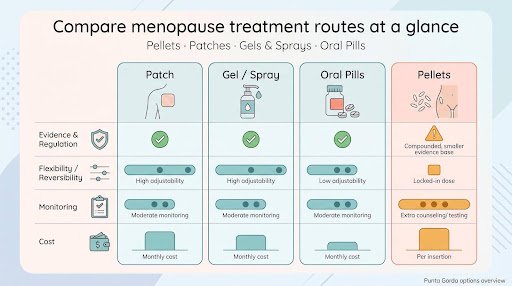
Here’s a quick overview before we dig deeper. We lined up the four routes Punta Gorda patients ask about most (pellets, patches, gels or sprays, and oral tablets) against the questions that matter: evidence, flexibility, monitoring, and cost.
Clinical yardsticks guide every row. The Menopause Society calls systemic estrogen “the most effective treatment” for moderate-to-severe hot flashes and for preventing bone loss. ACOG recommends starting with an FDA-approved product and notes that compounded pellets are less predictable and require extra counselling and testing.
| Route | Evidence & regulatory status | What you’ll love | Watch-outs | Typical cash outlay* |
| Estradiol patch | FDA-approved; robust data for systemic symptoms | Twice-a-week ease, quick dose change, no first-pass liver hit | Adhesive issues, visible edge, progesterone needed if you have a uterus | From $74.99 per month |
| Estradiol gel or spray | FDA-approved transdermal | No patch glare, adjustable, liver-friendly | Daily drying time; skin-to-skin transfer risk before dry | From $69.99 per month |
| Oral estradiol ± progesterone | FDA-approved | Familiar pill, generics, often insurance-friendly | First-pass liver effects; less ideal if clot risk looms | Estradiol $39.99 per month + progesterone $23 per month |
| Subcutaneous pellets | Usually compounded; smaller evidence base, irreversible until worn off | No daily dose, about 12–13-week convenience | Minor procedure, dose locked in for months, higher upfront cost | $350–$425 per insertion |
*Prices capture publicly listed Southwest Florida or national telehealth cash rates as of August 2026. Insurance, laboratory work, and added progesterone can change the math.
Take-away: patches and gels win on adjustability; pellets win on low-maintenance rhythm; and pills lead on upfront price, unless your cardiovascular profile points you toward a transdermal route. Next we’ll match these trade-offs to common health histories and lifestyles.
How We Evaluated Menopause Providers Serving Punta Gorda
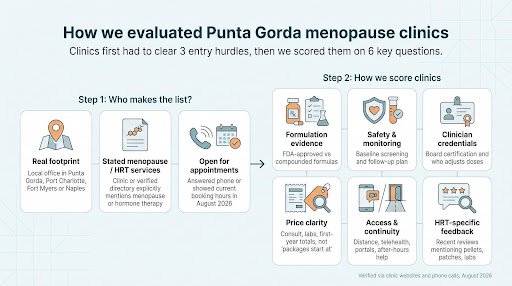
We value transparency. Many search results show glossy city pages with no street address, and even fewer list prices. We did the opposite. Every clinic that appears later in this guide cleared three basic hurdles:
- Real footprint. The site lists an office in Punta Gorda, Port Charlotte, or a short drive away (Fort Myers or Naples for pellet programs).
- Stated menopause or hormone-therapy services. The clinic’s page—or a verified directory such as Biote or EvexiPEL—explicitly mentions menopause or hormone-replacement care. Generic “wellness” claims were not enough.
- Open for appointments. During our August 2026 checks, the office answered calls or showed current booking hours; shuttered pages with legacy BHRT copy were excluded.
Once on the list, we rated each practice against six questions:
- Formulation evidence. Is the main product FDA-approved or custom-compounded? National guidelines favor approved estradiol and micronized progesterone as first-line therapy.
- Safety and monitoring. Does the site outline baseline screening, follow-up timing, and what happens if bleeding or high testosterone appears? ACOG warns that larger lab panels do not automatically mean safer care.
- Clinician credentials. Board certification, active license, and who writes or adjusts the prescription.
- Price clarity. Does the website publish consult, lab, and first-year totals instead of “packages start at”?
- Access and continuity. Distance, telehealth options, portal messaging, and after-hours help.
- HRT-specific feedback. We read the 20 most recent Google reviews for words such as “pellet,” “patch,” “menopause,” and “lab.”
Why no “best overall” trophy? Most local practices still hide like-for-like data. We would rather give you a fair, side-by-side field guide than a forced ranking.
Menopause Clinics and Providers Serving Punta Gorda
Punta Gorda is close enough to tap Fort Myers expertise yet small enough that most readers still want a local name and face, not a call-center script. Rather than rank clinics, we list them alphabetically so you can match services, price visibility, and follow-up style to your needs.
All details were verified on clinic websites or phone calls in August 2026. Always confirm current hours and fees.
Contemporary Health Center: Regional Pellet Program
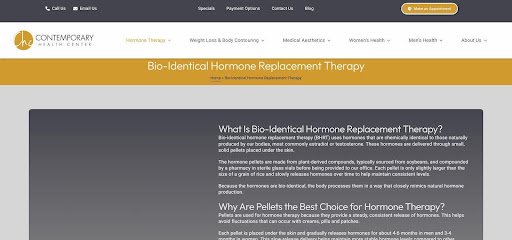
Contemporary Health Center, led by Dr. Richard L. Bloy, operates in Fort Myers and Naples, about an hour away. The practice markets compounded estradiol-plus-testosterone pellets, and its site lists a $425 female insertion that maintains consistent hormone release for roughly three to five months, a clear breakdown that draws many locals searching for hormone replacement therapy punta gorda. Labs and progesterone are separate, and insurance rarely covers pellet fees. The team checks bloodwork before each insertion (typically every 12 to 13 weeks) and offers phone or portal follow-ups.
Carlisa Family Medical & Aesthetics: Downtown Convenience
Carlisa on Charlotte Street blends primary care with Biote pellet therapy. The website lists no prices; ask for a first-year quote that includes baseline labs and follow-ups. Expect reinsertion every 12 to 13 weeks and standard insurance billing for non-pellet visits.
Face It Botox Bar: Med-Spa Plus Hormone Menu
Face It on Olympia Avenue offers Biote pellets alongside aesthetics. An all-inclusive first insertion covers consultation and supplies, but labs are extra. Confirm whether bloodwork is required each cycle and request menopause-specific reviews, not just cosmetic feedback.
Peaceful Harbor Gynecology: Traditional Women’s Health
Dr. Stephanie Finley’s Loveland Boulevard practice prescribes FDA-approved patches, tablets, and low-dose vaginal estrogen; compounded pellets are rare. Standard insurance visits and pharmacy copays keep costs predictable. Bring questions about route, uterine protection, and follow-up timing.
Premier Health Plus: Primary-Care Backbone
Premier Health Plus advertises 30- to 45-minute visits that weave menopause care into functional primary care. Treatments include FDA-approved patches, oral estradiol, and micronized progesterone; no pellet procedures. Insurance usually covers visits, while non-formulary medications bill as cash pay at the pharmacy.
PCP Health: Port Charlotte Pellet Pricing Up Front
PCP Health lists an EvexiPEL pellet package from $350 per insertion (consult included). Labs, follow-up bloodwork, and progesterone are separate. The clinic recommends two to four insertions a year; verify the full panel and partner-lab fees before scheduling. Some directories still show “Rooted Wellness” at the same address, so confirm when calling.
Aesthetics & Wellness by Monic Menard: Nurse-Led EvexiPEL
Located on Veterans Boulevard, this boutique practice posts female pellet pricing at $375. Most women need two to four pellets annually ($750-$1,500 before labs or progesterone). Baseline labs precede each insertion; ask which testosterone assay is used and what happens if levels exceed physiologic ranges.
AdventHealth Port Charlotte: Hospital-System Resources
The women’s-health service starts with FDA-approved oral or transdermal estrogen plus micronized progesterone when indicated; compounded pellets are not on the formulary. Office visits and labs bill through standard insurance contracts. Verify network status and ask about telehealth follow-ups once dosing stabilizes.
Port Charlotte VA Clinic: Veterans’ Option
Eligible veterans receive systemic estrogen, progesterone, or nonhormonal therapy through the VA formulary. Custom pellets are not supplied, but clinicians can transition existing pellet users to adjustable regimens. Care is covered under VA benefits; use VA Video Connect for virtual follow-ups when possible.
Desired Medical Solutions: Confirm Status First
Google still lists this Olympia Avenue suite, but the site now notes most services are discontinued and phone lines roll to voicemail. Call ahead to see whether menopause care is still active before making the drive.
Next: why patches, gels, and oral tablets attract stronger guideline support than pellets, and how to choose the right fit for your symptoms.
Estradiol Patches – How They Deliver Hormone Help
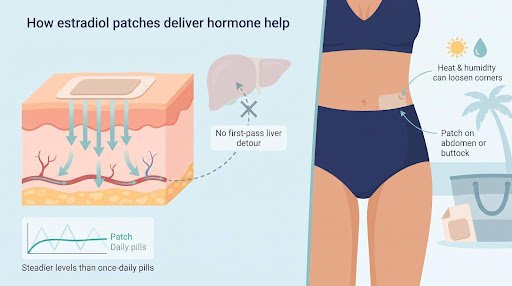
Picture a nicotine patch sized for menopause. A thin adhesive matrix on your abdomen or buttock releases bioidentical 17β-estradiol straight into the bloodstream with no first-pass liver detour. That direct route is one reason major guidelines favor transdermal hormone therapy when clot or cardiovascular risk makes pills less ideal. In 2026, the FDA removed the boxed warning from certain approved estrogen products to reflect updated safety data for appropriate candidates, but this change does not cover compounded items such as pellets.
Most brands come in once- or twice-weekly systems that deliver 0.025–0.1 mg (25–100 µg) of estradiol per day. Peel, stick, press for ten seconds, then forget it until change day. Blood levels rise within a few hours and stay steady, avoiding the peaks and valleys of once-daily tablets. Because you can simply remove the patch, symptoms of too much estrogen (breast tenderness, spotting, jitters) usually ease inside 24 hours.
That reversibility is powerful: you and your clinician can dial down or pause treatment without waiting months for a pellet to wear off.
Florida heat, sunscreen, and humidity can loosen corners. Rotate sites, press firmly after showers, and smooth out air bubbles. Keep a spare in your beach bag; it is cheap insurance when pool days call.
Oral Menopause Hormone Therapy – Convenience in a Pill Bottle
If your morning routine already includes a multivitamin, adding a 0.5–1 mg estradiol tablet (500–1,000 µg) feels natural: one swallow and you are done. The pill dissolves, travels through the portal vein, and reaches the liver, where part of the dose converts to estrone and increases clotting proteins. Because of that first-pass detour, guidelines steer women with a history of clots, migraine with aura, or metabolic risk toward patches or gels instead.
For healthy women within ten years of their final period, a low-to-moderate oral dose often tames hot flashes, night sweats, and mood swings. Generic prices hover around $40 per month for estradiol and $23 for micronized progesterone (uterine protection), and many insurers drop the copay to single digits.
Flexibility is strong: miss a pill and simply resume tomorrow; need a lower dose, your clinician writes a new script. Side-effect hiccups, like breast tenderness, spotting, and bloating, usually settle after a dose tweak within weeks.
Monitoring stays basic: blood pressure, breast screening, bleeding pattern, and overall cardiovascular risk. Routine estradiol labs are uncommon; symptom relief drives fine-tuning. If triglycerides or A1c ran high before therapy, expect those rechecked at routine physicals, not in a special hormone panel.
Oral therapy shines when simplicity, price, and insurance coverage top the wish list. If you need faster reversibility or your risk picture points you toward a transdermal route, the next section explains that option.
Hormone Pellets – How the Insertion Works
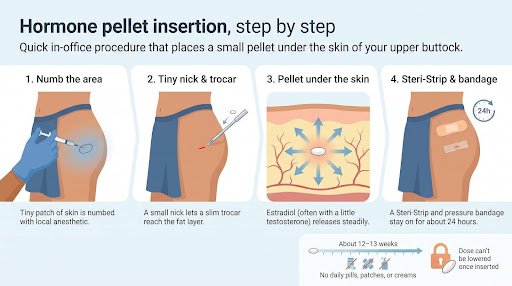
Picture a grain of rice slipped just under the skin of your upper buttock. That is a hormone pellet: compressed estradiol, often blended with a small dose of testosterone, prepared by a compounding pharmacy and designed to last about 12 to 13 weeks for women (around 22 weeks for men).
The procedure is quick. After numbing a two-centimetre patch with lidocaine, the clinician makes a tiny nick, guides a metal trocar into the fat layer, and deposits the pellet. A Steri-Strip seals the nick, and a pressure bandage stays on for 24 hours.
Hormone release begins soon after insertion. Blood flowing around the pellet leaches estradiol in a slow, near-linear trickle, so levels stay flatter than with daily dosing. Convenience is the draw: no pills to swallow, no patches to re-apply, no cream transfer worries.
Irreversibility comes with the package. If the dose feels too strong or side effects flare, you wait weeks—sometimes months—for the pellet to wear off; it cannot be dialled back like a patch or pill. ACOG therefore advises extra counselling and monitoring when pellets are chosen.
Infection or extrusion is uncommon but possible. Keep the site clean, skip pools for three days, and call your clinician if redness spreads or a marble-hard lump appears.
Cost is front-loaded. Local clinic listings show $350-$425 per female insertion, and most programmes recommend two to four insertions each year. Add baseline labs and a progesterone prescription (if you have a uterus), and first-year spending often tops $1,000.
What Should a Menopause Clinic Monitor?
Before You Swallow, Patch, or Pellet: The Baseline Blueprint
Good hormone care starts before the first prescription. At your initial visit, expect a thorough work-up that covers:
- Symptoms. Frequency of hot flashes, night sweats, sleep changes, mood shifts, vaginal dryness, and libido.
- Menstrual history. Date of the last period and any recent bleeding help anchor the menopause timeline.
- Medical history. Personal or family history of clots, stroke, heart disease, migraine with aura, liver or gallbladder disease, or estrogen-sensitive cancer—all shape route and dose decisions. An intact uterus means you will need progesterone with systemic estrogen.
- Vitals and metrics. Blood pressure, weight in kilograms and pounds, body-mass index, and waist circumference in centimetres and inches feed cardiovascular and metabolic risk calculations.
- Targeted exam. Breast, thyroid, heart, lungs, abdomen (for liver clues), and a pelvic exam if bleeding or genitourinary symptoms are present.
- Age-appropriate screening. Up-to-date mammogram, Pap or HPV test, colonoscopy, and bone-density scan when indicated.
ACOG notes that history, exam, and guideline screening form the foundation; labs should answer a clinical question, not decorate the chart. When a clinic skips these steps and jumps straight to a pricey “menopause panel,” consider it a red flag.
Labs That Matter And Those That Don’t
Lab work should answer a question, not pad a bill. For most healthy women starting FDA-approved systemic hormone therapy, basic safety needs little more than an up-to-date blood pressure reading and routine age-based cancer screening. ACOG reminds clinicians that “most women do not need serial serum estrogen or progesterone testing simply to individualise standard MHT.”
When Do Numbers Count?
- Pregnancy test if you are under 55 and periods vanish suddenly.
- Thyroid-stimulating hormone when symptoms overlap with thyroid disorders.
- Lipids and A1c if cardiovascular or metabolic risk already shows up in your chart (LDL ≥ 130 mg/dL or ≥ 3.4 mmol/L; A1c ≥ 5.7 percent).
- Liver panel when history points to hepatitis, fatty liver, or heavy alcohol use.
- Complete blood count if fatigue could reflect anaemia rather than hormones.
- Testosterone when pellets or androgens are used—request an assay validated for typical female ranges (15–70 ng/dL or 0.5–2.4 nmol/L).
Pellet programmes may add estradiol levels to confirm delivery; that is reasonable once therapy starts, but results should complement, not replace, symptom tracking and bleeding logs.
Red-Flag Marketing to Avoid
- Saliva tests sold as “precision dosing.” Hormone levels swing widely in spit.
- Broad “menopause panels” of 20 markers with no plan for how each result changes care.
- Anti-aging “optimal ranges” not found in recognised guidelines.
Bottom line: every lab must feed a decision tree, change the dose, switch the route, or order imaging. Anything else is decoration.
Follow-Up After You Start or Change Treatment
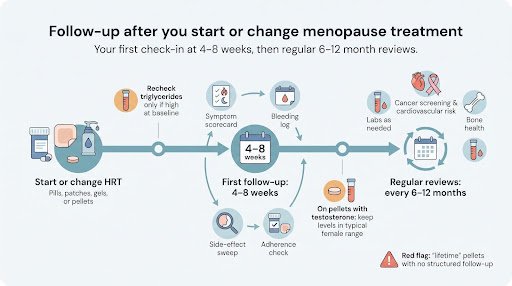
Your first prescription is a trial run, not a finish line. Most clinicians schedule a check-in four to eight weeks after you begin or adjust a dose, following Endocrine Society guidance. Expect four quick hits:
- Symptom scorecard. Are hot flashes down? Is sleep deeper or restless? Any breast tenderness or new bloating?
- Bleeding log. Note dates, flow, and cramps; spotting often appears while the dose ramps up.
- Side-effect sweep. Mood swings, acne, swelling, patch irritation, or pellet-site redness steer next steps.
- Adherence check. Missed pills, peeling patches after pickleball, or cream applied too soon before skin-to-skin contact can derail results.
Labs stay selective. Recheck triglycerides only if they were high at baseline. On pellets with testosterone, verify levels remain within the typical female range (15–70 ng/dL or 0.5–2.4 nmol/L). Otherwise, symptoms—not a target number—guide tweaks.
Once route and dose feel right, follow-ups move to every 6-12 months. Annual visits review cancer screening, cardiovascular risk, bone health, and whether benefits still outweigh risks as birthdays add up.
Red flag: a clinic that sells “lifetime” pellets but offers no structured follow-up. Hormone therapy is not fire-and-forget; your plan should evolve as you do.
How Much Does Menopause Treatment Cost in Punta Gorda?
Pellet Price Math – The Numbers Behind “Set It and Forget It”
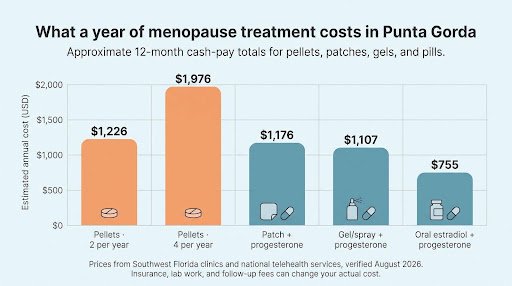
Most local pellet clinics quote $350–$425 per female insertion. At two to four insertions a year, procedure fees alone run $700–$1,700.
Typical extras:
| Cost driver | Low | High | Notes |
| Labs (CBC, CMP, lipids, thyroid, hormone panel) | $150 | $250 | Cash packages; some insurance lab cards accepted |
| Progesterone (uterus intact) | $23 per month | $23 per month | Generic micronised; $276 per year |
Approximate annual totals:
- Two pellets per year: $1,226
- Four pellets per year: $1,976
Some clinics fold labs into the pellet fee, while others add supplies or “booster” pellets. Ask for a written first-year quote that lists consult, labs, procedure, progesterone, and follow-ups.
Direct-Pay Patch, Gel, and Pill Costs – The Budget Flip Side
National telehealth services shipping to Florida advertise:
| Product | Monthly cash price* |
| Estradiol patch | $74.99 |
| Estradiol gel or spray | $69.99 |
| Oral estradiol | $39.99 |
| Micronised progesterone | $23.00 |
*Prices verified in August 2026; confirm current offers.
Approximate annual totals for someone with a uterus:
- Patch plus progesterone: $1,176
- Gel plus progesterone: $1,107
- Oral combo: $755
Insurance often lowers these figures; many PPO plans place generic estradiol and progesterone on tier 1 or 2 (copays under $20). Video-visit fees range $49-$250 but are often waived if you maintain a monthly plan.
Bottom line: run the full-year math, including labs and follow-ups, before deciding whether pellet convenience is worth the premium.
What Florida Patients Should Know About Compounded Hormones
“Bioidentical” describes chemical structure, not safety. Estradiol tablets, patches, and progesterone capsules at major pharmacies are already bioidentical and FDA-approved. Compounding matters only when a needed dose, route, or allergen-free base is not available off the shelf.
Under Florida law:
- 503A pharmacies prepare patient-specific prescriptions written by a licensed clinician; they may not compound pellets in bulk for every clinic in town (Florida Board of Pharmacy Rule 64B16-27.700).
- 503B outsourcing facilities can batch-produce office-use stock but face FDA inspection and stricter sterile standards (FD&C Act §503B).
Before you fill a compounded script, ask:
- Is the order patient-specific or for office stock?
- Which pharmacy or outsourcing facility supplies it, and is the permit active?
- What potency and sterility testing backs each lot?
- What is the beyond-use date, and how should it be stored?
- How will I be notified of recalls or adverse events?
If a clinic compounds pellets onsite, confirm it holds a Florida pharmacy permit, follows current USP chapters, and reports adverse events. No permit means no legal pathway.
Bottom line: Compounding is valuable when you truly need a custom formula. It is not a shortcut around FDA review and should never replace approved hormone therapy for marketing flair. Vet the pharmacy as carefully as you vet the prescriber.
Nonhormonal Prescription Alternatives When Estrogen Isn’t an Option
Hot flashes can hit even when systemic estrogen is off the table because of cancer history, clotting risk, or personal preference. Modern medicine still offers effective relief.
Fezolinetant (Veozah) is the first neurokinin-3 receptor blocker approved for moderate to severe vasomotor symptoms. One 45 mg tablet daily can cut flash frequency within three weeks. The trade-off: the FDA added a boxed warning for rare yet serious liver injury. Clinicians order hepatic labs before treatment, monthly for the first three months, then at months 6 and 9.
If you also want a mood lift, low-dose paroxetine, venlafaxine, or desvenlafaxine can cut hot flashes by 40-60 percent in clinical trials. Nausea, dry mouth, or libido changes usually declare themselves in the first two weeks.
Gabapentin, best known for nerve pain, eases night sweats at bedtime doses of 300-600 mg. Morning drowsiness is common, so clinicians start low and often keep it as a night-only medicine.
When vaginal dryness or painful sex is the sole complaint, systemic therapy is overkill. Low-dose vaginal estrogen, vaginal DHEA, or the selective estrogen receptor modulator ospemifene treat tissue symptoms locally with minimal systemic exposure.
Key takeaway: nonhormonal does not mean no monitoring. Whether it is liver panels for fezolinetant or blood-pressure checks on SNRIs, every option comes with a follow-up rhythm. Know the schedule before you pick up the first bottle.
Lifestyle Support That Complements Medical Treatment
Hormones can do the heavy lifting, but daily habits often decide how far that lifting goes.
- Strength training. Two or three 30-minute sessions of squats, lunges, or resistance bands each week signal your skeleton to keep calcium strong (National Osteoporosis Foundation guidance).
- Sleep. Hot flashes can shred REM. Keep the bedroom 65-68 °F (18-20 °C), choose breathable cotton sheets, skip late-night alcohol, and track triggers such as spicy food.
- Nutrition. Aim for 25-30 g of protein per meal and leafy-green calcium sources. A one-week food-tracking app check can reveal fibre gaps; swapping beans for half the meat in chilli may lower LDL cholesterol.
- Pelvic health. Five minutes of daily pelvic-floor exercises—or a plan from a women’s-health physiotherapist—can curb stress incontinence. Over-the-counter vaginal moisturisers twice a week keep tissue supple, even while you use systemic hormone therapy.
Lifestyle tweaks do not replace evidence-based prescriptions; they amplify results and reduce long-term risks. Think of them as the maintenance plan that keeps newly balanced hormones working smoothly.
Twelve Questions to Ask a Punta Gorda Menopause Clinic
Bring this list to your first visit; clear, written answers separate transparent practices from sales pitches.
- Which exact hormone and brand will you prescribe first?
- Is the product FDA-approved or custom-compounded, and why is that best for me?
- If I still have a uterus, how will you protect my endometrium?
- Which baseline tests are required, and how will each result change treatment?
- Do you use saliva testing to set doses?
- When is my first follow-up after starting or changing therapy?
- What is your plan if I develop unexpected bleeding or breast tenderness?
- If testosterone is part of my plan, which lab assay and target range do you use?
- For pellets, what happens if the dose feels too strong or the pellet comes out?
- Can prescriptions go to my preferred pharmacy, and will you help with prior authorisations?
- What is the estimated first-year cost, including consult, labs, medication, and follow-ups?
- How can I reach you after hours if a side effect appears?
Clinics that answer crisply in writing usually handle care with the same confidence. If an office dodges any line above, consider another option.
Conclusion
Menopause care in Punta Gorda spans everything from guideline-backed patches and pills to convenient yet costlier pellet programs. Use the comparisons above, vet each clinic’s monitoring plan, and run the year-one math before committing. Armed with the questions and insights in this guide, you can partner with a clinician who aligns treatment safety, flexibility, and pricing with your personal health goals.