

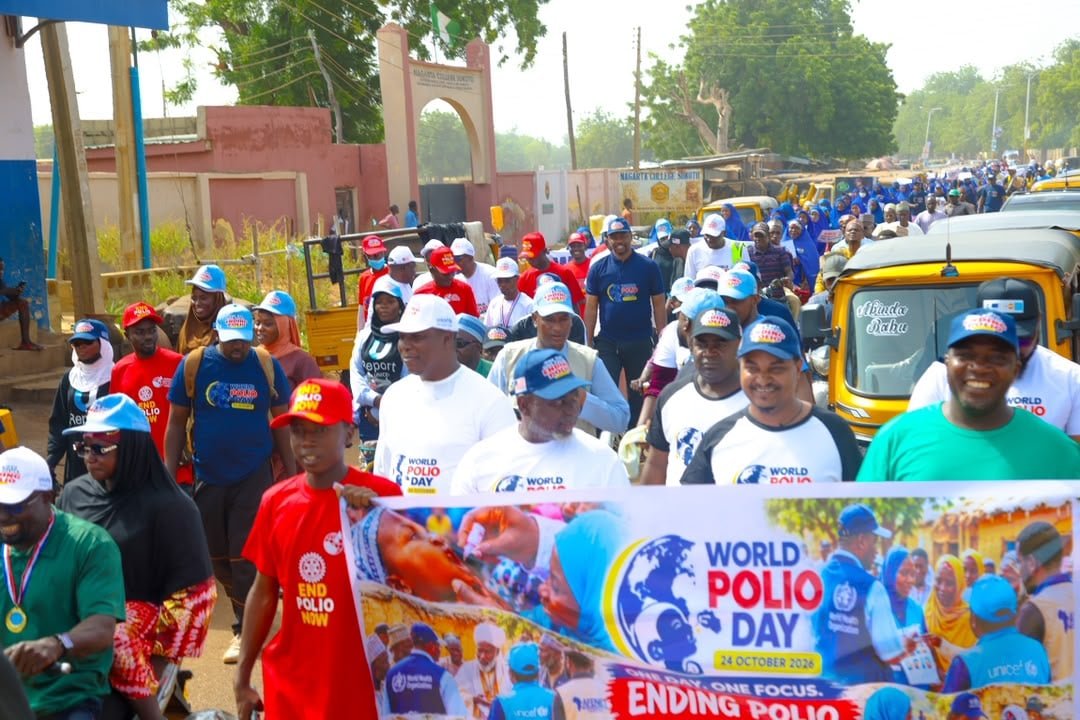
The United Nations Children’s Fund (UNICEF) and the Sokoto State Government have launched renewed efforts to eradicate polio, targeting more than one million children for vaccination amid insecurity and difficulty accessing hard-to-reach communities.
The campaign featured an advocacy rally on Saturday and a para-soccer tournament involving polio survivors on Friday, as part of activities marking the 2026 World Polio Day.
The rally began at the Specialist Hospital in Sokoto, passed through Marina and Gobirawa, and ended at the hospital, with participants calling on parents and caregivers to ensure their children receive the free polio vaccine.
Speaking during the exercise, UNICEF Social Policy Specialist, Issa Ibrahim, said the participation of government officials, community leaders, health workers and media practitioners reflected a collective commitment to protecting children against the disease.
“Our expectation is to ensure that no child is left behind and that every child gets access to the vaccine. By the end of this year, we are hoping Nigeria will be a polio-free country,” Ibrahim said.
He identified insecurity and limited access to some communities as major challenges to achieving universal vaccination coverage, stressing the need to involve local stakeholders in reaching children in vulnerable areas.
“In some communities, it is very difficult for people coming from outside to access them. We can only work with community leaders, media practitioners, health workers and other stakeholders who understand their immediate environment,” he said.
Ibrahim disclosed that the campaign was targeting more than one million children across the state, adding that the government had set up an executive committee to coordinate vaccination activities and ensure effective implementation. He urged parents to cooperate with vaccination teams, stressing that the vaccine was free and essential to preventing the debilitating effects of polio.
The Director of Advocacy, Communication and Social Mobilisation at the Sokoto State Primary Health Care Development Agency, Umar Gada, said sustained government commitment, adequate funding and community participation were critical to achieving polio eradication.
Gada said activities marking the occasion included a youth football match on October 21, a friendly match between government officials and development partners on October 22, a para-soccer tournament involving polio survivors, and the advocacy rally. He said they were designed to raise awareness about polio prevention and encourage collective responsibility among government institutions, development partners and residents.
“Without strong government leadership, commitment and funding, no partner can succeed,” he said, commending Governor Ahmed Aliyu for supporting the campaign.
Gada described the para-soccer tournament as a reminder of the devastating consequences of polio, noting that the experiences of survivors underscored the importance of preventing new infections.
The final match between Team Vaccine and Team Polio, played at Gingiya Memorial Stadium on Friday, ended 3-3 in regulation time before Team Vaccine won in a penalty shootout.
“The virus brings disability; vaccines bring life. Vaccines must always win,” Gada said.
He also commended UNICEF, the World Health Organisation, Rotary and other development partners for supporting the campaign, urging parents to take their children to primary healthcare centres for immunisation.
UNICEF Child Protection Specialist and Staff Association Chair for the Sokoto Field Office, Pius Wamanwa, said the campaign’s theme, “One Focus, One Day, Ending Polio,” underscored the need for coordinated action among government agencies, development partners and communities.
Wamanwa said polio remained a threat to children’s health and wellbeing, stressing that sustained public awareness, community mobilisation and access to vaccination were essential to eradicating the disease. He praised the participation of polio survivors, saying their experiences highlighted the importance of preventing new infections and protecting children’s rights.
The State Health Educator at the agency, Sabiu Gandhi, said the government had introduced measures to strengthen vaccination monitoring, address resistance to immunisation and improve coverage across communities.
Gandhi said commissioners and special advisers had been deployed to monitor vaccination activities, identify operational challenges and ensure frontline health workers received the necessary support. He added that non-compliance resolution committees had been established to engage families refusing vaccination, while ward councillors had been assigned supervisory responsibilities, including participation in daily review meetings.
According to him, the government is also supporting vaccine storage and distribution, alongside community mobilisation efforts to ensure that all eligible children are reached.
The stakeholders called on traditional rulers, religious leaders, community organisations, parents and caregivers to support vaccination campaigns, particularly in hard-to-reach communities. They stressed that sustained collaboration among government agencies, development partners and residents was essential to overcoming barriers to immunisation and protecting every child against polio.
WATCH TOP VIDEOS FROM NIGERIAN TRIBUNE TV