

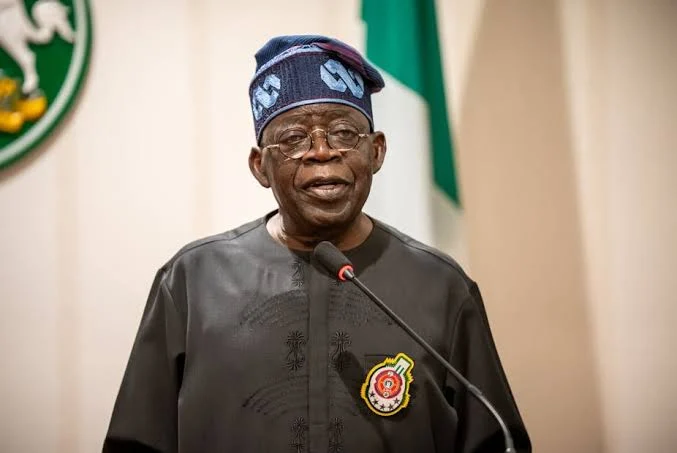
President Bola Tinubu has been projected to win the 2027 presidential election, with the Renewal Group forecasting that the incumbent will secure 20 states, while former Vice President Atiku Abubakar of the African Democratic Congress and Nigeria Democratic Congress candidate Peter Obi are projected to win nine and eight states respectively.
The projection was contained in a statement signed by the Convener of the Renewal Group, Lai Omotola, and made available to our correspondent on Tuesday in Abeokuta, Ogun State.
The group said the forecast reflected the political circumstances prevailing at the moment and should not be regarded as a prediction of the outcome of the 2027 election.
It said, “Tinubu’s perceived achievements in stabilising the economy and efforts to reposition the country could give him an advantage over his major challengers.
“The forecast places all six South-West states — Lagos, Ogun, Oyo, Osun, Ondo and Ekiti — in Tinubu’s column.
“The President is also projected to win Kano, Borno, Gombe, Yobe, Sokoto, Nasarawa, Kogi, Kwara, Katsina, Plateau, Benue, Bauchi, Zamfara and Adamawa, although the group noted that Adamawa could be a closely contested state between Tinubu and Atiku.”
The Renewal Group, however, acknowledged that the political landscape could change considerably before the election, noting that inflation, employment, insecurity, infrastructure and the cost of living could significantly influence voters’ decisions.
It added that “Tinubu’s administration’s ability to communicate its achievements and convince Nigerians of the impact of its policies could become a major campaign issue.”
On Atiku, the group projected that the former vice president would win nine states, with considerable support expected across parts of Northern Nigeria, including Kaduna and some states in the North-East and North-West.
The group said, “Atiku’s established political network and experience from previous presidential campaigns could strengthen his ability to mobilise support.
“His position on the fuel subsidy policy could become a major campaign issue, particularly if Nigerians continue to face high transportation costs and rising living expenses.”
However, the group noted that Atiku’s chances could depend on his ability to combine his northern support with substantial backing from other parts of the country.
Obi, according to the forecast, is projected to win eight states, with the Federal Capital Territory and Edo State among the areas expected to favour the NDC presidential candidate.
The group said Obi’s projection reflected the political support he built during the 2023 presidential election, when he performed strongly in several parts of the country.
It added that Obi’s campaign was expected to focus on political change, economic management, accountability, public spending and efficiency in government, but noted that his major challenge would be expanding his support beyond areas where he traditionally performed strongly.
The Renewal Group said its projection was based on a scenario in which the presidential election was held in September under the political circumstances prevailing at the time, with the All Progressives Congress emerging victorious.
It stressed that new alliances, defections, coalition arrangements, choice of running mates and changes in the popularity of the candidates could significantly alter the political equation before the election.
The group also said economic conditions, particularly inflation, petrol prices, unemployment, insecurity and the cost of living, could influence voters’ preferences, while religion, ethnicity and regional interests could also feature in political calculations.
For now, the Renewal Group’s projection places Tinubu in the strongest position with 20 states, followed by Atiku with nine and Obi with eight, while emphasising that the political equation could change considerably before Nigerians go to the polls in 2027.