

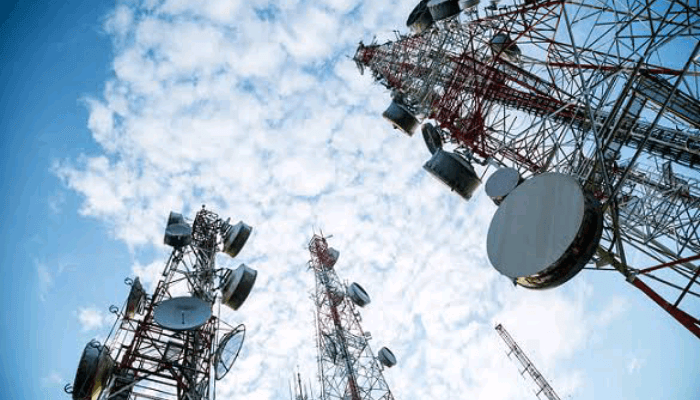
Deolu Ogunbanjo, president of the National Association of Telecommunications Subscribers (NATCOMS), has given telecommunications operators until the end of September to improve network quality, warning that subscribers could seek legal redress if poor service persists.
Ogunbanjo told BusinessDay that subscribers have endured deteriorating network services despite repeated interventions, warnings, and sanctions by the Nigerian Communications Commission (NCC). He noted that if the situation fails to improve through regulatory intervention, NATCOMS will seek justice through the courts by the end of the third quarter.
Rising data consumption strains network infrastructure
The ultimatum comes as rising data consumption, subscriber migration, and growing demand for mobile services place severe pressure on network infrastructure across parts of the country.
The NCC stated that mobile operators have offered compensation to more than 75 million subscribers for poor network quality following a regulatory directive requiring restitution in locations where performance fell below required standards. The regulator is conducting an independent review to determine whether all eligible subscribers received proper compensation.
The compensation scheme, provided through automatic airtime credits for verified service failures dating back to November 2025, requires no individual claims from consumers. For many subscribers, however, airtime credits do little to offset the broader economic and personal toll of unreliable connectivity.
Subscribers detail business losses and personal emergencies
Emeka Douglas, a subscriber, recounted how poor network quality nearly turned a medical emergency into a tragedy when he was unable to transfer funds to a hospital during his wife’s surgery. Douglas noted that his brother in the United States eventually sent funds directly to the hospital’s account after local banking channels failed.
Janet Okoye, a small business owner, said unreliable connectivity severely affected her business after service disruptions on her Airtel and Globacom lines led clients to cancel orders. Teniola Adeyemi, a university student, highlighted dropped calls as a major concern, stressing that recent tariff increases ought to reflect in better service quality.
Grace Eze, an Abuja-based media professional, explained that fluctuating network connectivity once delayed a lead news story intended for her editor in Lagos, resulting in an official query over late submission.
Data traffic and active subscriptions hit new highs
Pressure on national networks is driven by both expanding subscriber numbers and rising usage intensity. Active telephony subscriptions in Nigeria rose from 182.2 million in January 2026 to over 187 million by April, according to NCC data. MTN leads the market with 96.4 million subscriptions, followed by Airtel with 64.7 million and Globacom with 23.2 million.
An industry specialist, speaking on condition of anonymity, noted that while subscriber migration alone does not account for service failures, network performance remains a continuous race between capacity and demand. As subscribers move between networks, infrastructure faces strain from handling far more traffic than originally designed to support.
Simultaneously, data consumption has surged as users engage in video streaming, social media, online meetings, mobile banking, and remote work. NCC data shows Nigerians consumed roughly 4.06 million terabytes of mobile data between January and March 2026, spending approximately N3.33 trillion on data services during the quarter.
Vandalism and capital expenditure shape operational reality
The NCC has advised consumers with unverified data deductions to lodge formal complaints with their service providers before escalating unresolved cases to the commission. The regulator has also urged subscribers to monitor high-bandwidth background activities, such as cloud backups and automatic updates, which rapidly consume data.
In its regulatory framework, the NCC distinguishes dropped calls from other voice performance failures, such as one-way audio and distorted voices. Quality-of-service rules strictly govern call setup, transmission efficiency, and customer complaint resolution timelines.
Infrastructure vandalism remains another critical bottleneck. Damage to optical fibre cables, base stations, and transmission gear forces operators to reroute traffic through remaining infrastructure, compounding network congestion. The regulator has identified vandalism as a primary industry challenge and noted that infrastructure companies have upgraded equipment across more than 2,000 base stations to expand capacity.
Capital investments struggle to yield tangible service gains
Network challenges persist despite substantial capital deployment. Mobile operators invested over N2.13 trillion in network infrastructure and upgrades in 2025, while tower companies added N373.8 billion, expanding or upgrading more than 2,800 telecom sites. For 2026, the industry has projected N1.86 trillion in capital expenditure for infrastructure expansion and technological upgrades.
However, persistent complaints over slow data speeds, dropped calls, and network outages raise fundamental questions about whether heavy capital investment is translating into improved consumer experience.
Ogunbanjo acknowledged the NCC’s compensation scheme as a positive step but questioned public awareness regarding escalation procedures, such as the 622 toll-free line. He urged operators to deploy additional radio equipment and expanded network capacity, reaffirming that subscribers are prepared to institute legal action if service quality fails to meet expectations by the September deadline.

Get Newsletter Updates
Enjoying our column?
Subscribe to our specialised **Tech Pulse** feed to receive fresh reports and analyses directly in your inbox.


