

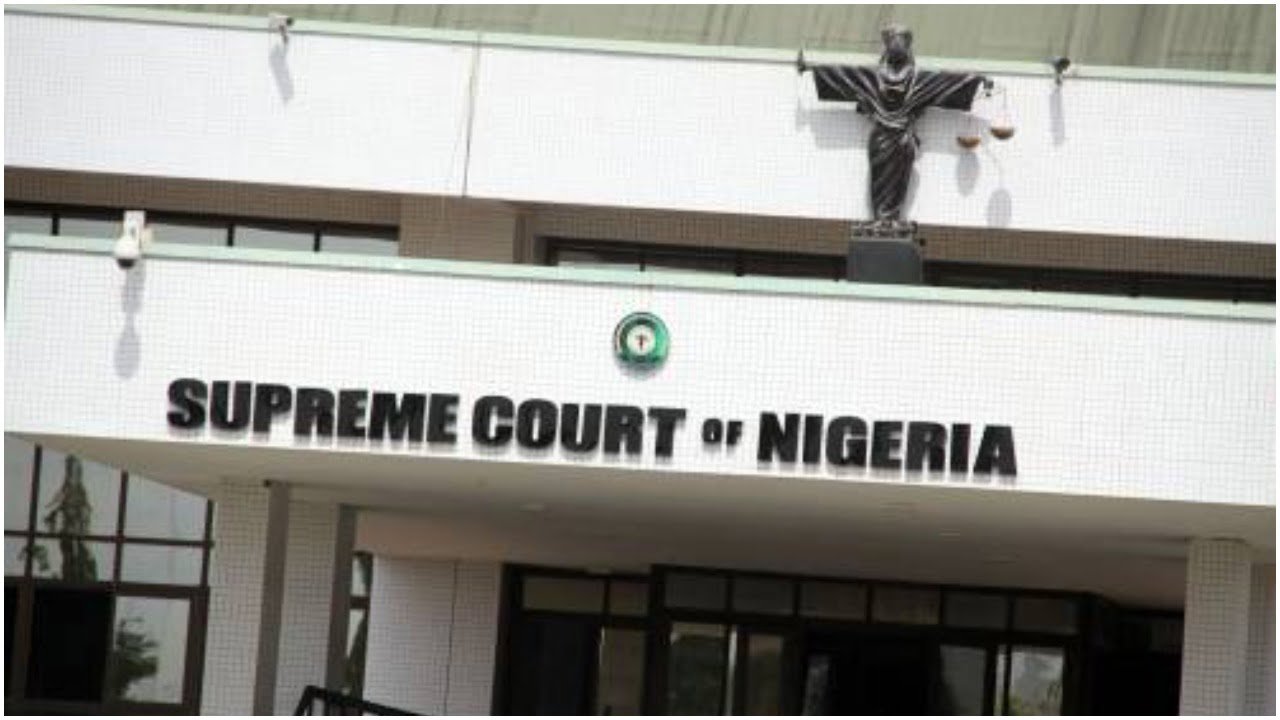
In the notice of appeal, containing 18 grounds of appeal, filed before the Supreme Court by his team of lawyers, led by Joseph Daudu, SAN, Adelegbe wants the apex court to allow his appeal and set aside the October 9 interlocutory orders and judgment of the Court of Appeal.
The appellant equally wants the Supreme Court to issue an order affirming, restoring and directing INEC to recognise, publish and maintain his name, profile, and nomination particulars as the duly nominated candidate of the APC for the Owo/Ose Federal Constituency of Ondo State in the next general elections.
He is contending, in the first ground of appeal, that the Court of Appeal erred in law and occasioned a grave miscarriage of justice when it refused his motion on notice brought pursuant to Order 4 Rule 2 of the Court of Appeal Rules 2021 for leave to adduce fresh/additional evidence.
Adelegbe identified the additional evidence he wanted to submit to the court as statutory public documents, which included APC official candidate forwarding letter, dated 26 June, 2026; his Form EC9 affidavit; INEC Candidate Nomination Portal, ICNP, submission receipt, dated 11 July, 2026), and certified true copy, CTC, of the official APC Election Committee result sheet showing, showing that he polled 13,094 votes.
He added that the essence of the said application showed that, had Arobo joined him as a party in the suit leading to the August 5 judgment, he would have provided sufficient evidence which would have shown that he was the person who was declared the winner of the APC primaries for the Owo/Ose Federal Constituency.
The appellant contends that by Order 4 Rule 2 of the Court of Appeal Rules 2021, the appellate court has full discretionary power to receive further evidence on questions of fact, particularly where such evidence could not have been produced at the trial court, as a result of his exclusion, through no fault of his own, or where special grounds exist.
Adelegbe, who accused Arobo of deliberately excluding him from the proceedings before the trial court, further contended that unlawful exclusion and non-joinder of a necessary and indispensable party at the lower court constitute the highest threshold/level of “special grounds” under Order 4 Rule 2, since a party who was unaware of a proceeding cannot be faulted for not tendering documents during trial from which he was excluded.
On another ground of appeal, he argued that the Court of Appeal erred in law and reached a perverse decision when it affirmed the trial court’s judgment delivered in total breach of Section 36(1) of the 1999 Constitution and without joining him as an indispensable necessary party, upon the erroneous finding that no final declaration or return had been made in his favour.
The appellant added that the appellate court further erred in law when it held that he was bound by the trial court’s proceedings under the doctrine of “standing by” and that his interests were adequately represented and defended by the APC.
He contends that the doctrine of estoppel by “standing by” strictly requires clear proof that the non-party had full, actual notice of the institution and pendency of the suit, possessed a direct interest in the subject matter, and consciously made an informed election to stand by and allow others to fight his cause on his behalf.
Adelegbe noted that he deposed in his uncontroverted affidavits that he was never served with documents in relation to the suit Arobo filed and on which the trial court’s judgment was based and hence, he “had absolutely no actual or constructive knowledge of the suit until after final judgment was delivered behind his back on 5th August 2026, thereby making it legally impossible to invoke the doctrine of ‘standing by’ against him.”
He added that the Court of Appeal erred in law when it held that Arobo was justified in bypassing the final appellate organ of the APC, the National Working Committee NWC, after waiting 11 days.
The appellate also faulted the appellate court for holding that Arobo’s suit at the trial court was properly commenced by originating summons under Paragraph 7(1) of the Pre-Election Practice Directions 2026 despite grave, hostile, and conflicting factual allegations which were raised in the suit.
Meanwhile, the Supreme Court has scheduled a hearing in the appeal for Wednesday, November 18.