

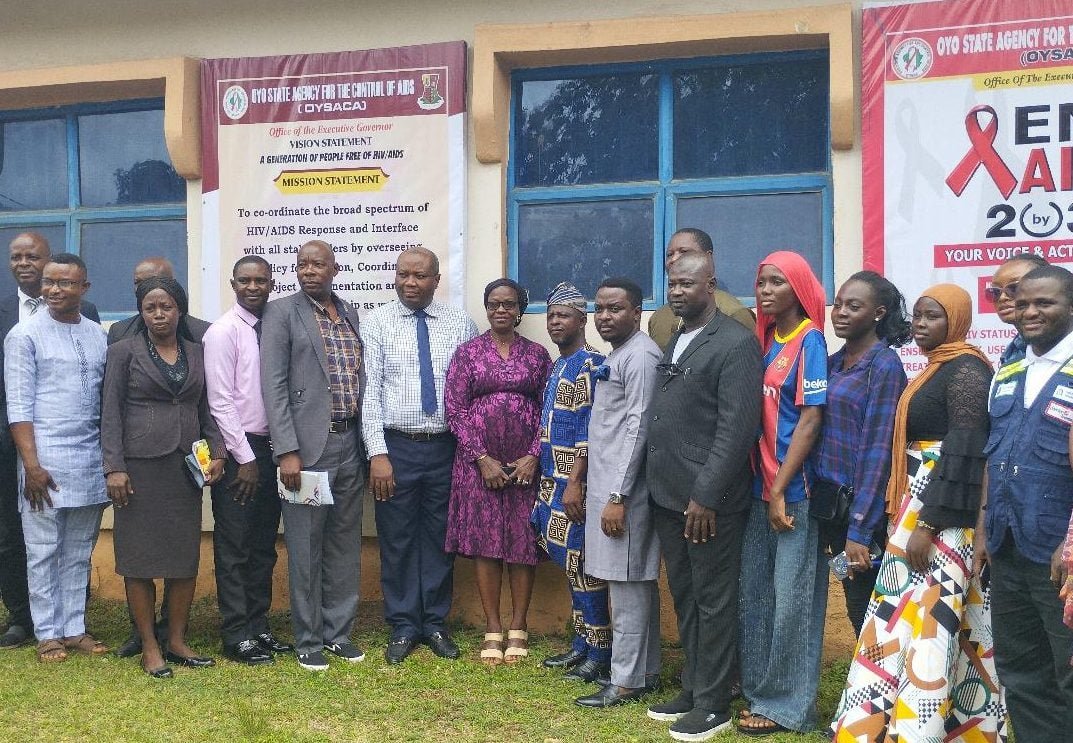
The Oyo State Government has launched a renewed push to protect gains recorded in the fight against HIV/AIDS, as the Oyo State Agency for the Control of AIDS (OYSACA) called for increased domestic financing and stronger partnerships to prevent funding challenges from undermining the state’s HIV response.
OYSACA Chairman, Aare (Dr) Gbola Adetunji, made the call at the third-quarter meeting of the Oyo State HIV Resources Mobilisation Technical Working Group and Sustainability Plan Committee in Ibadan.
He said the changing global health financing environment and donor transition had made it urgent for Oyo State to develop sustainable alternatives for financing HIV prevention, testing, treatment, care, and support.
Adetunji said the state could no longer rely predominantly on external support to sustain critical HIV interventions and urged government institutions, local government areas, development partners, civil society organisations, communities, and the private sector to strengthen domestic ownership of the HIV response.
“Resource mobilisation goes beyond funding or material resources. It includes strategies that will ensure that the HIV response continues to thrive towards ending HIV/AIDS in Oyo State and Nigeria at large,” he said.
He called for greater involvement of the state’s 33 Local Government Areas in HIV planning, budgeting, and implementation, including integrating HIV priorities into local government development plans and budgets.
While acknowledging progress in HIV testing, treatment linkage, community outreach, advocacy, and service integration, Adetunji urged corporate organisations, foundations, professional bodies, and other non-traditional partners to support HIV prevention, treatment, community mobilisation and health-system strengthening.
Mr Babatunde Makinde, Partner Focal Person and representative of the Oyo State Commissioner for Health, Dr. Oluwaserimi Ajetunmobi, said the state was adopting a coordinated approach anchored on the Health Sector Strategic Blueprint, with emphasis on “one voice, one conversation, one plan, and one report.”
ALSO READ: FG targets five million Nigerians with free spectacles, 25,000 cataract surgeries by 2027
He said partners working in similar thematic areas would be encouraged to plan jointly with government programme officers to reduce duplication, improve accountability, and strengthen reporting. Makinde added that preparations for the 2027 Annual Operational Plan had commenced, with government and partners working together to develop a coordinated HIV plan.
Dr Dickson Adetoye, State Team Approach Lead for APIN Public Health Initiatives in Oyo State, disclosed that 10 of 52 APIN-supported facilities had achieved full HIV service integration, while 21 had attained partial integration.
He said the progress followed deliberate interventions, including stronger facility leadership, greater involvement of government health workers, and efforts to ensure that people living with HIV are treated as clients of the entire health facility rather than as beneficiaries of a stand-alone programme.
Adetoye identified service integration, leadership and governance, health financing, and human resources as critical pillars for sustaining the HIV response. He said integration should go beyond relocating ART clinics to involve all health workers in HIV service delivery.
He disclosed that the programme targeted at least 80 per cent integration across all supported facilities by the end of September, although the target had not yet been achieved.
Mr Faith Olawale, Chairman of the Network of People Living with HIV in Oyo State, called for a gradual and inclusive approach to integration. He raised concerns about how integration would work in secondary facilities where HIV, TB, malaria, and other services operate separately and called for systems that would allow clients to access multiple services conveniently.
Olawale also stressed the need to address self-stigma among people living with HIV and prepare them for the changing service-delivery environment by helping them understand that integration would make HIV care part of routine healthcare.
Mr Muideen Isa, representative of the Damien Foundation, called for stronger top-level advocacy with the government to accelerate integration and sustain the HIV response.
Isa urged stakeholders to ensure that roadmaps and recommendations from technical and community-level discussions reach government decision-makers, stressing the need for a clear roadmap, timeline, and milestones for integration.
He said grassroots advocacy remained important, but high-level government engagement was equally necessary to secure policy commitment and ensure that all stakeholders worked toward a common objective.
WATCH TOP VIDEOS FROM NIGERIAN TRIBUNE TV