

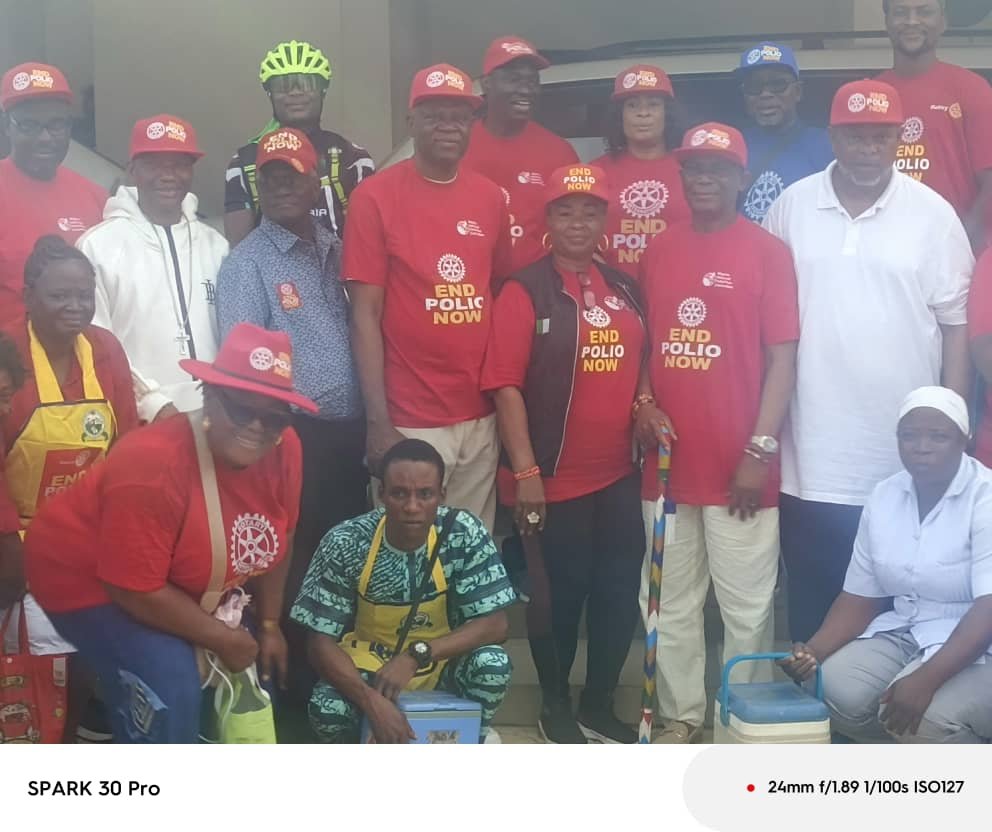
The Orimolusi of Ijebu Igbo, Oba Lawrence Jaiyeoba Adebajo, has urged parents and caregivers to ensure their children are immunised against poliomyelitis, recalling how the disease crippled children in his community in the 1960s when many people attributed it to spiritual causes.
Adebajo spoke at the weekend during a campaign walk organised by Rotary International District 9112 to commemorate the 2026 World Polio Day in Ijebu Igbo, Ogun State.
The monarch, who led seven other traditional rulers and members of the Rotary Club on the awareness walk, said he witnessed the devastating effects of polio in his community as far back as 1960 and 1961.
He recalled that his immediate younger brother contracted the disease but survived, while two other people he knew were left with permanently crippled legs.
Traditional rulers who participated in the awareness walk included the Bejeroku of Oke Agbo, Oba Stephen Adekoya; the Onimepe of Imepe, Oba Tajudeen Omotayo; the Sopen Lukale of Oke Sopen, Ijebu Igbo, Oba Dr Muftau Yusuf; the Olokine of Ojowo, Oba Abayomi Banjo; the Keegbo of Atikori, Oba Ibitoye Solaja; and the Abijaparaku of Japara, Oba Adewale Aderemi Ogunye.
The campaign formed part of efforts to mobilise communities, strengthen vaccine acceptance and sustain the drive towards a polio-free world.
ALSO READ:UNICEF partners Bauchi govt, Rotary to celebrate 2026 World Polio Day
The monarch said, “When we talk of polio, I think I experienced it in 1960, 1961, yes. That was in the village, a far, far remote area. But at that time, we thought it was a spiritual problem.
“They would call it ‘Olode’ and several other names. They would perform all sorts of rituals without knowing that there was something causing it that could be contained.
“This happened to my immediate younger brother, and it was by the grace of God that he survived. But I know another two persons whom this disease crippled their legs until today.”
Adebajo, however, expressed optimism that sustained commitment by health organisations, donors, governments and community leaders would eventually lead to the eradication of the disease.
He commended Rotary International and its partners for their efforts to protect children through immunisation, particularly the administration of the oral polio vaccine.
He also pledged the continued support of traditional rulers in Ijebu Igbo for the campaign, stressing the importance of unity among the monarchs in advancing the cause.
Speaking on the significance of the campaign, the Chief of Staff to the District Governor of Rotary International District 9112, Rotarian Adenike Abdul-Aziz, said World Polio Day, observed annually on October 24, provided an opportunity to intensify public awareness and encourage parents to protect their children against the disease.
She explained that polio could cause paralysis or death, particularly among young children, and stressed the importance of vaccination in preventing its devastating consequences.
According to her, Rotary International began its global polio eradication initiative following an initial immunisation effort in the Philippines in 1979, which informed the expansion of the programme worldwide.
Abdul-Aziz said Rotary had since partnered with the World Health Organisation, the United Nations Children’s Fund, the United States Centers for Disease Control and Prevention, governments and other organisations to eliminate the disease.
She also acknowledged the contributions of the Gates Foundation and Nigerian businessman Aliko Dangote to funding polio eradication efforts.
Abdul-Aziz said the global campaign had recorded significant progress since the launch of the Global Polio Eradication Initiative in 1988, when wild poliovirus was endemic in more than 120 countries and paralysed hundreds of thousands of children annually.
She noted that Pakistan and Afghanistan remained the only countries where wild poliovirus was still endemic, adding that the progress made so far should encourage renewed efforts to eliminate the remaining cases.
“We have come a long way. More than 120 countries had the wild poliovirus when we started this immunisation programme in 1988. Today, only two countries are left: Pakistan and Afghanistan.
“For that remaining fraction, it is a must for us to get it out. That is why we are out today to create awareness and let people know that they must immunise their children, from birth to five years, according to the recommended schedule and during vaccination campaigns, to protect them against this virus,” she said.
Abdul-Aziz commended the traditional rulers for participating in the campaign, describing their involvement as critical to the success of grassroots mobilisation.
She said community members were more likely to accept public health messages when they were endorsed by traditional institutions and leaders they trusted.
Also speaking, a former District Governor of Rotary International District 9112 and Vice Chairman, South-West, Nigerian National Polio Plus Committee, Mr Yomi Adewunmi, said the campaign was designed to sustain public awareness about polio prevention and the progress made towards global eradication.
Adewunmi said that despite decades of advocacy and immunisation, misconceptions about the disease persisted in some communities, making the involvement of traditional rulers particularly important.
He recalled the Orimolusi’s account of his younger brother’s experience with polio in the 1960s, saying it illustrated how the disease had previously been misunderstood.
Adewunmi warned that paralysis caused by polio could be permanent, stressing that vaccination remained the most effective means of prevention.
“Once you have a child between zero and five years, get that child immunised, whether the child is a boy or a girl. Once the child is attacked, there is no remedy,” he said.
Adewunmi described traditional rulers as influential partners in community mobilisation, noting that their endorsement could help improve public acceptance of vaccination.
WATCH TOP VIDEOS FROM NIGERIAN TRIBUNE TV