

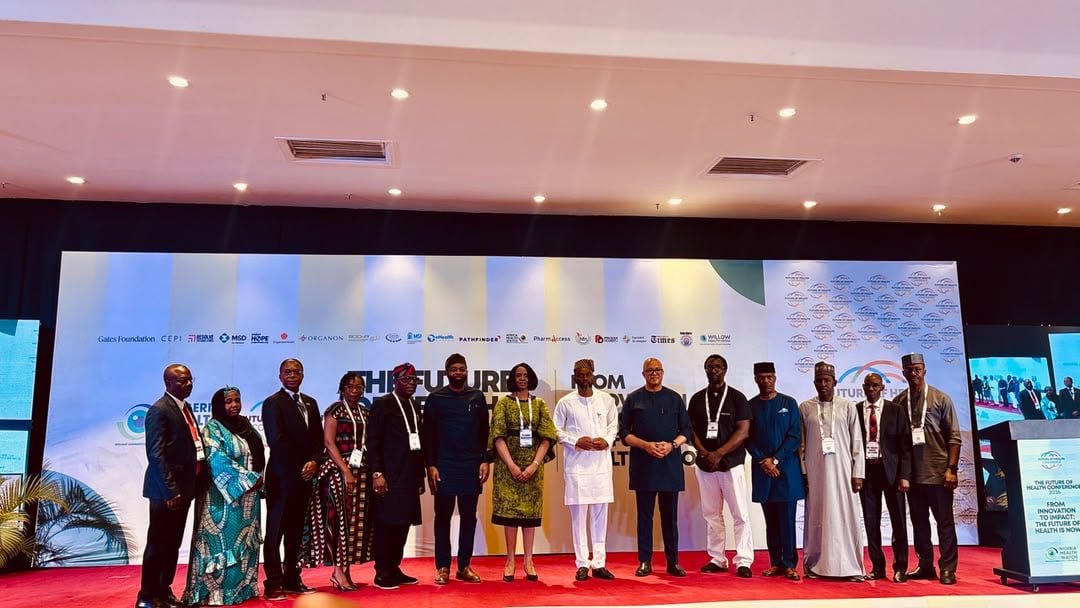
The National Health Insurance Authority (NHIA) is pushing reforms to expand health insurance coverage, enforce existing mandates and protect vulnerable Nigerians from out-of-pocket medical expenses, as more than 90,000 women have benefited from a government-backed initiative providing free emergency childbirth care.
The Director-General of the NHIA, Dr Kelechi Ohiri, disclosed this at the 2026 Future of Health Conference, organised by Nigeria Health Watch in Abuja, where he stressed the need for sustainable healthcare financing, stronger institutional coordination and locally driven innovations to improve access to quality healthcare.
Ohiri said the disruption in global health financing had made it imperative for Nigeria to take greater responsibility for funding and shaping its healthcare system rather than rely heavily on external assistance.
Speaking on the theme, “From Innovation to Impact: The Future of Health Is Now,” he said Nigeria needed to develop sustainable financing mechanisms and strengthen collaboration among stakeholders to translate healthcare innovations into measurable improvements in service delivery.
“The giant should not be lying down begging for crumbs,” he said, stressing the need for Nigeria to determine its health priorities and develop solutions suited to the needs of its population.
He explained that the Federal Government’s health sector reform agenda focused on governance, service delivery, private-sector participation and health security, with emphasis on coordination, accountability and effective implementation.
According to him, Nigeria’s federal structure requires collaboration between the federal and state governments, while the involvement of multiple actors in the health sector makes a coordinated approach essential.
“Fragmentation was no longer an option. We all had to go in the same direction,” he said, adding that government leadership, oversight and accountability were critical to achieving sustainable healthcare reforms.
The NHIA chief said innovation should extend beyond medical equipment and digital technology to include new approaches to healthcare financing, service delivery, research and institutional management.
“Reforming the health sector is messy. There are no quick solutions, and there is not going to be a big-bang innovation,” he said.
Ohiri noted that Nigeria faced a complex disease burden, with infectious diseases and high maternal mortality occurring alongside a growing incidence of non-communicable diseases such as hypertension and diabetes.
He said the country needed a healthcare system capable of addressing these challenges while ensuring that poor and vulnerable Nigerians were not excluded from essential services because of their inability to pay.
The NHIA Director-General stressed that health insurance must provide genuine financial protection by ensuring that enrollees could access treatment without being burdened by out-of-pocket payments.
“When we say someone is covered, two things must hold. First, if I have malaria, or a pregnant woman has a complication in pregnancy and goes to a hospital, it means that if you’re covered, that thing which ails you, you should have access to care,” he said.
“It should also mean the second thing: you’re not supposed to pay money out of pockets.”
He said the government could not afford to wait for universal health insurance coverage before addressing emergency maternal healthcare needs, warning that delays in treatment could expose women to preventable complications and deaths.
According to him, women experiencing childbirth complications often face delays in receiving treatment because they cannot afford hospital deposits, emergency surgery and other essential services.
To address the problem, he said the government had introduced an initiative to finance emergency obstetric care, enabling women with childbirth complications to receive treatment without upfront payment.
“About 300 hospitals across the country, fully accredited, every state, and more being added daily, where any woman that has a complication in childbirth, no questions asked, the treatment will be financed and paid for by the NHIA,” he said.
Ohiri disclosed that more than 90,000 women had benefited from the initiative within the preceding year and a half, describing it as an example of how healthcare financing reforms could expand access to life-saving services.
He also said the authority had begun supporting locally driven research to develop solutions tailored to Nigeria’s healthcare challenges.
According to him, five independent researchers had been identified and funded through a competitive process supported by the World Health Organisation.
“We made a commitment last year that we’ll begin to fund research that was context-specific and addressed our own problems,” he said.
The authority had also established a health technology assessment mechanism to evaluate innovative medicines, technologies and other interventions to determine their potential benefits for Nigerians, he added.
He emphasised the need to strengthen primary healthcare facilities and equip frontline health workers with the clinical, administrative and financial management skills required to improve service delivery.
Ohiri said the success of healthcare reforms should ultimately be measured by their impact on patients, particularly women experiencing childbirth complications, premature infants requiring essential care and vulnerable Nigerians at risk of falling into poverty because of medical expenses.
Earlier, Vivianne Ihekweaze highlighted the importance of sustained engagement among policymakers, healthcare professionals, development partners and private-sector actors in advancing healthcare reform and universal health coverage.
She said the Future of Health Conference, which began in 2013, had provided a platform for examining challenges confronting Nigeria’s healthcare system and developing solutions to improve access to affordable and quality services.
“At the time, the discussions were very much anchored around universal health coverage. How can we ensure that every single Nigerian, no matter who you are, has access to affordable, quality healthcare, and it does not leave you financially disadvantaged?” she said.
Ihekweaze said healthcare costs remained a major concern for families, particularly during medical emergencies, adding that discussions at the conference had expanded over the years to cover healthcare financing, service delivery, data and private-sector participation.
She also highlighted the potential of digital tools and artificial intelligence to improve diagnosis, expand access to services and address gaps in healthcare delivery.
“We as a country, and we as a continent, must take a much active role in shaping that future,” she said.
Speaking on healthcare implementation in Africa, a senior adviser at the Africa Centres for Disease Control and Prevention (Africa CDC), Erasmus Morah, said scientific breakthroughs alone would not transform healthcare without political commitment, effective leadership and community participation.
Drawing on his experience in Nigeria and other African countries, Morah said the successful implementation of health interventions depended on translating scientific evidence into policies and practices that responded to people’s needs.
He cited Nigeria’s progress in HIV treatment coverage, recalling that coverage stood at about 33 per cent in 2017 before a national survey helped revise estimates of the number of people living with HIV.
He said the Nigerian AIDS Indicator Survey estimated the population of people living with HIV at about 1.8 million, rather than the previously projected 3.2 million, helping to identify gaps in the country’s response.
Morah argued that reliable data could improve decision-making but stressed that achieving results also required leaders willing to challenge established assumptions.
He recounted efforts in Malawi to expand HIV testing through a shift from voluntary testing and counselling to provider-initiated testing and counselling.
“Science without politics, it’s powerless. Politics without science, dangerous,” he said, urging governments, researchers and communities to work together to support locally accountable implementation of health innovations.
Meanwhile, the founder of AfroScientric, Ifeyinwa Rhodes-Vivour, highlighted the potential of malaria genomics to help Nigeria develop more targeted interventions as drug resistance threatens the effectiveness of existing treatments.
She said genomic sequencing could help researchers identify resistance patterns, track malaria parasites and provide policymakers with evidence to guide interventions suited to different locations.
Rhodes-Vivour said research conducted by her team had identified differences in drug-resistance profiles between malaria parasites in northern and southern Nigeria, underscoring the limitations of a uniform approach to malaria treatment and control.
She said the research included a pilot study in Lagos State in 2017 and subsequent national surveys, including a second survey in 2025, during which about 32,000 parasite samples were collected.
According to her, the team had reduced the cost of genomic sequencing from about $150 per sample to between $20 and $24, making the technology more accessible.
She added that a dashboard and an artificial intelligence-powered WhatsApp interface had been developed to help policymakers access information on malaria drug resistance.
On Lassa fever, the Project Coordinator of the ENABLE 1.5 Nigeria Lassa Fever Epidemiological Study, Elsie Ilori, said the research was designed to address critical knowledge gaps about disease transmission at the community level.
“What is happening within the community? We do not even understand the dynamics… It’s been with us for 50 years, but we do not understand it,” she said.
Ilori explained that the ENABLE study followed participants over a defined period to establish how they became infected and identify factors contributing to transmission.
She said findings from the study had helped improve understanding of the disease burden, identify infected people and broaden knowledge of symptoms, noting that some patients might not present with fever, a major feature of the standard case definition.
She cited a case involving a participant whose only symptom was tiredness, which initially did not raise concern but was later confirmed to be associated with Lassa fever following testing.
Ilori said the findings could help improve disease surveillance and inform policies on diagnosis and treatment.
She added that the study had identified children as particularly vulnerable and was generating information on survivors and complications, including sensory loss.
She stressed that community participation was essential to successful disease research, noting that involving residents helped researchers understand local experiences and identify appropriate interventions.
Also speaking, the Senior Manager, Resource Mobilisation, at the Coalition for Epidemic Preparedness Innovations (CEPI), Dr Chidubem Ogwulu, said the organisation was established to translate scientific innovation into public health impact by addressing gaps in investment in vaccines against epidemic threats.
He said CEPI brought together governments, philanthropies, scientists, vaccine developers, industry and civil society to mobilise resources, support promising research and share development risks.
According to him, the organisation had supported more than 50 vaccine candidates and 25 platform investments since its establishment in 2017.
He disclosed that the world’s first Phase Two clinical trial of a Lassa fever vaccine had begun in Abuja, adding that CEPI had funded six Lassa fever vaccine candidates, with two clinical trials in West Africa.
Ogwulu said the organisation had also launched a major study on vector-borne illnesses across West Africa and supported the establishment of a Lassa fever coalition involving West African health ministers.
He said epidemic preparedness extended beyond healthcare to protecting economies, strengthening scientific institutions and building national resilience.
At a panel session on moving health innovations from research to impact, speakers called for stronger collaboration between government and the private sector, as well as sustainable financing for primary healthcare.
Jennifer Ayanti of the Healthcare Federation of Nigeria said private-sector players should be integrated into health system planning, including commodities management, drug supply, local production and costing.
She noted that committees were often organised under government oversight without sufficient deliberate inclusion of private-sector stakeholders.
“In the problem of scaling, government must come together with private sector as a single system,” she said, calling for patient capital and dedicated development funds to support primary healthcare centres.
The Commissioner for Health in Niger State, Murtala Mohammad, said his administration had established a sector-wide approach office to address fragmentation and improve coordination among stakeholders.
He said the office provided a platform for bringing together development partners and relevant government departments to bridge gaps between the state ministry of health, primary healthcare centres and secondary healthcare services.
WATCH TOP VIDEOS FROM NIGERIAN TRIBUNE TV