

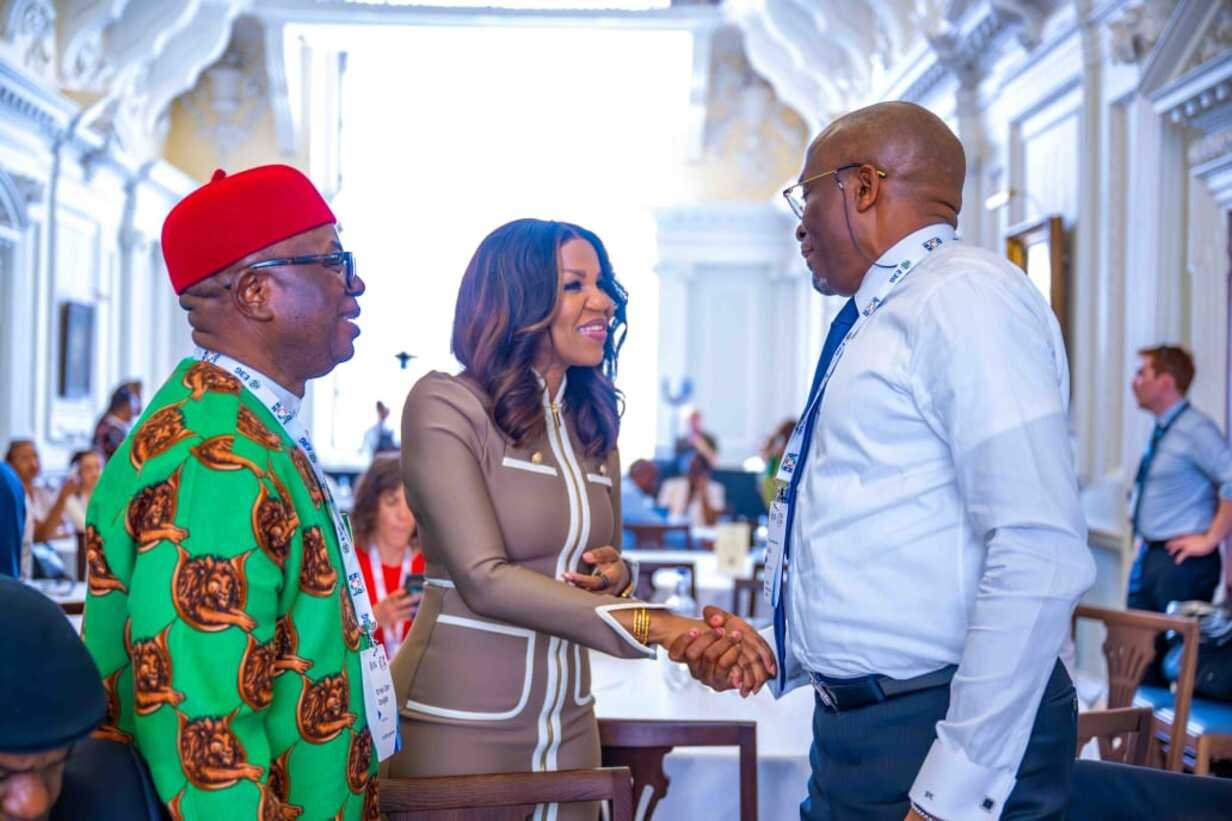
Deputy Speaker of Nigeria’s House of Representatives, Hon. Benjamin Kalu, on Tuesday said that Nigeria’s green transition offers practical, immediate and diverse opportunities across the energy, agriculture, transport and adaptation infrastructure sectors.
Hon. Kalu made the disclosure while delivering his keynote address at the ongoing Nigeria Climate Investment Summit, a flagship event of London Climate Action Week, themed “Catalysing Nigeria’s Climate Policy Progress into Financial Flows for Green Projects”, in London, United Kingdom.
Assuring investors of the country’s readiness to convert policy into bankable projects, the Deputy Speaker listed key sectors open to investment, including distributed renewable energy, solar mini-grids, battery storage, clean cooking solutions, electricity transmission and distribution infrastructure, and industrial energy efficiency.
He also highlighted climate-smart agriculture, irrigation, cold-chain logistics, food processing and resilient rural infrastructure as areas that can strengthen food security while increasing incomes.
Other opportunities Hon. Kalu identified include electric mobility, mass transit, low-carbon urban transport, waste-to-value systems, methane reduction, circular economy enterprises and green manufacturing.
The Deputy Speaker further pointed to flood-control systems, resilient drainage, coastal protection, nature-based solutions and climate-resilient housing as key adaptation priorities, stressing that Nigeria’s green transition must expand access to affordable energy, create decent jobs, support communities, equip young people with new skills, promote women’s participation and ensure that no region is left behind.
He said, “The opportunities before investors are practical, immediate and diverse. They include distributed renewable energy, solar mini-grids, battery storage, clean cooking solutions, electricity transmission and distribution infrastructure, and industrial energy efficiency.
“They include climate-smart agriculture, irrigation, cold-chain logistics, food processing and resilient rural infrastructure; investments that can strengthen food security while improving incomes for millions of Nigerians. They include electric mobility, mass transit, low-carbon urban transport, waste-to-value systems, methane reduction, circular-economy enterprises and green manufacturing.
“They also include climate adaptation: flood-control systems, resilient drainage, coastal protection, nature-based solutions, climate-resilient housing and infrastructure that can protect communities and productive assets from the growing effects of climate change.
“This is especially important because Nigeria’s climate challenge is both a mitigation challenge and an adaptation challenge. Our people are already living with the consequences of extreme weather, flooding, land degradation, food insecurity and climate-related displacement. Climate finance must therefore support both emissions reduction and human resilience.
“Our message is simple: Nigeria’s green transition must be a just transition. It must expand access to affordable energy, create decent work, support communities, equip young people with new skills, promote women’s participation in the green economy and ensure that no region or social group is left behind.”
Hon. Kalu also linked climate investment to the broader economic reforms of the administration of President Bola Ahmed Tinubu, noting that the removal of the fuel subsidy has redirected resources to infrastructure and doubled government revenues in 2025 to more than ₦28.3 trillion.
He added that the unification of the foreign exchange market has reduced arbitrage, increased foreign exchange liquidity and boosted international investor confidence.
“Distinguished ladies and gentlemen, climate investment thrives where there is confidence in the broader economic environment. Under the leadership of His Excellency, President Bola Ahmed Tinubu, GCFR, and supported by robust legislation from the 10th National Assembly, the government has embarked on significant economic reforms aimed at restoring fiscal credibility, improving revenue mobilisation, strengthening the foreign exchange framework and creating a more sustainable foundation for long-term growth. The removal of the fuel subsidy has redirected vital public resources towards infrastructure, doubling government revenues in 2025 to over N28.3 trillion.
“Furthermore, the unification of the foreign exchange market has reduced trade arbitrage, increased foreign exchange liquidity and boosted international investor confidence,” he said.
Assuring investors of protection, Hon. Kalu said the 10th National Assembly is providing legal certainty through the Climate Change Act and the Electricity Act.
He noted that the Climate Change Act provides a framework for climate governance, carbon budgeting, emissions reporting and market-based mechanisms, while the Electricity Act enables decentralisation and greater private sector participation, allowing states such as Lagos to become engines of green investment.
The Deputy Speaker also pledged the commitment of the lawmakers to strengthen the implementation of climate laws, monitor climate expenditure, support carbon market and green finance frameworks, improve investor protection and streamline approvals for green projects.
“The 10th National Assembly has a central role in this national effort. The Climate Change Act provides Nigeria with an important legal framework for climate governance, carbon budgeting, emissions reporting, climate action planning and the development of market-based mechanisms that can support low-carbon growth. It gives institutional expression to Nigeria’s climate ambition and creates a framework through which government, business and civil society can pursue coordinated action.
“The Electricity Act has also opened a new chapter in Nigeria’s power sector. By enabling greater decentralisation and expanding the scope for state electricity markets and private sector participation, it has created fresh opportunities for subnational governments, investors and innovators to develop electricity solutions that respond to local needs.
“This is particularly relevant to Lagos State and other subnational governments. States are increasingly positioned to become engines of green investment through project origination, land facilitation, demand aggregation, transparent procurement, urban planning and partnerships with private capital,” he said.
The Deputy Speaker urged international investors, pension funds, insurers, banks, development finance institutions and philanthropic organisations to partner with Nigerian institutions.
He also called for blended finance models, green guarantees, first-loss facilities, political risk insurance and local currency financing to reduce the cost of capital.
To move from conversation to action, Kalu proposed a structured Nigeria–London Green Finance Partnership to develop an investor-ready pipeline of priority projects across clean energy, transport, agriculture, resilient infrastructure and the circular economy, as well as create a project preparation and transaction support platform that would move viable projects from concept to bankability and implementation.
“Nigeria is therefore inviting international investors, pension funds, insurers, green asset managers, banks, development finance institutions and philanthropic organisations to work with Nigerian financial institutions and public authorities to develop innovative financing structures.
“We require blended finance models that combine public, private and concessional capital. We require green guarantees, first-loss facilities, political risk insurance, local currency financing, project preparation support and credit enhancement instruments that can reduce the cost of capital for viable green projects.
“Nigeria is ready to work with GLOBE International, the City of London, SOStainability, Sustainable Energy for All, the United Nations system and global financial institutions to ensure that our green taxonomy, reporting standards and project preparation systems are increasingly aligned with international expectations.
“Our objective is straightforward: every pound sterling, dollar, naira or euro invested in Nigeria’s green economy should produce measurable value.
“Today, I propose that this summit should not end as another important conversation. It should become the beginning of a structured Nigeria–London Green Finance Partnership. This is how ambition becomes action. This is how policy becomes finance. And this is how finance becomes infrastructure, jobs, resilience and shared prosperity,” Hon. Kalu said.
WATCH TOP VIDEOS FROM NIGERIAN TRIBUNE TV