

Two Chinese-backed fintech companies OPay and PalmPay have amassed about 85 million users in Nigeria, reshaping Africa’s retail banking landscape and forcing the country’s biggest lenders to spend billions of naira on technology as they battle to defend their dominance.
The two digital finance platforms, which entered Nigeria in 2018 and 2019 respectively, have risen from start-ups to become two of Africa’s largest customer-facing financial institutions. Together they now serve almost as many users as Nigeria’s biggest banks, highlighting how smartphones, agent networks and low-cost digital services are changing the continent’s financial system.
Read also: Zedcrest acquires Leatherback to strengthen global fintech expansion
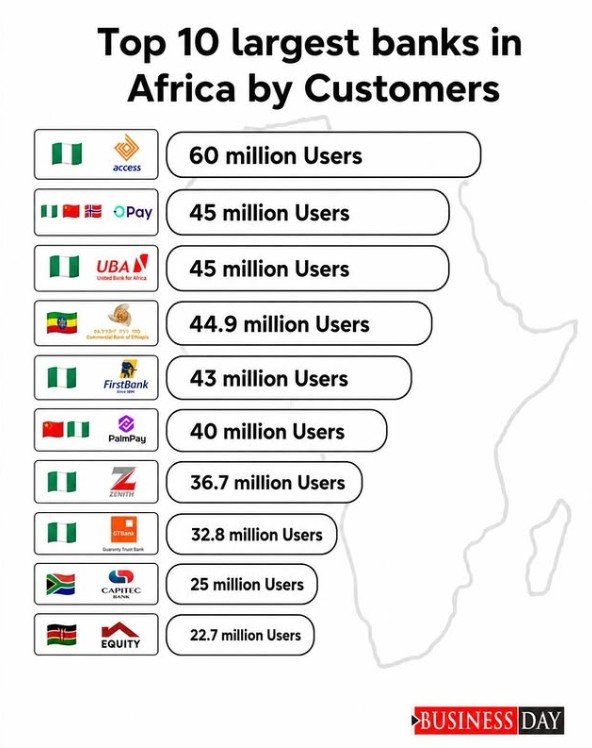
A BusinessDay ranking of Africa’s largest banks and financial institutions by customer numbers shows Access Bank leading the continent with 60 million customers, followed jointly by OPay and United Bank for Africa (UBA) with 45 million each. Commercial Bank of Ethiopia ranks fourth with 44.9 million, while FirstBank has 43 million customers. PalmPay follows with 40 million, ahead of Zenith Bank with 36.7 million, GTBank with 32.8 million, Capitec Bank of South Africa with 25 million, and Equity Bank of Kenya with 22.7 million.
The ranking underscores Nigeria’s emergence as Africa’s largest retail banking market, with seven of the top ten institutions operating primarily from the country. More importantly, it reflects a shift in competitive advantage, from physical branches to mobile applications, agent banking and digital payments.
The rise of OPay and PalmPay has been driven by a strategy that traditional banks struggled to replicate for years. Rather than building expensive branch networks, the fintech companies invested heavily in agent banking, allowing customers in markets, villages and urban neighbourhoods to access financial services through millions of merchants and point-of-sale terminals.
Both firms also capitalised on Nigeria’s large unbanked population, rapid smartphone adoption and repeated periods of cash shortages, when consumers increasingly turned to digital wallets for transfers, bill payments and cash withdrawals.
OPay, backed by Chinese investors including SoftBank, says its technology infrastructure delivers a 99.9 percent transaction success rate, helping millions of Nigerians rely on the platform for daily financial transactions.
“Our advanced technology infrastructure has enabled us to achieve a 99.9 percent transaction success rate, building the trust that allows millions of Nigerians to rely on OPay for their daily financial needs.
“We are not just processing payments, we are driving financial inclusion at scale and remain committed to our long-term vision of reaching one billion users while supporting millions of merchants across Africa,” said Douda Gotring, managing director and chief executive officer of OPay Nigeria.
PalmPay has followed a similar path, focusing on underserved communities through digital payments, savings products and one of Nigeria’s largest agent networks.
“Financial inclusion goes beyond access; it must be equitable and tailored to real-life needs of underserved communities, including women, rural dwellers and low-income earners,” said Chika Nwosu, managing director of PalmPay.
The rapid expansion of fintechs has forced Nigeria’s largest lenders to respond aggressively.
Financial statements show that the country’s biggest banks sharply increased technology spending in the first quarter of 2026 as competition shifted from branch expansion to digital infrastructure, artificial intelligence and cybersecurity.
The combined technology spending of Nigeria’s ten largest lenders rose 30.8 percent year-on-year to N177.91 billion in the first quarter of 2026 from N136.04 billion a year earlier.
Among the biggest spenders, Zenith Bank more than doubled its technology investment to N43.83 billion from N21 billion, reflecting spending on server infrastructure, cybersecurity and core banking systems. GTCO increased technology spending by 24.3 percent to N16.4 billion, while software acquisition alone climbed nearly 69 percent.
Across Nigeria’s Tier-1 lenders: Access Bank, Zenith Bank, GTCO and UBA, technology expenditure rose 43.2 percent year-on-year to N119.03 billion, as banks upgraded digital platforms, strengthened cyber resilience and expanded capacity to handle growing transaction volumes.
Bank executives say the spending is no longer optional.
“The future of banking belongs to platforms that can process transactions seamlessly and instantaneously.
“Our investments in software and technology-led subsidiaries like Squad are intended to build a defensive and offensive ring around our retail base. We are not just protecting our corporate turf; we are aggressively contesting the retail and micro-merchant space where agile fintechs used to dominate,” Segun Agbaje, group chief executive officer of GTCO, said.
For Zenith Bank, technology has become central to protecting profitability as customers migrate from physical branches to digital channels.
“Our heavy infrastructure outlays are a deliberate strategy toward customer service excellence and sustainable digital innovation.
“By scaling up our server capacity and deploying artificial intelligence, we smoothly transition high-volume retail activities away from brick-and-mortar operations. This shift protects our earnings via robust e-banking income, limits transaction downtime, and optimises the bank’s long-term cost-to-income framework,” Adaora Umeoji, group managing director and chief executive officer of Zenith Bank, said.
The digital battle is increasingly centred on transaction volumes rather than customer acquisition alone.
Read also: Nigeria’s fintech future will be built on payment rails, AI and trust — Nwamaghinna
While fintech companies now rival traditional banks in user numbers, established lenders continue to dominate in deposits, lending, corporate banking and total assets. Banks are also leveraging artificial intelligence, cloud infrastructure and advanced analytics to improve customer experience and comply with new regulatory requirements, including local data hosting standards.
The competition marks a new phase in African banking, where success will depend less on the size of a branch network and more on the ability to process payments instantly, personalise financial services and keep customers active within digital ecosystems.
For now, OPay and PalmPay have demonstrated that technology, rather than brick-and-mortar expansion, has become the fastest route to scale in Africa’s largest banking market. Their combined 85 million users have altered the competitive landscape, forcing institutions that have dominated Nigerian banking for decades to reinvent themselves for the digital age.

Get Newsletter Updates
Enjoying our column?
Subscribe to our specialised **Tech Pulse** feed to receive fresh reports and analyses directly in your inbox.

