

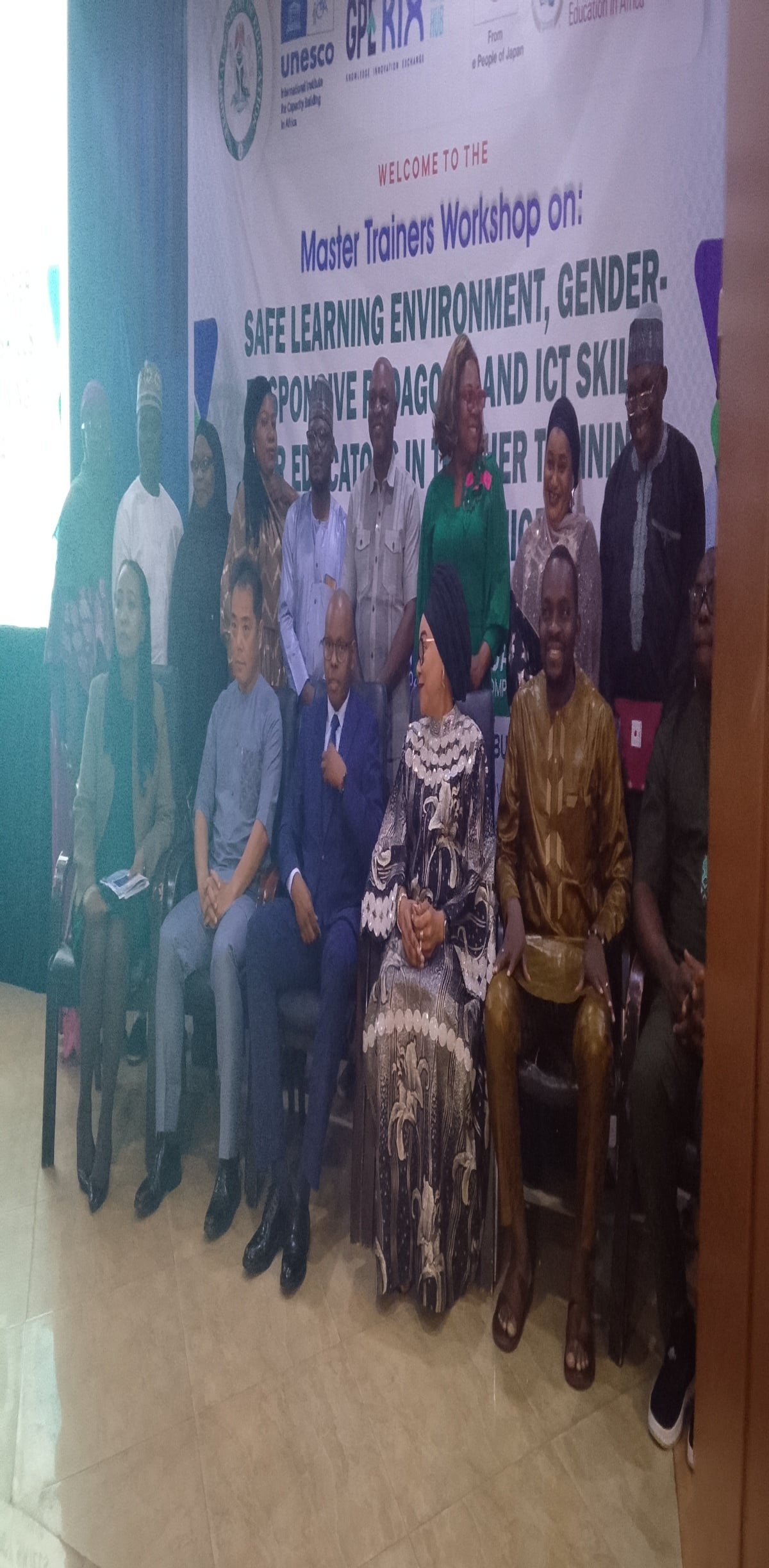
…trains 45 master trainers to ensure safe-school, gender, ICT skills to 500 educators
The Federal Government has warned that bullying, exclusion and unsafe learning environments could gradually push girls out of education, even when they remain physically present in school.
The Minister of State for Education, Prof. Suwaiba Ahmad, gave the warning in Abuja at the opening of a three-day National Master Trainers’ Workshop on Safe Learning Environment, Gender-Responsive Pedagogy and ICT Skills for Educators in Teacher Training Institutions in Nigeria.
The workshop is aimed at equipping master trainers with practical skills to be cascaded to pre-service and in-service teachers in their respective institutions, extending the intervention beyond the 15 participating colleges.
Ahmad, who was represented by the Director, Colleges of Education, Federal Ministry of Education, Dr Uchenna Uba, said the government was concerned that conventional school attendance figures might not reflect children who were disengaging from learning due to hostile or unsafe classroom experiences.
She said a girl could gradually withdraw from learning after repeated experiences of ridicule, exclusion or other situations that made her feel unsafe, even when her name remained on the school register.
“A girl does not always leave school on a day her name disappears from the register. Sometimes she leaves a little early while she is still sitting in the classroom,” she said.
The minister said the situation highlighted the need to equip teachers with the skills to identify bullying, respond appropriately to abuse and ensure that every learner participated meaningfully in classroom activities.
She said the Federal Ministry of Education had introduced a National Policy on Anti-Bullying in Nigerian Schools and its implementation guidelines, but noted that the effectiveness of the policy would depend largely on its implementation by teachers and other education stakeholders.
ALSO READ: FG warns security personnel against diversion of official arms
“Their success, however, will be decided in schools and classrooms by whether a teacher recognises bullying, whether a child knows how to seek help, and whether the adults responsible respond with care and consistency,” Ahmad said.
She also cited UNICEF data indicating that 74 per cent of children aged seven to 14 lacked basic reading and mathematics skills in 2024, saying the figure reinforced the need to address not only access to education but also the quality, safety and inclusiveness of learning.
Ahmad said the workshop would train 45 master trainers from 15 colleges of education, who would subsequently cascade the knowledge acquired to about 500 teacher educators across the country.
According to her, the training would focus on gender-responsive pedagogy, safe learning environments, prevention and response to school-related gender-based violence, and the effective use of ICT in teaching and learning.
She urged the participants to make the training practical and ensure that the knowledge gained was embedded in their institutions rather than treated as a one-off intervention.
“When you return to your colleges, show your colleagues what this work looks like in a real lesson. Let them practise it. Observe what changes,” she said.
The minister also challenged the trainers to demonstrate how ICT equipment could be used in actual classroom situations, including projectors, smart boards and tablets, while developing teaching resources that could remain useful in areas with limited internet connectivity.
“The measure of the donation will be the teaching it makes possible,” she said.
Also speaking, the UNESCO Representative to Nigeria, Dr Isaias Barreto da Rosa, said the workshop marked another milestone in the implementation of a project launched in 2024 to strengthen teacher-training systems and promote continuous, inclusive and quality education for girls in West Africa.
Da Rosa said a situational analysis and baseline assessment conducted under the project identified three critical areas requiring intervention: teachers’ capacity to apply gender-responsive pedagogy, the creation of safe and supportive learning environments, and improved digital competence and ICT integration in teaching and learning.
He said the three areas were interconnected, stressing that teachers needed to combine inclusive teaching methods, learner protection and digital competence to improve learning outcomes.
“Technology can provide tools. Policy can provide the framework. But the teachers bring learning to life,” he said.
The UNESCO representative noted that the organisation had provided ICT equipment to 15 teacher-training institutions in Nigeria in May 2026, but stressed that equipment alone could not transform the education system without adequately trained and motivated teachers.
“We cannot transform education with equipment only. People, practice and institutions do transform education. But let me say, especially teachers, we cannot invest billions, but if we don’t have good teachers, trained teachers, and especially motivated teachers, our educational system will not improve,” he said.
On his part, the Deputy Head of Mission and Counsellor, Embassy of Japan in Nigeria, Mr Kozaki Hitoshi, said the Japanese government was supporting the initiative with a grant of about $3 million.
Kozaki said the project, implemented by UNESCO in collaboration with the African Union and the Nigerian Government, covered six African countries and was designed to strengthen teacher-training institutions and advance continuous, inclusive and quality education for girls.
He identified gender inequality, insecurity and unsafe learning environments as some of the barriers confronting girls’ education, stressing that well-trained teachers were critical to ensuring that girls remained in school and had opportunities to realise their potential.
“Teachers are at the heart of quality education. Teachers matter a lot for girls in school,” he said.
Kozaki said ICT equipment had already been provided to 15 colleges of education in Nigeria under the project but noted that technology could only have meaningful impact when teachers were equipped to use it effectively.
“Technology is only a tool. Its impact depends on the people who use it,” he said.
Also speaking, the Coordinator of the African Union International Centre for the Education of Girls and Women in Africa, Mr Boubakar Yougbare, stressed the importance of strengthening teachers’ capacity as part of broader efforts to advance girls’ education across the continent.
WATCH TOP VIDEOS FROM NIGERIAN TRIBUNE TV