

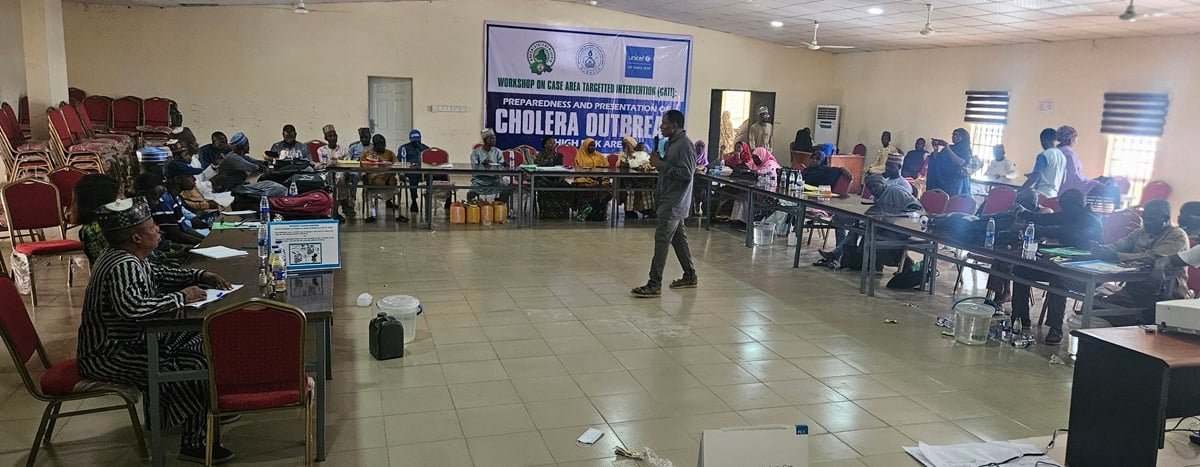
Water, Sanitation and Hygiene (WASH) Desk Officers from eight local government areas (LGAs) in Bauchi State, where cholera cases have been reported, have undergone training to strengthen preparedness and improve response to the outbreak.
The workshop on Case Area Targeted Intervention (CATI), focusing on cholera preparedness and response in high-risk areas, was organised by the Bauchi State Government through the Rural Water Supply and Sanitation Agency (RUWASSA) in collaboration with the United Nations Children’s Fund (UNICEF).
Speaking at the workshop, UNICEF Water, Sanitation and Hygiene (WASH) Specialist at the Bauchi Field Office, Nambam Dawap, said the training was designed to equip WASH Desk Officers from the eight high-risk LGAs with the knowledge and skills required to respond effectively to cholera outbreaks.
“We are here to prepare for a possible cholera outbreak. We want to train the WASH Desk Officers from the eight high-risk LGAs to equip them to respond effectively,” she said.
Dawap explained that UNICEF’s focus on child survival, particularly during the first 1,000 days of life, makes cholera prevention a priority.
“UNICEF is focused on child survival, especially during the first 1,000 days of a child. Cholera is a fundamental concern when it comes to child survival. Where water is not safe, where there is inadequate sanitation and poor hygiene, there is a very high risk of cholera, diarrhoea and other waterborne diseases,” she said.
She stressed the importance of providing safe drinking water, saying access to water alone is insufficient unless its quality is guaranteed.
“It’s not enough to have water for drinking. Water must be clean and safe, especially for children. Where water is provided, we must ensure that it is tested and safe for consumption,” she added.
Dawap warned that contaminated water distribution systems and poor sanitation increase the risk of disease outbreaks.
She also emphasised the need to end open defecation, noting that research has shown that human waste contains millions of bacteria and viruses capable of causing cholera and diarrhoea.
She further stressed the importance of handwashing with soap at critical times, including after using the toilet, before preparing or serving food, before feeding children and after cleaning a child.
According to her, proper hand hygiene can reduce the risk of disease transmission by more than 50 per cent.
She urged governments, civil society organisations, parents and caregivers to work together to promote safe water, improved sanitation and good hygiene practices to protect children, particularly during the cholera season.
Also speaking, the Director of Sanitation and Hygiene at RUWASSA, Bala Zailani, said the training became necessary following reported cholera cases in seven LGAs.
“This training is to update WASH Desk Officers on the current cholera situation and strengthen their preparedness and emergency response capacity,” he said.
He explained that participants would return to their communities to train others using the knowledge acquired during the three-day workshop.
“We want them to go back to their communities and step down what they have learnt. We must act quickly to curb the spread of cholera,” he said.
Zailani assured residents that RUWASSA was fully prepared to respond to the outbreak, adding that officials would be deployed to affected high-risk communities immediately after the training.
He also disclosed that cholera prevention kits had been sent to LGAs where no cases had yet been recorded to support public sensitisation and preparedness activities.
ALSO READ: FG targets one million MSMEs, 50,000 jobs with renewable energy programme
Some participants, including Hauwa and Ibrahim, commended the organisers, describing the workshop as timely.
They said the training exposed them to new techniques for cholera preparedness and emergency response, which they would apply in their respective communities.
WATCH TOP VIDEOS FROM NIGERIAN TRIBUNE TV