

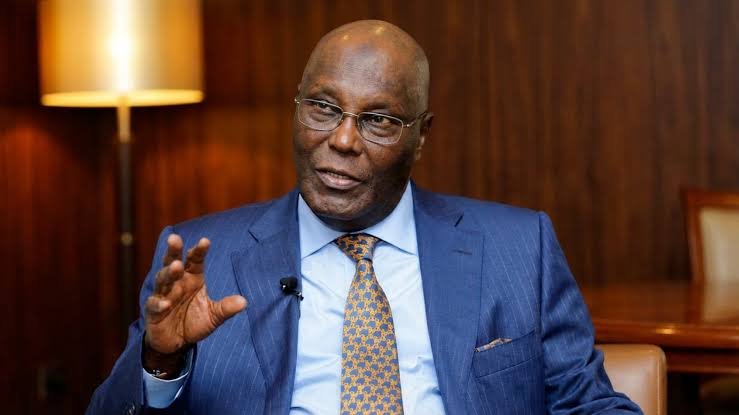
Former Vice President Atiku Abubakar has expressed concern over the state of Nigeria’s economy under President Bola Ahmed Tinubu, citing a significant net outflow of foreign portfolio investment and rising government borrowing as indicators of declining investor confidence.
Speaking on Tuesday through his Senior Special Assistant on Public Communication, Phrank Shaibu, Atiku said the latest Nigerian Exchange data reflected challenges in the economy that required urgent policy attention.
According to the statement, between January and July 2026, foreign investors brought ₦513.36 billion into the Nigerian equities market but pulled out ₦779.43 billion, resulting in a net outflow of ₦266.07 billion.
The statement noted that outflows exceeded inflows in each month during the period, and that the net outflow is about 11.7 times the ₦22.68 billion recorded in the corresponding period of 2023.
“This is not merely an investment statistic. It is an indication of how investors currently view the economy,” the statement said.
The statement further noted that the Federal Government increased domestic borrowing by 90.5 per cent to ₦24.7 trillion in the first eight months of 2026, while government credit grew faster than credit to the private sector.
“The result is that Nigerian businesses are finding it harder to access credit, while foreign investors are reducing exposure to the market,” it said. “Local businesses are under pressure. Foreign capital is exiting. Government borrowing is rising. Food prices and transportation costs remain high, even as the administration continues to speak about ongoing reforms.”
Atiku said an economy cannot be said to be recovering when entrepreneurs struggle to access credit, manufacturers face high operating costs, households have reduced purchasing power, and investors are unwilling to retain capital in the country.
He urged the administration to focus on policy consistency, inflation control, predictable regulation and measures that support sustainable real returns for investors.
“Nigeria requires an economic policy that restores confidence, lowers the cost of doing business, makes energy and transportation more affordable, encourages production and allows the private sector to drive growth, rather than relying excessively on government borrowing,” the statement said.
The statement added that the fundamental difference between the current approach and Atiku’s proposed approach is a shift toward private-sector production and improved household affordability.
“You cannot crowd out the private sector with borrowing, reduce consumer purchasing power and still expect to attract and retain investment,” it said.
WATCH TOP VIDEOS FROM NIGERIAN TRIBUNE TV