

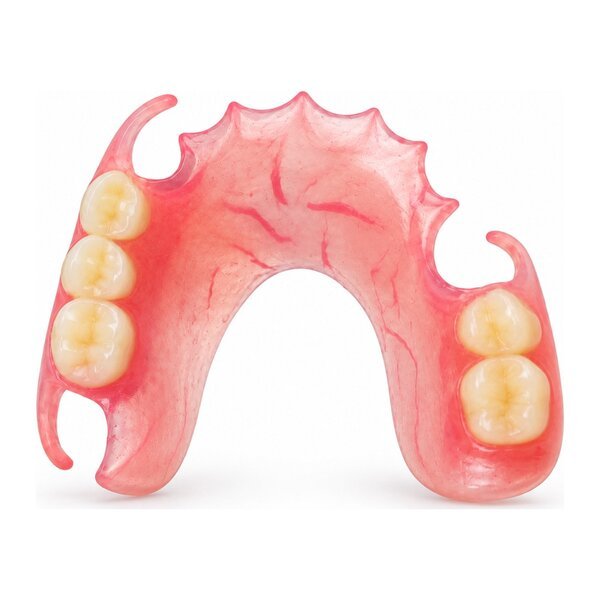
Flexible partials are popular because they are light, bend slightly and hold on with gum-colored clasps instead of metal wire. The same material that makes them comfortable also makes them a little fussier to care for than a rigid acrylic plate. Most problems people run into, like a dull cloudy look, a stale smell or a clasp that suddenly feels loose, come from habits that are fine for other things in the bathroom but not for nylon-type resin.
Why Does A Flexible Partial Need Different Care?
Flexible partials are made from a thin nylon-type material. It is tough to break, but its surface scratches more easily than acrylic, and scratches collect stain and bacteria. It also reacts to heat and to drying out, both of which can change its shape. Gentle cleaning and keeping it wet are the two rules that matter most.
What Does The ADA Recommend?
The American Dental Association’s advice for dentures is short and applies to flexible partials too (ADA MouthHealthy: Dentures):
- Brush your dentures daily to remove food particles and plaque. Brushing also helps keep the teeth from staining.
- Rinse them before brushing to remove loose food.
- Use a soft-bristled toothbrush and a non-abrasive cleanser on all surfaces, so they do not get scratched.
- When you are not wearing them, keep them in a safe place covered in water so they do not warp.
- Brush your gums, tongue and the roof of your mouth every morning with a soft brush before you put the dentures in.
- Look for cleansers and adhesives with the ADA Seal of Acceptance.
Everything below builds on those basics.
What Is The Daily Routine?
After meals. Take the partial out and rinse it under cool running water. Swish your mouth with water too, so trapped food does not sit against the gums.
Once a day, a proper clean. Hold the partial over a sink with some water in it or over a folded towel, so it lands softly if it slips. Rinse it, then brush every surface, inside and out, with a soft brush and a non-abrasive cleanser, such as mild liquid soap or a cleaner made for flexible dentures. Pay attention to the inner side of the clasps, where plaque builds up.
Overnight. Take it out to sleep and keep it in water or in a soaking cleaner labeled safe for flexible or nylon dentures. Rinse it well before you put it back in.
What Should You Never Use On A Flexible Partial?
- Regular toothpaste. It is abrasive and leaves fine scratches that make the material look dull.
- Hot or boiling water. Heat can warp the base and loosen the fit. Use cool or lukewarm water.
- Bleach or household cleaners. They can discolor the gum-colored resin and weaken it.
- Stiff brushes or scouring pads. Same problem as toothpaste, only faster.
- Soaking tablets not meant for flexible material. Some general denture cleaners are too harsh for nylon-type resin. Read the label before you buy.
How Should You Store It?
Keep the partial wet whenever it is out of your mouth. A flexible partial left to dry on a nightstand can change shape slightly and feel tight the next morning. Use a lidded case with water, or a flexible-safe cleaning solution, and keep the case out of reach of pets and small children.
When you travel, pack the case in your carry-on with a small bottle of water so you can rinse the partial after meals on the road. A spare soft brush in your bag makes that easy.
What About Stains And Odor?
Coffee, tea, red wine and tobacco all stain flexible material. Rinsing right after drinking them helps more than scrubbing later. If a smell lingers even after cleaning, plaque has usually built up in tiny scratches; a soak in a flexible-safe cleaner and a gentle brush is the fix. Do not reach for stronger chemicals, which only make the surface rougher.
What Are The Signs The Fit Has Changed?
A clasp that feels looser than it used to, a new sore spot, or a partial that rocks when you press on it are worth paying attention to. Heat and drying out are frequent causes, so check your routine first. If the fit was never right from the start, contact the company you ordered from and ask about their remake policy. Smile Lab USA, for example, offers flexible partial dentures made by a licensed partner dental lab, with free remakes for 60 days until it fits.
A Simple Checklist
- Rinse after every meal.
- Brush once a day with a soft brush and a non-abrasive cleanser.
- Keep it in water or a flexible-safe cleaner overnight.
- Cool water only, never hot.
- No toothpaste, bleach or harsh tablets.
- Never let it dry out.
A clean, wet and cool partial looks better and feels better for longer. Once the routine becomes a habit, it takes very little time, and it saves you from the surprise of a partial that no longer fits.