

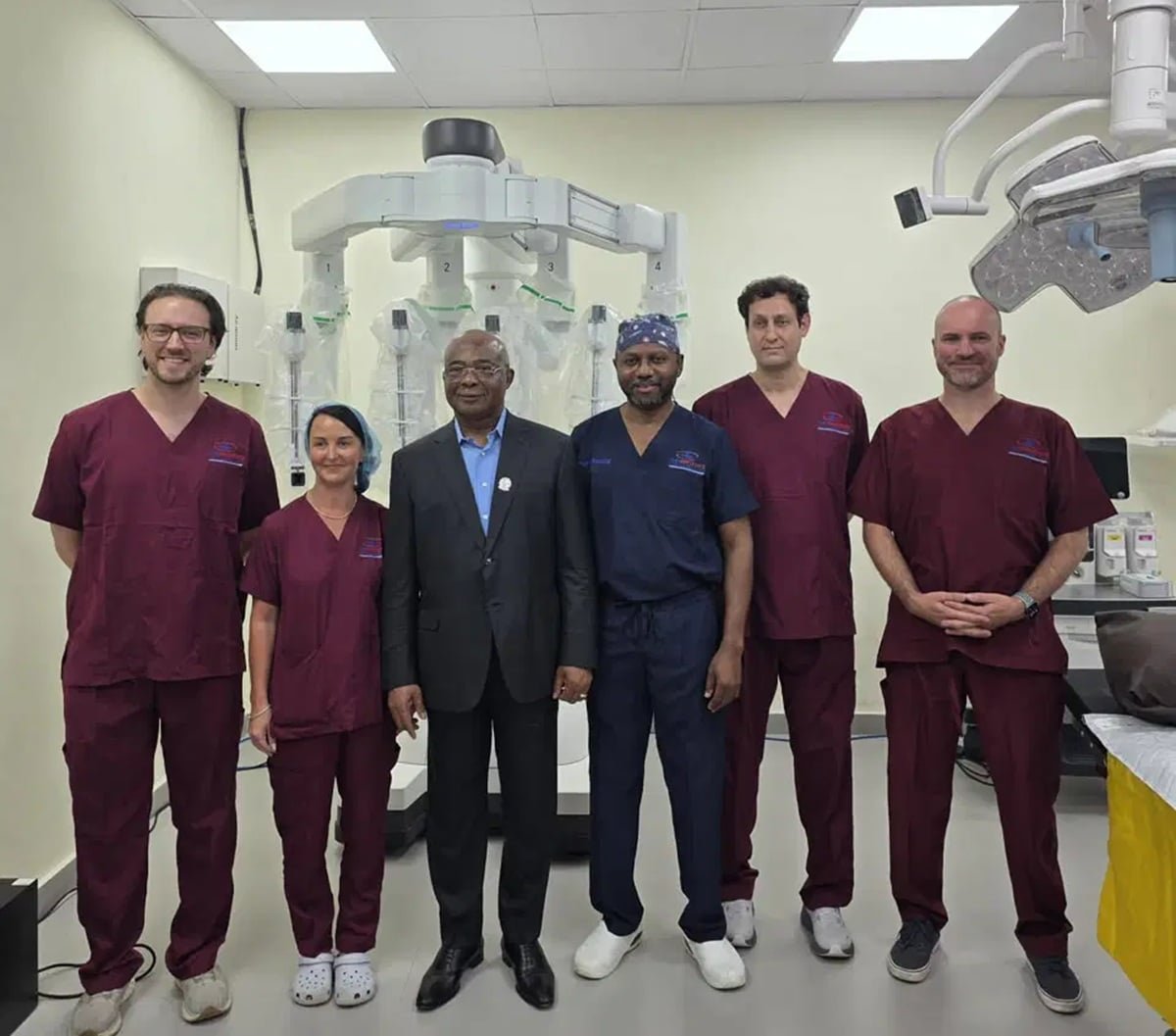
Imo State University has established a robotic surgery academy in partnership with the Imo Robotic Centre, targeting the training of 500 surgeons and other surgical professionals within two years.
Professor Kingsley Ekwueme, recently appointed Professor of Robotic Surgery at the university, disclosed the initiative, describing it as Africa’s first dedicated robotic surgery academy located within a university campus.
He said the partnership followed a meeting between the university and its partners on August 18, 2026, with a memorandum of understanding subsequently signed and a departmental building allocated to the academy.
According to Ekwueme, the programme will train more than 250 Nigerian surgeons alongside other surgical professionals, attracting participants from across Africa.
The training will cover multiple specialities, including urology, gynaecology and general surgery, rather than focus exclusively on prostate-related procedures.
“We are not only training surgeons, but we are also training the whole surgical team. And this is very important because we want to train a team to be able to deliver safe and effective robotic surgery at their own local centre,” he said.
He added that the academy would assist participating hospitals with robotic equipment procurement and installation, while international faculty members would support the training. Imo State University would oversee certification.
Ekwueme said the Imo Robotic Centre, established in partnership with the Imo State Government under Governor Hope Uzodimma, had commenced operations, performing its first surgery in August 2026 and subsequently carrying out several robotic procedures.
He said the facility was expanding access to advanced surgical care in the South-East, reducing the need for patients to travel elsewhere for specialised treatment.
“We have bridged the gap. So, nobody needs to travel beyond leaving your house and driving a few minutes down the road to have your surgery,” he said.
He disclosed that plans were also underway to establish an oncology centre beside the robotic facility to provide advanced diagnostic and cancer treatment services.
ALSO READ: Why parents, caregivers should avoid hitting children on the head – Neurosurgeon
Explaining the technology’s benefits, Ekwueme said robotic systems provide magnified three-dimensional views and instruments that enable precise movements during complex operations. Procedures include prostate and kidney surgeries, fibroid removal, hysterectomy and bowel cancer surgery, with potential benefits including reduced blood loss, surgical trauma and recovery time in appropriately selected patients.
He stressed, however, that acquiring robotic equipment without adequate training could compromise outcomes, making surgical proficiency central to the academy’s objectives.
Ekwueme, who is clinical lead for urology at Glan Clwyd Hospital, North Wales, United Kingdom, said his team had performed more than 145 robotic procedures through a programme he developed, describing the figure as the highest recorded by a comparable programme in Africa.
He called on the Federal Government and public hospitals to support robotic surgery through partnerships, affordable equipment procurement and reduced taxes on imported medical equipment.
“We know how to acquire affordable robotic systems. I will advise any public institution to come to train with us. We will help them to acquire robots, without a doubt,” he said.
Ekwueme said his long-term ambition was to make robotic surgery accessible across Nigeria, reduce medical tourism and encourage Nigerian medical professionals abroad to return home.
“In ten years, I see every Nigerian having access to robotic surgery anywhere in Nigeria. I see a Nigeria where brain drain would be significantly less,” he said.
WATCH TOP VIDEOS FROM NIGERIAN TRIBUNE TV