

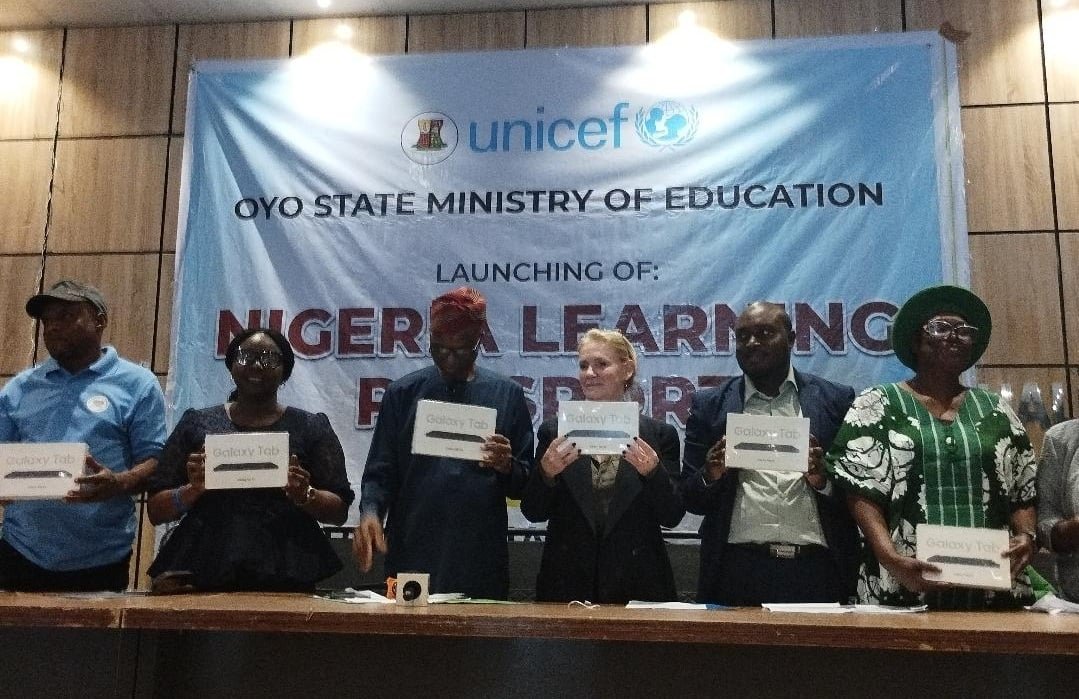
Oyo State has launched the Nigeria Learning Passport (NLP) in collaboration with the United Nations Children’s Fund (UNICEF) to expand access to quality digital education for children across the state.
With the launch on Wednesday at the Local Government Hall, Secretariat, Ibadan, Oyo State becomes the 26th state in Nigeria to deploy the platform, a free digital learning initiative that provides curriculum-aligned lessons online and offline.
Governor Seyi Makinde, represented at the event by the Commissioner for Education, Science, and Technology, Hon. Segun Olayiwola, while officially declaring the platform launched, described it as more than a technology rollout.
“It is another important step in our determination to build an education system that prepares our children for the opportunities and challenges of the 21st century. Education is the foundation of sustainable development,” Makinde said.
“The Nigeria Learning Passport provides an important opportunity to expand access beyond the traditional classroom. The real measure of success will not be today’s ceremony, but how many children and teachers actually use it to improve learning outcomes,” the governor added.
ALSO READ: PHOTO: Peter Obi releases handover document to counter Anambra govt’s debt claims
Governor Makinde commended UNICEF and other development partners, including Microsoft, IHS Towers, Airtel, and TECNO, as well as the Ministry of Education, SUBEB, TESCOM, teachers, and school administrators who worked to make the launch possible.
He charged education officers and school heads to ensure effective utilisation, while urging students to embrace technology “not only for entertainment, but as a powerful tool for learning, creativity, and personal development.”
In his address, the Commissioner for Education, Science, and Technology, Hon. Segun Olayiwola, said the initiative aligns with the administration’s agenda to leave no child behind.
“The world is changing rapidly, and education cannot remain outside this transformation. A child should not be disadvantaged simply because of where he lives, whether in Ibadan, Shaki, or Iseyin,” Olayiwola said.
According to him, the platform will allow learners to study anytime on phones and tablets, even offline, while empowering teachers to improve classroom delivery as part of its drive for a more inclusive, innovative and digitally-enabled education system.
The Permanent Secretary, Mrs Toyin Oyinloye, said the launch represents a deliberate shift towards inclusive, flexible, and technology-enabled learning for children, teachers, and stakeholders.
Celine Lafoucriere, Chief of Field Office, UNICEF Lagos, who represented UNICEF, said the NLP was created during COVID-19 to prevent learning disruption and has since become a national tool to tackle learning poverty and the out-of-school challenge.
“The Nigeria Learning Passport is designed to ensure every child has access to uninterrupted education of heightened quality. We are very thankful to Governor Makinde and the Commissioner for making Oyo the 26th state to benefit,” she said.
According to Lafoucriere, the platform currently hosts thousands of lessons covering the national primary and junior secondary curriculum and is accessible at no cost to learners through the support of private sector partners.
“We thank Microsoft, IHS Towers, Airtel, which is providing free data access, TECNO, which is providing devices, and many others who make this possible at no cost to Nigerian children,” Lafoucriere said.
She noted that sustained teacher training, monitoring of learning outcomes, and reaching children in underserved communities would be critical to success.
Chairman, Nigeria Union of Teachers (NUT), Oyo State Wing, Com. Hassan Ajibola Fatai, welcomed the initiative but stressed the centrality of teachers.
“Technology can open the door, but the teacher helps the child walk through it. We must back this with continuous digital training, electricity, and internet, especially for rural schools; otherwise, we create a new digital divide,” he warned.
The state government said the platform will allow learners to study anytime on phones and tablets, even offline, while empowering teachers to improve classroom delivery as part of its drive for a more inclusive, innovative and digitally-enabled education system.
WATCH TOP VIDEOS FROM NIGERIAN TRIBUNE TV