

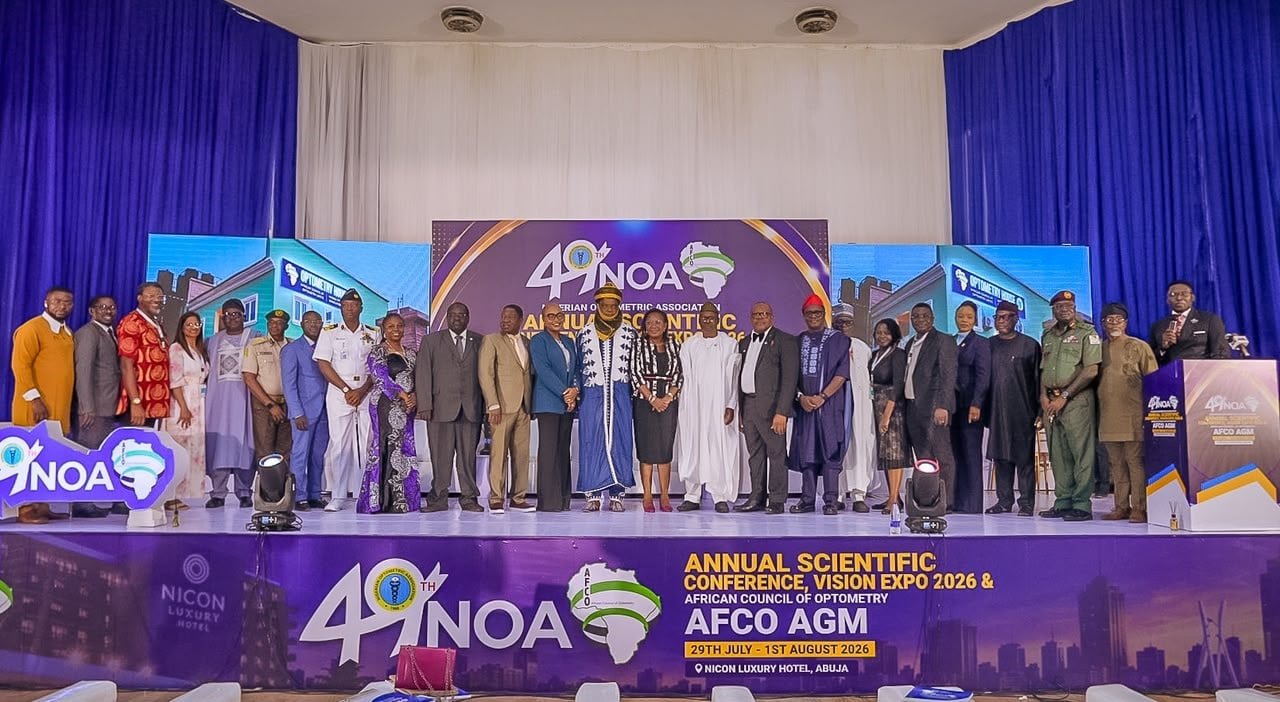
The Federal Government has reaffirmed its commitment to making eye health a national development priority, announcing plans to expand its flagship Jigi-Bola 2.0 initiative to deliver at least five million free pairs of spectacles and 25,000 free cataract surgeries by the end of 2027 as part of efforts to reduce preventable blindness and improve access to quality eye care across Nigeria.
The Minister of State for Health and Social Welfare, Dr Iziaq Adekunle Salako, disclosed this on Thursday while declaring open the 49th Annual National Scientific Conference of the Nigerian Optometric Association (NOA) and the African Council of Optometry (AFCO) Annual General Meeting, held under the theme, “Optometrists in a Changing Africa: From Diversity to Unity.”
Salako said the conference theme underscored the need for African countries to build a stronger and more united optometric community capable of responding to emerging healthcare challenges while respecting the continent’s cultural and professional diversity.
“The theme for this year’s gathering, ‘Optometrists in a Changing Africa: From Diversity to Unity,’ speaks to the absolute need to build a shared and strong optometric community in our continent while respecting the differences in our cultures, backgrounds and ideas.
Healthcare delivery across our continent is evolving rapidly, and if we are going to make the enduring change that our health systems deserve and address the public health challenges we face, we have to do it together while respecting our diversity. Government cannot do it alone, and clinical professionals cannot do it in isolation,” the minister said.
He observed that eye health had for many years received inadequate attention despite the enormous social and economic burden of avoidable visual impairment.
“For a very long time, eye health has been treated as an afterthought in broader health discussions, even though avoidable visual impairment robs millions of our citizens of their productivity, their independence and their dignity. That is precisely why His Excellency, President Bola Ahmed Tinubu, has placed a deliberate, unwavering focus on expanding primary eye care access and tackling preventable blindness head-on,” Salako said.
The minister said the Federal Government, through the Ministry of Health and Social Welfare, was implementing the National Eye Health Strategic Development Plan 2024–2028 to integrate eye care services across the primary, secondary and tertiary healthcare levels for early detection and effective management of eye diseases.
According to him, the ministry has also launched the Nigeria Glaucoma Guidelines and Toolkit to standardise diagnosis, treatment and referral protocols nationwide, while ophthalmologists from the 36 states and the Federal Capital Territory have been trained to cascade the guidelines within their respective states.
He added that under the Effective Spectacle Coverage Initiative Nigeria (Jigi-Bola 2.0), more than 2,220 Primary Health Care workers in 16 states have been trained and equipped with basic vision screening kits to strengthen primary eye care services.
Salako said the Jigi-Bola 2.0 programme had already screened nearly two million Nigerians, while over 1.3 million people had received free reading glasses, with approximately 66 per cent of beneficiaries receiving spectacles for the first time.
“The Jigi-Bola 2.0 programme, an iconic mobile eye care initiative, stands as a testament to Mr President’s determination to reduce the heavy burden of eye problems in Nigeria by reaching vulnerable populations right where they live. It is now being expanded under the Renewed Hope Health Connect to deliver at least five million free pairs of spectacles and 25,000 free cataract surgeries by the end of 2027,” he said.
The minister noted that investments in eye care produce significant economic and social benefits, saying studies have shown that every one dollar invested in eye care generates returns of between 28 and 36 dollars through improved productivity, better quality of life and lower healthcare costs.
He also said the deployment of mobile eye clinics under the Jigi-Bola programme had helped remove barriers of distance and cost that often prevent Nigerians from accessing vision care.
Describing optometrists as the frontline providers of community eye health services, Salako said the success of government programmes depended largely on the commitment and expertise of eye care professionals.
“Government initiatives like Jigi-Bola are only as strong as the human capital behind them. Optometrists are the frontline of defence for community eye health. You bridge the vital gap between primary screening and advanced clinical management.”
“We see your sacrifices, your research and your commitment, often working in under-resourced corners of our country to restore clarity and hope to families,” he said.
The minister assured members of the Nigerian Optometric Association that the Federal Government would continue collaborating with the profession to deepen community-based eye care services and achieve universal access to quality eye healthcare.
“We want to hear your ideas, tap into your research and lean on your expertise to make universal eye health a reality in Nigeria,” he said.
Calling for increased investments in eye care, Salako said improved vision health would not only prevent blindness but also enhance education, social inclusion, productivity and national development.
ALSO READ: How I struck late UNIJOS graduate three times with wooden plank — Suspect
“When we invest in vision health, we create a brighter future for individuals, communities, nations and the world. We not only prevent blindness and enhance human dignity, we also create a mechanism for identifying wider health problems that burden society.
“Let us therefore work together to increase investments in eye care, develop sustainable eye care systems, promote research and development and increase access to quality eye care services,” he added.
Salako commended the leadership of the Nigerian Optometric Association for its contributions to the profession, particularly for securing the headquarters of the African Council of Optometry for Nigeria and producing the president-elect of the continental body.
He urged optometrists across Nigeria and Africa to continue advancing the profession through mentorship, innovation and stronger partnerships with government to improve eye health outcomes across the continent.
The minister thereafter declared the 49th Annual National Scientific Conference officially open, expressing optimism that the gathering would advance efforts to close the existing gaps in the prevention and treatment of vision loss in Nigeria and across Africa.
WATCH TOP VIDEOS FROM NIGERIAN TRIBUNE TV