

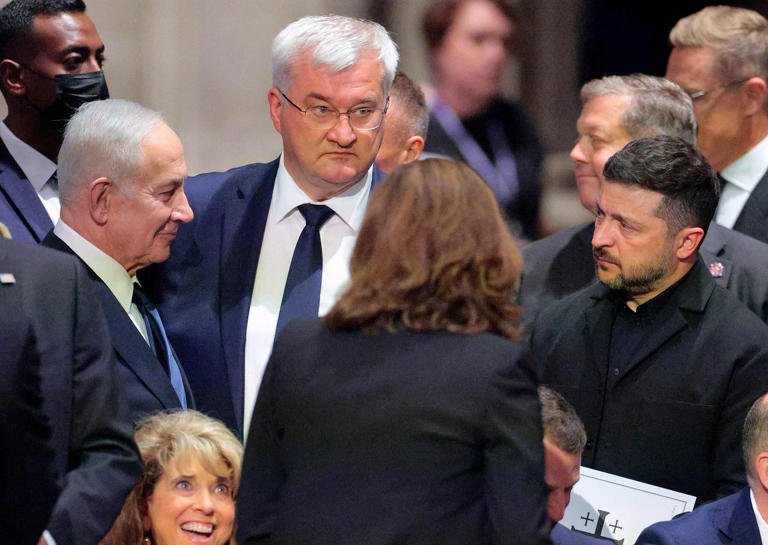
The Ukraine war and the Iran war converged on a single diplomatic stage in Washington on July 28. Following separate meetings with U.S. President Donald Trump at the White House, Ukrainian President Volodymyr Zelenskyy and Israeli Prime Minister Benjamin Netanyahu directly met and exchanged brief remarks at the funeral of Senator Lindsey Graham—marking their first face-to-face encounter in nearly three years.
In his meeting with Trump, Zelenskyy discussed the implementation of a Patriot missile production license promised at the NATO summit earlier this month, as well as air defense cooperation. After the talks, he stated, “We discussed the Patriot missile production license and various ideas that could be helpful,” adding, “It is also necessary to reinvigorate the diplomatic process.”
Notably, ahead of the meeting, Ukraine announced it had struck Russian military transport ships and warships linked to Iran in the Caspian Sea. Iran condemned the action as a violation of the UN Charter and vowed, “We cannot remain unresponsive.” This overt display of Ukraine targeting Iran’s military supply network to Russia was interpreted as a message to Trump that the U.S. and Ukraine are aligned against a common adversary in Iran.
Trump has recently shown greater appreciation for Ukraine’s strategic value. Ukraine has accumulated extensive air defense and electronic warfare experience while countering Iranian-made Shahed kamikaze drones deployed by Russia. It has also directly targeted supply routes connecting Iran and Russia. Analysts suggest Trump’s growing interest in Ukraine’s drone capabilities and combat experience against Iran signals a shift in viewing Ukraine as a potential military partner for U.S. Middle East strategy—once considered a burden.
Netanyahu, who visited the White House afterward, focused his discussions with Trump on Iran. Following the meeting, he remarked, “There was complete understanding of our shared goal to prevent Iran from obtaining nuclear weapons,” calling it “one of the best conversations I’ve had with President Trump.” The two also reportedly discussed bringing Saudi Arabia into the Abraham Accords.
At Graham’s funeral at the Washington National Cathedral, Zelenskyy and Netanyahu shook hands and exchanged brief remarks. Their face-to-face meeting was the first since September 2023, and their conversation the first since January 2025. Though both sides considered holding a separate summit in Washington, it did not materialize.
Israel’s Foreign Minister Gideon Saar and Ukraine’s Foreign Minister Andrii Sybiha also held separate talks, discussing challenges posed by Iran. Saar stated afterward, “We discussed the threats both nations face, particularly from Iran,” reaffirming their commitment to expanding cooperation.
As military collaboration between Russia and Iran deepens, the Ukraine war and the Middle East conflict are increasingly seen as interconnected. In Washington, leaders from both wars gathered to persuade Trump and address Iran as a shared threat, with their foreign ministers elevating it to a common agenda. This has led to assessments that the two conflicts now converge under a single strategic axis: the anti-Iran front.