

For years, Africa’s fintech boom has been defined by startups such as Flutterwave, Moniepoint and Wave, which built large payments businesses from scratch before attracting billion-dollar valuations.
But a new opportunity may be emerging from traditional banks, an unlikely source.
A growing number of analysts and investors believe some of Africa’s biggest future fintech deals could come not from new startups, but from banks separating their payments businesses into standalone companies, unlocking value that has long been hidden inside larger banking groups.
The idea is simple. Payments businesses are often valued differently from banks because investors see them as technology-driven growth companies rather than traditional financial institutions.
Once separated from their parent banks, these units can attract external investors, secure higher valuations, and potentially pursue listings or acquisitions.
The model has already worked elsewhere. In the telecom sector, companies such as MTN and Airtel unlocked billions of dollars in value by carving out their mobile money businesses.
MTN brought in investors including Mastercard at a valuation of about $5 billion for its fintech arm, while Airtel Money attracted global investors and was valued at around $2.6 billion.
Now attention is shifting to banks. One example often cited is Magnati, the payments business formerly owned by First Abu Dhabi Bank. The company processed about $200 billion in annual payments and generated roughly $300 million in revenue before it was acquired by Brookfield in a deal valuing the business at $1.15 billion.
Read also: Banks, telcos, fintechs face growing AI reputation challenge
The transaction demonstrated that payments units embedded within banks can command fintech-style valuations once they are separated from the parent organisation.
In Africa, several banks are beginning to follow a similar path. GTCO’s HabariPay has emerged as one of the fastest-growing payments businesses on the continent.
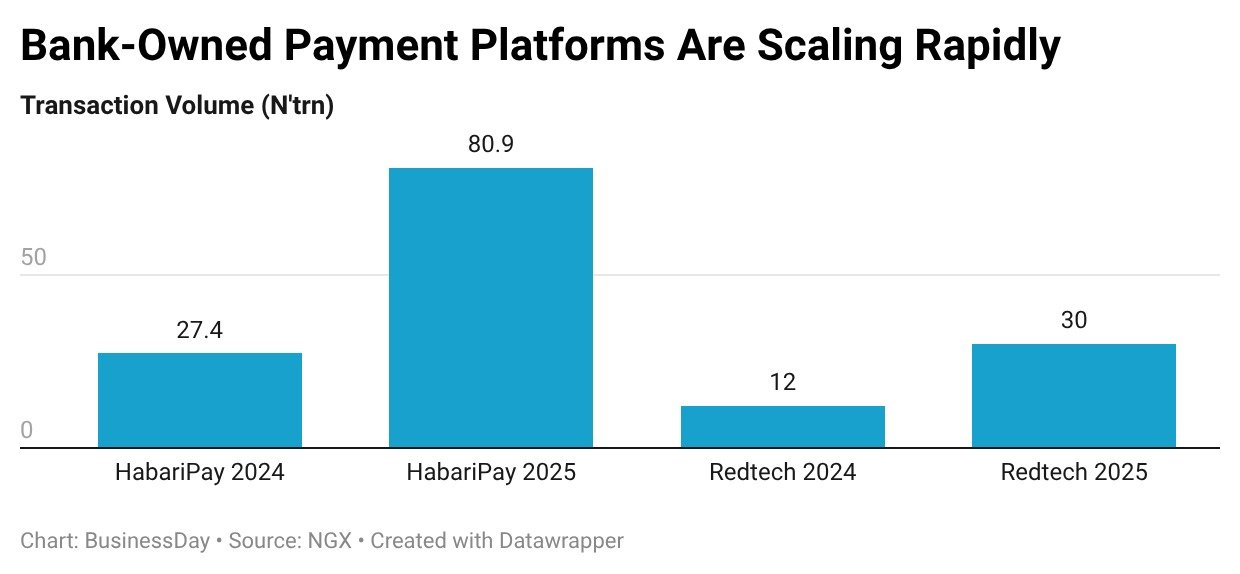
In 2024, HabariPay processed transactions worth N27.4 trillion, marking a 124.6 percent increase from the previous year and underscoring its rapid growth in Nigeria’s digital payments market.
The momentum accelerated in 2025, with total transaction value soaring to N80.9 trillion, a 195.4 percent year-on-year increase. Since launching operations four years ago, the payments subsidiary has processed more than N150 trillion in cumulative transactions, highlighting its emergence as one of the fastest-growing digital payment platforms in the country.
The platform has shown strong growth in transaction volumes and profitability, with reports noting significant increases such as profits rising substantially in recent periods.
Redtech, a Heirs Holdings-backed fintech, processed over N30 trillion in transactions during the 2025 financial year, more than double its 2024 volume of N12 trillion. To date, the platform has processed over N37.2 trillion.
Reuben Mwatosya, an ex-banker and fintech operator, who has deep experience in payments, lending, and partnerships across Africa, highlights the strategic value in such structures like payments infrastructure can serve as foundational rails, but standalone entities allow for focused innovation and capital attraction that integrated banking divisions often constrain.
However, perhaps the most striking example is Ecobank. The pan-African lender operates in more than 30 countries and has built one of the continent’s largest payments networks spanning remittances, merchant payments, card services, collections, and cross-border transactions.
Ecobank’s own reporting position its payments ecosystem as a major player processing substantial volumes and contributing meaningfully to revenues.
Jeremy Awori, group CEO of Ecobank, has emphasised the group’s focus on building infrastructure for seamless payments and real-time capabilities across markets, including partnerships that enhance cross-border and fintech integration.
Those numbers would place the business among Africa’s largest fintech platforms if it operated independently.
Read also: South African firm unveils $176 million fund to power rural Africa
Yet unlike Flutterwave, Moniepoint, or other fintech unicorns, the payments operation remains embedded within the broader banking group, making it harder for investors to assign a standalone valuation. This creates what some analysts describe as a valuation gap.
While startups are often valued on growth potential and future earnings, payment businesses inside banks are typically bundled into broader banking valuations. As a result, large payments franchises can remain underappreciated despite handling transaction volumes that rival or exceed some of Africa’s most celebrated fintech companies.
Tayo Oviosu, founder of Paga, a major Nigerian payments platform, notes the persistent opportunities in addressing cash-heavy economies and building scalable infrastructure: “The average Nigerian is still paying bills in cash. There are still massive opportunities ahead of us.”
The implications could be significant. As venture funding becomes more selective and investors increasingly focus on profitable businesses, bank-owned payment platforms may become attractive acquisition and investment targets.
Private equity firms, sovereign wealth funds, and strategic investors could see opportunities to back established payments businesses with proven revenues.
That could spark a new wave of fintech transactions across Africa, ranging from carve-outs and minority investments to full acquisitions and public listings.
The shift would also mark a new phase in Africa’s fintech evolution. The first wave produced startup unicorns. The second wave was led by telecom operators monetising their mobile money platforms. The next chapter may belong to banks that decide to separate their payments businesses and allow investors to value them as fintech companies rather than banking divisions.
Reuben Mwatosya has written on the massive scale of Africa’s payments opportunity, estimating significant market sizes driven by mobile money, remittances, and bank channels, underscoring why unlocking these embedded assets could catalyze the next wave of deals and innovation.
If that happens, some of Africa’s next billion-dollar fintech companies may already exist today, hidden in plain sight inside the continent’s largest banks.

Get Newsletter Updates
Enjoying our column?
Subscribe to our specialised **Tech Pulse** feed to receive fresh reports and analyses directly in your inbox.

