

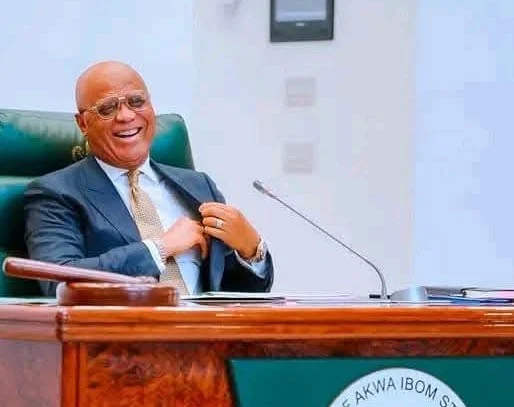
Akwa Ibom State Governor, Umo Eno, has likened himself to a political forerunner, saying he defected from the Peoples Democratic Party to the All Progressives Congress ahead of many of his colleagues who have since followed the same path.
Eno spoke in an interview with TVC on Friday, where he addressed criticism that trailed his early exit from the PDP and explained the thinking behind his defection.
The governor said his decision was born out of practical necessity, insisting there was nothing wrong with aligning with a party in a position to deliver funding for the state.
“You can’t be hungry all the time. Why don’t you reject it? The man has done well. Funds are coming. Allocations are coming. And we’re able to have funds to get to work for our people. And so I had to. It was a decision well thought out,” he said.
Eno said the presence of Senate President Godswill Akpabio, a fellow Akwa Ibom indigene, in the APC also shaped his decision, as remaining in a different party could have created a damaging contest for political control of the state.
“The Senate president is from Akwa Ibom. I don’t see how we would have maintained the peace trajectory we are talking about with me in another party and the Senate president in another party. The soul of the state is what everybody will be fighting for,” he said.
On his exit from the PDP itself, the governor said he had foreseen that the party would not support his re-election bid, a position many dismissed as premature at the time.
“I did not see through how the way my party then, the PDP, was going, who will endorse my form for a second term. And people said no, it’s too early to judge. But it’s one of the instincts of leadership — your ability to see the future where others can’t see,” he said.
Eno noted that his prediction had since played out, as several governors elected on the PDP platform had also decamped to the APC.
“Today, you can see who is going to endorse these forms. On which platform will I have run? Almost every serving governor, even second-term governors, have now left the party. Then you expect a first-term governor… So why did they leave? The same people who said I was too quick, I shouldn’t have done that — almost all of them have left. Some of them are with me now in the APC,” he said.
The governor described himself as a trailblazer among his colleagues who later joined the ruling party.
“I said to them, I came like John the Baptist to prepare the way for you,” he said.
Eno added that leadership was ultimately judged by outcomes over time, insisting that recent political developments in the country had vindicated his decision.
“A leader’s judgement call must be such that over time, people will know if you’re truly a leader or not. What has happened today in this country should vindicate some of us.
“And people should be able to be humble enough to say we’re sorry, we were wrong, you were right. But human character, sometimes it’s difficult to apologise,” he said.
He challenged critics to consider how many of the governors who had faulted his defection remained in the PDP today.
“The truth is glaring. Who is staying? Who among those governors are there now?” he said.
The governor said peace remained his foremost priority in office, stressing that no cost was too high to preserve stability in Akwa Ibom.
“For me, you must know the trajectory you want to take your people. First, there is no price I cannot pay for peace in this state. No price. Because we only know when trouble starts. We don’t know how it’s going to end,” he said.
Eno warned that unresolved crises could spiral beyond control, drawing a comparison with unrest witnessed elsewhere in the country.
“Check everything that has happened in this country, all the trouble. Sometimes those troubles were imported. People brought them, but now they can’t control those things.
“It’s like a case of a man who stands and throws a stone into a market square. You don’t know who the stone is going to hit,” he said.
He said internal cohesion in the state made it harder for external forces to cause disruption, pointing to his working relationship with Akpabio as an example.
“If you don’t have support from within, the external forces will not gain too much access. Between me and the Senate president, we’re good. I go to him, I check things with him.
“There’s never been a tension. He’s in Abuja doing his work; I’m in Uyo doing my work. Anything he can see up there that will favour the state, he brings it to the table, and anything I can see down here, I put it on the table too,” he said.
On his relationship with former governors of the state, Eno said he had never disrespected any of his predecessors, even when criticised publicly.
“Give respect to these people. They’ve been here. He’s been a governor. I give respect to all past governors, all of them, without an exception. Nobody can say I’ve ever insulted one of them. If they say things I don’t like, I simply move away,” he said.
The governor compared his response to criticism with the reaction of a child who withdraws quietly after being reprimanded by a parent, describing his restraint as a product of upbringing rather than political calculation.
“Like a young child whose daddy was spanked, and you go and cry in the bedroom. You don’t stay there to reply your dad. This is about culture. It’s about upbringing. It’s about your ability to manage situations,” he said.