

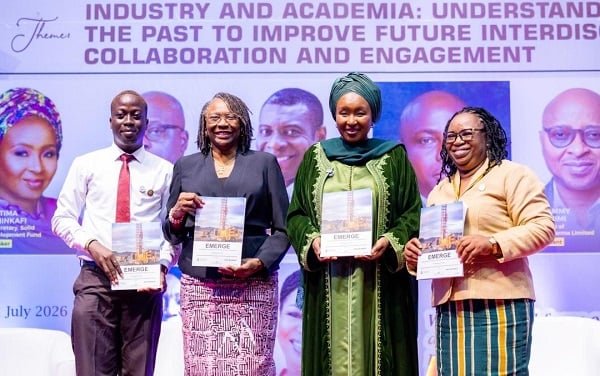
Nigeria’s solid minerals sector generated more than ₦70 billion in federation revenue in 2025, marking a significant increase from ₦16 billion recorded in 2023, as reforms introduced by the Federal Government continue to drive growth and attract fresh investments into the industry.
The Executive Secretary and Chief Executive Officer of the Solid Minerals Development Fund (SMDF), Hajiya Fatima Umaru Shinkafi, disclosed this while delivering the keynote address at the maiden Annual Lecture Series of the Faculty of Physical and Earth Sciences at the University of Lagos (UNILAG), where she highlighted the impact of ongoing reforms on the mining sector.
According to a statement issued by the SMDF’s Head of Media, Idowu Jokpeyibo, Shinkafi said the sector’s revenue rose from ₦16 billion in 2023 to ₦38 billion in 2024 before surpassing ₦70 billion in 2025, representing a 337 per cent increase within two years.
She attributed the impressive performance to the implementation of reforms aimed at strengthening governance, improving regulation and positioning the mining industry as a major contributor to Nigeria’s economic diversification agenda.
Shinkafi also revealed that the sector recorded a real growth rate of 33.5 per cent in 2025, far exceeding Nigeria’s overall Gross Domestic Product (GDP) growth of 3.9 per cent during the same period.
Despite the gains, she noted that Nigeria’s solid minerals sector still contributes less than one per cent to the country’s GDP, while mineral exports accounted for only 0.4 per cent of total exports in 2025, underscoring the enormous untapped potential of the industry.
She said the Federal Government is implementing the Ministry of Solid Minerals Development’s Seven-Point Agenda to unlock the sector’s potential, adding that the reforms have already attracted about $2.6 billion in new investment commitments, including a $1.3 billion alumina refinery project.
ALSO READ: Speaker Abbas, Kalu task parliamentary correspondents on promoting national unity
According to her, the government’s long-term target is to transform the mining industry into a ₦30 trillion sector contributing at least three per cent to Nigeria’s GDP by 2030.
Shinkafi further disclosed that efforts to curb illegal mining have yielded results, with Mining Marshals arresting more than 300 illegal miners, recovering nearly 100 illegal mining sites and supporting the revocation of over 2,500 dormant mining licences.
To deepen collaboration between academia and industry, she unveiled the SMDF’s Early-Stage Mineral Exploration and Research Grant Endowment (EMERGE), launched in June 2026 to provide competitive funding for geoscience research in Nigerian universities.
She explained that the initiative would support Master’s and PhD research through grants covering eligible research costs while also providing technical and investment training to bridge the gap between academic research and commercial mineral exploration.
Responding, the Vice-Chancellor of the University of Lagos, Professor Folasade Ogunsola, welcomed the initiative, describing it as a timely intervention that would strengthen collaboration between universities, government and industry.
Also speaking, the pioneer Dean of the Faculty of Physical and Earth Sciences, Professor Olayinka Taiwo Asekun, pledged that the university would leverage the EMERGE programme to advance research capable of supporting the growth and competitiveness of Nigeria’s mining sector.
WATCH TOP VIDEOS FROM NIGERIAN TRIBUNE TV