

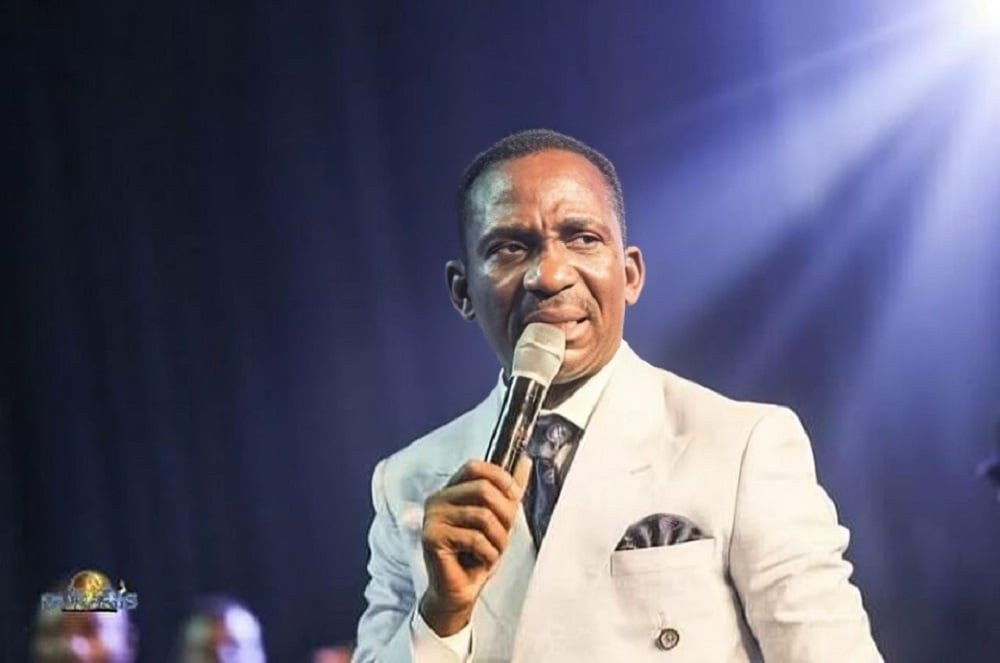
Senior Pastor of Dunamis International Gospel Centre, Pastor Paul Enenche, has declared that Christianity is not subordinate to any religion in Nigeria, while condemning comments linked to Islamic cleric Sheikh Yahya Jingir.
Speaking during the church’s Sunday service at its headquarters in Abuja, Enenche reacted strongly to the controversy generated by Jingir’s recent remarks, insisting that Christians could not be regarded as inferior to adherents of any other faith in the country.
The cleric described the suggestion that Christianity was secondary to another religion as unacceptable, arguing that Christians are present in large numbers across every part of Nigeria.
Enenche also warned against taking the Christian community for granted, maintaining that the church remains a significant force in the nation. He criticised individuals he accused of making divisive statements capable of deepening religious tensions and harming national unity.
The pastor further questioned the contributions of those promoting such views to Nigeria’s development, accusing them of encouraging discord and creating unnecessary divisions among citizens.
He called on security agencies to pay closer attention to comments that could incite violence, warning that reckless public statements had the potential to threaten peace and stability.
Enenche also urged religious and political leaders to act responsibly, stressing that provocative remarks should not be allowed to undermine harmony among Nigerians.
He said, in part, “I was away for the crusade this past week, and I heard from a friend what was going on where I think an insane man came up to say that Christianity is subordinate to any other religion in this country.
ALSO READ: Those killing people in Nigeria should be brought to book urgently — Pastor Enenche
“Either in the prison or in a mental home, to say that Christians are secondary to any other religion, the Lord rebuke you and your devils.
“Christianity is not secondary, and no group of religious fanatics will ever make it secondary.
“Not you, not any political group of people will ever make Christianity secondary to any other religion. If you have sense, take a look around.
“There is no part of Nigeria where Christians don’t exist en masse.”
His reaction followed comments made by Jingir in support of a Muslim-Muslim presidential ticket ahead of the 2027 general elections.
Jingir, in a video that circulated on social media, called on Muslims to support the continuation of a Muslim-Muslim presidential arrangement in the next election cycle.
The cleric made the remarks at an event attended by prominent political figures, including Kano State Governor Abba Yusuf and Jigawa State Governor Umar Namadi.
During the gathering, Jingir praised President Bola Tinubu for adopting a Muslim-Muslim ticket in the 2023 presidential election and identified himself as a supporter of the political arrangement.
He encouraged Muslims to unite behind the idea and urged them to obtain their Permanent Voter Cards ahead of future elections.
Jingir also acknowledged opposition to the arrangement from Christians and members of other religious groups while questioning the criticism directed at supporters of the ticket.
“Special thanks to my (political) hero, Bola Tinubu, who raised the flag of this political ideology, describing it as a purely Muslim-Muslim coalition,” he said.
“I am among the staunch advocates of the Muslim-Muslim ticket, and I call on you to come together for Muslim-Muslim ticket,” he added.
The comments drew criticism from Nigeria’s Ambassador-designate to South Africa, Femi Fani-Kayode, who described the remarks as provocative and potentially harmful to national cohesion.
While expressing respect for Jingir, Fani-Kayode argued that such rhetoric could deepen religious divisions and inflame tensions in an already sensitive environment.
He maintained that Nigeria is neither a Muslim nor a Christian nation but a secular and multi-religious state made up of citizens from different faith backgrounds.
Fani-Kayode also explained that his support for a Muslim-Muslim ticket in 2027 was based on his assessment of the candidates’ competence, character, and ability to govern rather than their religious identity.
According to him, future elections could equally produce a Christian-Christian ticket, adding that political discussions should focus on leadership qualities, policies, and national development instead of religion.
He urged Nigerians not to allow religious differences to create divisions, stressing the need for unity ahead of future elections.
WATCH TOP VIDEOS FROM NIGERIAN TRIBUNE TV