

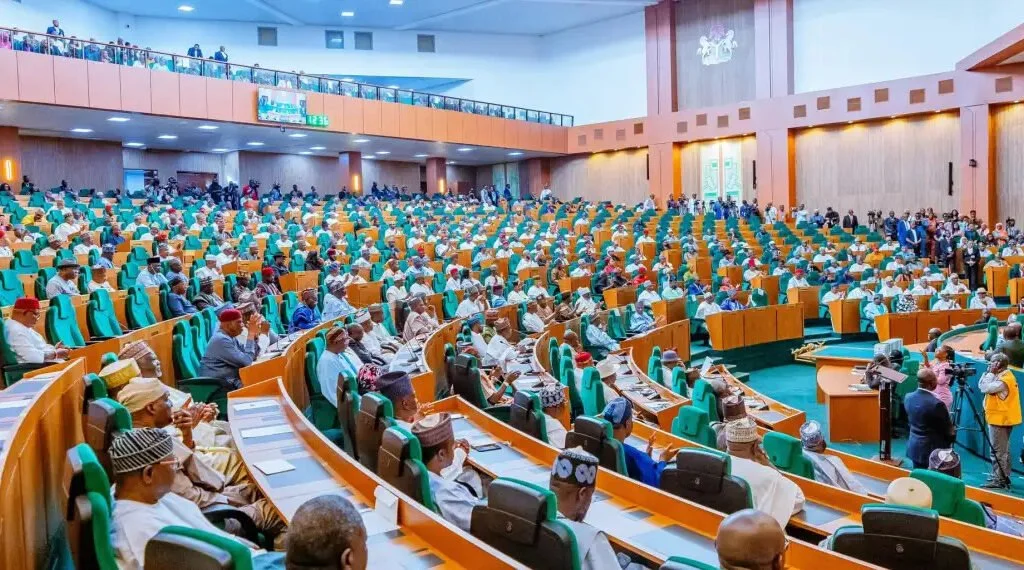
The House of Representatives on Wednesday passed for second reading a bill seeking to amend the Armed Forces Act, 2004, with a view to promoting synergy among various lead security agencies and other paramilitary institutions, particularly through intelligence sharing.
The private member’s bill, sponsored by Hon. Bukar Talba, seeks to promote and maintain synergy and collaboration among the Nigerian Army, Nigerian Navy, Nigerian Air Force, Department of State Services, Nigeria Immigration Service, Nigeria Customs Service, Nigerian Security and Civil Defence Corps (NSCDC) and other relevant security agencies towards upholding national security.
In his lead debate on the general principles of the bill, Talba observed that security coordination was critical in a federated environment where incidents were often not isolated and could affect several component units.
He maintained that “a coordinated response is essential to minimise the impact of incidents and vulnerabilities. Terrorism, cyber-attacks, natural disasters, pandemics and other national security threats usually extend beyond geographic and organisational boundaries.
“Each agency offers its own unique areas of expertise, intelligence and resources. Working together, these agencies can be more effective in counter-terrorism and security efforts generally than they would be on their own because a single agency may face difficulties addressing such events alone. This is why inter-agency collaboration at all levels is critical to addressing national security threats.”
According to him, the spirit and intention of the bill was for the Nigerian Army to lead and coordinate other agencies of the Armed Forces and relevant security agencies in maintaining joint efforts in the collection and analysis of intelligence to address gaps in national security.
The proponent of the legislative framework advocated an amendment to Section 1 of the principal Act by inserting, immediately after the existing subsection (3), new subsections (3A) and (3B):
“(3A) The Armed Forces, in discharging their functions under subsection (3), may collaborate with the Department of State Services, the Nigeria Immigration Service, the Nigeria Customs Service, the Nigerian Security and Civil Defence Corps and other relevant security agencies, including accredited non-state actors who, in the opinion of the Armed Forces Ruling Council, are needed in combating national security challenges.
“(3B) The Armed Forces, in collaborating with other security agencies under subclause (3A), shall share intelligence with other security agencies on matters relating to national security and shall be the lead agency in matters relating to their functions under this Bill.”
The bill also seeks to substitute the existing subparagraphs (i) and (ii) in subsection 4(a) with new subparagraphs:
“(i) assisting the Nigeria Customs Service and Nigeria Immigration Service in the enforcement of all customs laws, including anti-bunkering, fishery and immigration laws of Nigeria at sea; and
“(ii) assisting the Nigerian Maritime Administration and Safety Agency in the enforcement of national and international maritime laws ascribed or acceded to by Nigeria.”
It further proposes the insertion, after the existing subsection (4), of a new subsection (4A), which provides that, for the purposes of subsection (4)(a)(i) and (ii), the Nigeria Customs Service, the Nigeria Immigration Service and the Nigerian Maritime Administration and Safety Agency shall be the lead coordinating and enforcement agencies.
WATCH TOP VIDEOS FROM NIGERIAN TRIBUNE TV