

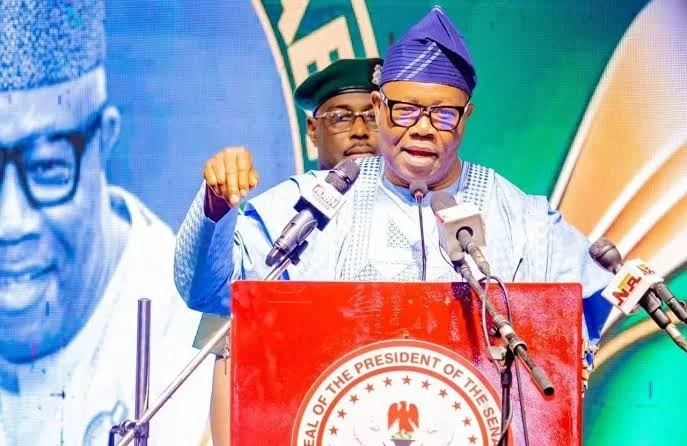
The President of the Senate, Godswill Akpabio, on Tuesday defended the performance of the 10th National Assembly, urging Nigerians to study legislation before criticising lawmakers.
This is as the Senate President noted that the parliament’s role in supporting key national reforms has often been misunderstood.
Speaking at the opening of the 2026 National Assembly Open Week in Abuja, Akpabio said the legislature remains the most accessible democratic institution in the country, stressing that the initiative was designed to deepen transparency, strengthen accountability and allow citizens to engage directly with the lawmaking process.
He said many criticisms directed at the National Assembly stem from an inadequate understanding of the legislative process.
The theme of the 2026 Open Week is “Three Years of the 10th National Assembly: Advocacy, Transparency, Inclusion and Reforms.”
“I want all of us to attend this Open Week. Please try to read the laws we make. You can question us after you have finished reading the laws. You can also challenge us,” Akpabio said.
Recalling a recent television programme, the Senate President said one academic criticised the recently passed tax reform legislation without reading its provisions.
“I saw somebody, a professor, on television condemning the tax bills. We asked him, ‘Which particular section of the Act are you against?’ He said he had not read any of the Acts. Sometimes before you comment on social media, take time to look at the work we have actually done,” he counselled.
According to him, lawmakers enact legislation with future generations in mind rather than for immediate political gains.
“Our job here is to make laws that will last for generations. We are not making laws for ourselves. We are making laws for the protection of Nigeria’s future,” he stated.
Akpabio also described the current National Assembly as the most harmonious since Nigeria’s return to democratic rule in 1999, attributing its legislative productivity to close collaboration between both chambers.
“This is the most peaceful and most productive Assembly that we have seen since 1999,” he said.
He noted that while disagreements occasionally arise between the Senate and the House of Representatives, both chambers ultimately work through consensus in the national interest.
The Senate President also commended security agencies for the recent rescue of abducted schoolchildren in Oyo State, saying the operation demonstrated that government remained committed to tackling insecurity.
“The rescue of those children is an indication that government is not sleeping-that government is working round the clock to ensure that Nigerians can sleep with their two eyes closed,” he said.
Akpabio further defended the economic reforms of the Tinubu administration, arguing that the country had become less dependent on crude oil revenue and that states now enjoy significantly improved monthly allocations.
“The President has been able to transform Nigeria from a mono-economy. Today, most states are able to execute projects and pay salaries without depending entirely on borrowing,” he stated.
Earlier, Speaker of the House of Representatives, Tajudeen Abbas, unveiled the Third-Year Legislative Scorecard of the 10th House, revealing that lawmakers had received 2,747 bills within three years, passed 363 of them and secured presidential assent for 72.
According to Abbas, the figures represent the highest legislative output since the return to democratic rule in 1999.
“Behind each of those bills stands a Nigerian who believed that the law could better their condition. This morning, I wish to account for how this House has honoured that trust,” he said.
Abbas also disclosed that the House would withdraw its earlier state police bill to give priority consideration to the executive bill transmitted by President Bola Tinubu on Tuesday.
He described the presidential proposal as more comprehensive and said it incorporated stronger safeguards against abuse.
“His Excellency the President has now transmitted to the National Assembly an Executive version of the state police bill, one that is more robust and more comprehensive than the version this House earlier passed.
“The House will therefore recall the version it earlier passed and accord the executive bill the expedited consideration that a matter of this urgency deserves,” Abbas announced.
Responding to concerns about transparency, the Speaker assured Nigerians that the proposed legislation would undergo extensive public scrutiny before passage.
“Nothing here is concealed. The bill will pass through public hearing and open scrutiny. I give this assurance to every Nigerian that the framework will carry robust safeguards,” he said.
He added that no state would establish a police service without satisfying strict constitutional conditions on accountability, funding, human rights protection and oversight.
On the broader performance of the House, Abbas said the legislature had prioritised legislation aimed at expanding access to education, reforming tax administration, stimulating investment, strengthening regional development and improving citizens’ welfare.
He stressed that the National Assembly’s support for President Tinubu’s reforms had been based on constitutional responsibility rather than political convenience.
“Every policy of the executive still had to become law, pass through appropriation and withstand legislative scrutiny. The President furnished the vision; the National Assembly furnished the laws that render the vision enforceable,” he added.
Also speaking, the Chief of Staff to the President, Femi Gbajabiamila, urged lawmakers to sustain reforms that promote openness and public confidence in democratic institutions.
According to him, transparency, inclusion and accountability remain essential pillars of a credible legislature.
“Transparency turns constitutional authority into public trust. Inclusion ensures that the voices of our diverse people are not only heard but reflected in national priorities. Reform keeps our institutions responsive to changing realities and capable of delivering better outcomes,” he said.
Gbajabiamila added that the annual Open Week should evolve beyond a ceremonial exercise into a platform for sustained public engagement.
“An Open Week must be more than the ceremonial opening of the gates of Parliament. It should be an invitation to scrutiny, dialogue and partnership.”
He also reaffirmed the Presidency’s commitment to maintaining constructive relations with the National Assembly.
“While the executive and the legislature are separate arms of government, they share one ultimate mandate, which is to improve the lives of the Nigerian people. Constructive cooperation does not diminish legislative independence,” he said.”
In his goodwill message, the Executive Director, Policy and Legal Advocacy Centre, Mr Clement Nwankwo urged the lawmakers not to be carried away by their scorecard, noting that there is a lot left to be done.
“As the 10th National Assembly marks three years in office, it is appropriate to reflect on both its achievements and the work that remains unfinished. The Assembly has demonstrated commitment in several important areas, including the ongoing constitutional review process, efforts to modernise legislative procedures, consideration of key electoral and governance reforms, increased use of digital platforms, and greater engagement with citizens and civil society.
“It has also shown resilience in responding to emerging national challenges and has maintained a generally stable legislative environment.
“At the same time, citizens rightly expect more from their legislature. They expect stronger and more independent oversight of the executive, more timely consideration of critical national issues, greater transparency in legislative business, broader public participation in law-making, and reforms that directly improve governance, security, economic opportunity and social justice.”
He reminded lawmakers that the parliament “is at its strongest not when it agrees with the executive, but when it faithfully discharges its constitutional duty to scrutinise executive action, protect public resources and ensure that government remains accountable to the people.”
According to him, “the jury is out there on how you have performed in this regard.”
In his words, there remains a significant opportunity for the 10th National Assembly to consolidate its legacy.
“Priority should be given to concluding the constitutional amendment process in a manner that reflects broad national consensus, particularly, ensuring the passage of the Special Seats Bill for Women; strengthening the legal framework for credible elections; advancing reforms that deepen inclusion, including greater representation of women and other historically underrepresented groups; improving transparency in legislative operations; and ensuring that oversight functions are rigorous, evidence-based and focused on measurable outcomes for citizens.”
He tasked the parliament to remain the foremost institution for accountability.
“It must ensure that public funds are properly appropriated and responsibly spent, that executive power is exercised within constitutional limits, that government policies are subjected to robust scrutiny, and that the voices of citizens are reflected in national decision-making
“Where oversight is weak, corruption flourishes. Where representation is diminished, public trust declines. But where Parliament performs its constitutional functions with courage, independence and integrity, democracy is strengthened and citizens’ confidence in government grows,” he added.
On his part, retired Catholic Archbishop of Abuja, John Cardinal Onaiyekan urged the lawmakers, as representatives of the people, to always consult their constituents on issues that affect them.
The event was attended by prominent personalities including former Speakers Aminu Masari, Patricia Etteh and Yakubu Dogara.
Others included the Coordinating Minister of Health and Social Welfare, Prof Ali Pate and former Deputy Speaker of the House of Representatives, Emeka Ihedioha, among others.
The National Assembly Open Week was introduced to deepen transparency, improve legislative accountability and provide citizens with direct access to parliamentary proceedings. This year’s event features engagements on constitutional amendment, state policing, women’s political representation, economic reforms, legislative oversight and youth participation in governance.