

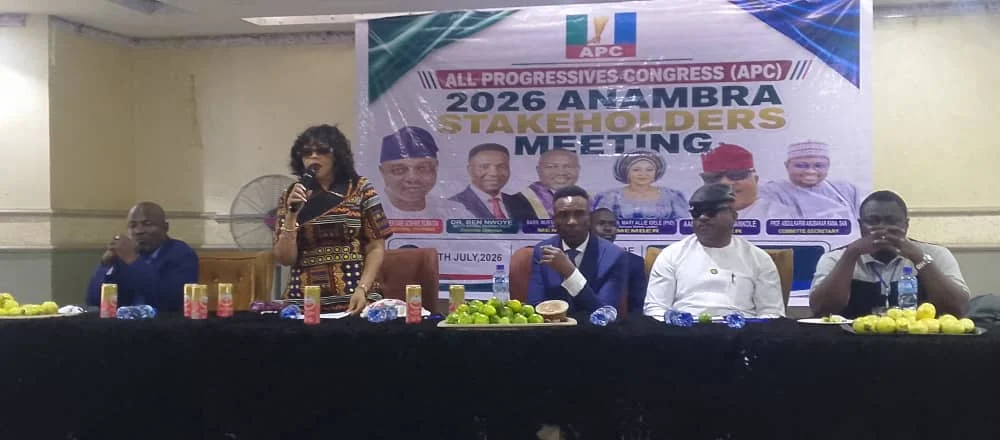
The national leadership of the All Progressives Congress on Tuesday held a stakeholders’ meeting to resolve the crisis in the Anambra State chapter, warning the warring factions to desist from actions capable of causing division.
During the meeting held at Chiben Leisure Resort and Hotel, Awka, the party launched a determined push to end months of internal wrangling in the state chapter, identifying disputed party structures, controversial candidate substitutions, court battles and alleged expulsions without due process as the key factors behind the crisis threatening its electoral fortunes ahead of the 2027 general elections.
The peace and reconciliation meeting, comprising APC state leaders, stakeholders, ward executives, youth and women leaders, was organised by the party’s National Reconciliation Committee, led by the Deputy National Chairman (South), Dr Benjamin Nwoye.
Addressing the gathering, Nwoye declared that the era of endless factional battles must give way to reconciliation, warning that a divided APC would stand little chance of delivering victory for President Bola Tinubu’s 2027 re-election bid or winning future elections in the state.
Nwoye said, “This meeting marks a crucial transition from dialogue to implementation after an earlier stakeholders’ reconciliation session held in Abuja on July 23. The Awka engagement is designed to translate the reconciliation process initiated by the party’s national leadership in Abuja into practical peace across the grassroots structures of the APC in Anambra.
“While the Abuja meeting succeeded in opening channels of communication among previously estranged party leaders, the success of the peace process now depends on its acceptance by ward executives, local government officials, youth and women leaders, and polling unit officers who remain the party’s closest link to the electorate.
“We are not gathered to reopen old wounds but to deepen the peace that began in Abuja. Politics is local, and any peace that does not reach the grassroots is incomplete.”
Describing grassroots members as the engine room of the APC, he said elections are won in communities, markets, churches, villages and polling units, making unity at that level indispensable.
Giving an update on the committee’s findings, Nwoye disclosed that consultations with stakeholders from different factions had identified the major issues fuelling the prolonged crisis within the state chapter.
He listed allegations of the removal of elected party officials, the replacement of candidates who reportedly won party primaries, the resort to litigation without exhausting the APC’s internal dispute resolution mechanisms, and the expulsion of party leaders and members without fair hearing as some of the issues fuelling the crisis at the state level.
Nwoye warned members against frustrating the reconciliation process, making it clear that the National Working Committee would not tolerate actions capable of deepening divisions within the party.
“We are not here to massage anybody’s ego. As this process continues, I don’t want to know the faction you belong to. Anyone who chooses to behave like a thug will be treated accordingly.
“We urge leaders to replace intimidation with consultation and encourage aggrieved members to pursue their grievances through the party’s internal mechanisms rather than prolonged court battles.
“Peace should never be mistaken for weakness but recognised as the strategic strength required to rebuild the APC ahead of future elections. Peace is a strategic strength. A united party can register voters, mobilise polling units, prepare credible candidates and compete seriously. A divided party cannot,” he added.
He urged stakeholders to move beyond complaints and begin rebuilding functional ward structures, disciplined campaign teams and inclusive communication channels capable of repositioning the APC across Anambra.
The deputy national chairman also reaffirmed the National Working Committee’s commitment to an all-inclusive peace settlement, assuring stakeholders that every submission made during the consultations would be forwarded to the party’s national leadership before a final decision was reached.
“The outcome must be seen as a joint decision involving everyone,” he said, urging members to accept the committee’s eventual recommendations in the interest of lasting peace.
Also addressing the gathering, the Anambra State APC Chairman, Senator Emma Anosike, pledged the state chapter’s commitment to President Tinubu’s re-election project, promising to reopen consultations aimed at bringing every aggrieved member back into the fold.
“We will go back to the drawing board, make the necessary adjustments and bring everybody on board,” Anosike said.
A former state chairman, Chief Basil Ejidike, appealed for genuine reconciliation, warning that neither of the rival factions possessed the strength to win elections independently.
The party’s Deputy National Secretary, Abdulkareem Abubakar Kama (SAN), assured stakeholders that the APC remained committed to giving the South-East a stronger sense of belonging within the party.
The National Woman Leader, Dr Mary Idele, described the reconciliation mission as urgent, warning that the elections were fast approaching and the party could no longer afford internal divisions.
Idele reminded members that “a house divided against itself cannot stand,” urging them to respect the supremacy of the party and place the collective interest above personal ambition.
The peace parley provided members of both factions with the opportunity to air their positions, with the committee promising that every contribution would form part of its report to the APC’s national leadership in Abuja for appropriate action.