

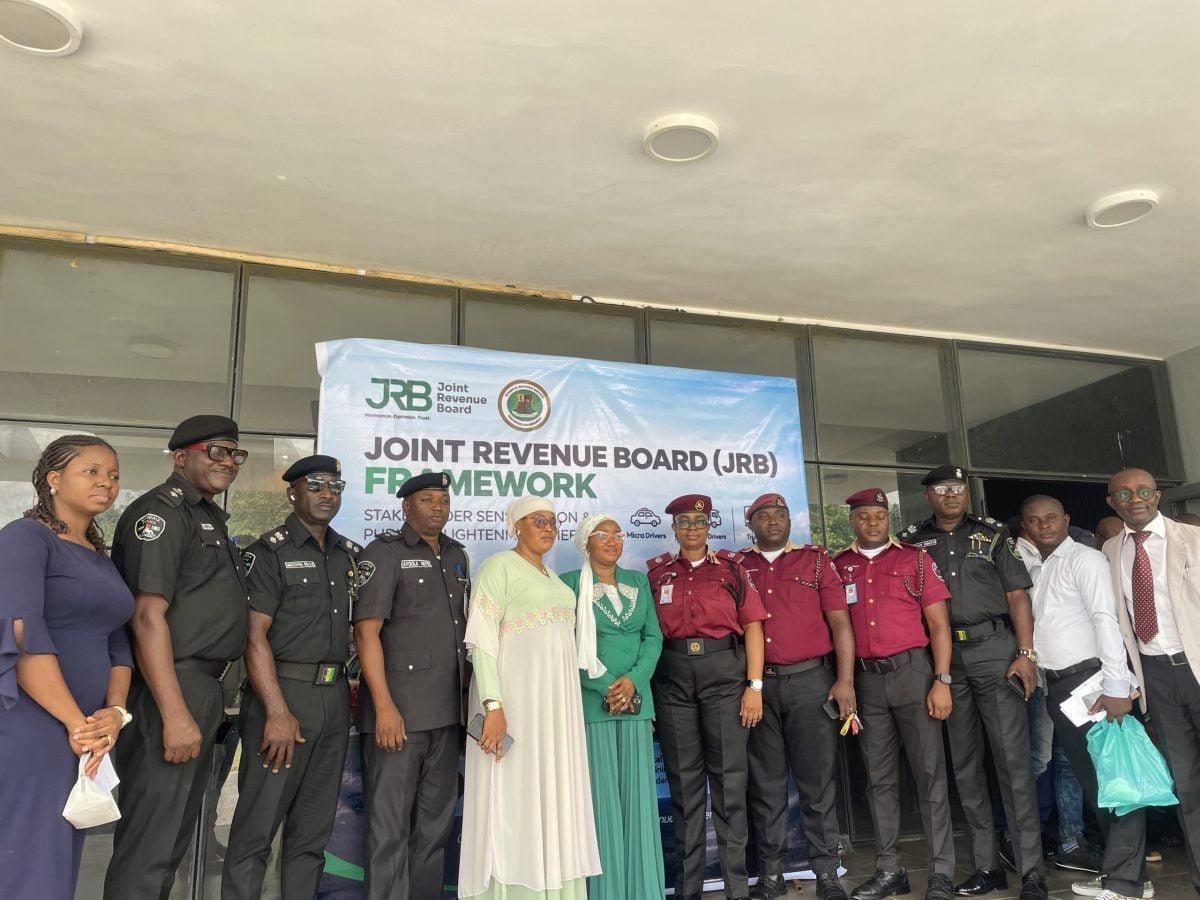
The Oyo State Government on Tuesday held a sensitisation programme for stakeholders in the haulage industry to improve revenue generation, simplify tax collection and enlighten citizens on the new national framework for haulage revenue.
The programme was organised by the Joint Revenue Board (JRB) in collaboration with the Oyo State Internal Revenue Service (OYSIRS) under the administration of Governor Seyi Makinde. It took place at the Local Government Staff Training Hall, State Secretariat, Ibadan.
According to the organisers, the reform became necessary after years of complaints from transporters who made multiple payments on a single journey to different agencies with different receipts. Some reported heavy fines for missing stickers, while others now drive at night to avoid task forces, exposing drivers to robbery and accidents.
Speaking, the Commissioner for Investment, Trade, Cooperatives and Industry, Prof. Salihu Abdulwaheed Adelabu, said the programme is about the entire economic chain.
“The essence of this programme is about the system and the way we drive economic activities in Oyo State and Nigeria as a whole. People think it is just about buying and selling, but it is beyond that. It is about going back to the farm. It is about our farm projects how do you bring them from the farm to the local market, and how do you take them out of Nigeria? When you see trucks moving on our roads from Oyo to Kano, they are carrying tons of goods. That is economic activity,” he said.
ALSO READ: Oyo govt expands micronutrient supplementation to tackle anaemia in pregnancy
He added that Oyo is now ranked third in Nigeria for Ease of Doing Business as a result of such efforts. “All our farm projects, including Fasola, Eruwa, Awe and Oke-Ogun, are transporting produce. We have solid minerals, we have lithium that we are taking from one point to another.”
A representative of the Joint Revenue Board, Abuja, Mr Yusuf Abdullahi, stressed the importance of the E-Tag and single levy. He said the board observed that intrastate movement was often misconceived as interstate, leading to wrongful collections.
“Under the new framework, more than 50 separate state and local government collection items have been consolidated into nine standard heads under a harmonised law, which the JRB reports has been domesticated by 18 State Houses of Assembly. The framework prohibits cash collection and roadblocks for covered revenue transactions.
“Now the Joint Tax Board has found a technical process to digitalise tax collections. Today we have an electronic tag which can be placed on a vehicle to register the vehicle and the driver. This consolidated levy is defined at the point of loading and offloading.
“The consolidated haulage levy is paid once at the point of loading and offloading and replaces the stack of separate haulage tickets. Each vehicle is to carry an E-Tag, a tamper-resistant tag fixed to the windshield that identifies the vehicle and allows electronic verification, making fake tags easy to detect. Payment is through approved digital channels, including mobile applications and POS devices. According to the JRB timetable, tag assignment became compulsory from April 2026, with physical installation from July 2026,” he said.
The Director of Other Taxes, OYSIRS, Jimoh Tiamiyu, said the event was purely to sensitise the public.
“This programme is to let them know what this levy is, the revenue we are collecting and those handling every aspect. There is no sale of emblems and stickers again. They harmonise everything. If you have your tag here in Oyo State, it will be useful anywhere in the state,” he said.
He listed approved consultants which was lead by ITC advisory services,to include Asiwaju Global Resources (E-Tag and Oyo State Control Paper) represented by Alhaja Simibiat Moronke Yahya; Chemiroy Nigeria Ltd for manufactured products; Bay-Hem Interbiz for forest produce; Brown and Caldwell for agricultural produce; and Al-Maruf Investments for scrap metal.
The Director of Produce at the Ministry of Agriculture, Mr Lawal Babatunde, educated participants on haulage involving agricultural produce.
In his keynote address titled “Beyond Revenue Collection”, the Managing Director and Lead Strategist of Hi-Tech Demographic Consulting Services Limited, Adeyemo Olumuyiwa Abimbola, urged the state to embrace digital transformation. Drawing on over three decades in the revenue sector, he said the future of revenue administration depends on systems that are lawful, coordinated, transparent, technology-enabled and humane.
He said every revenue demand must answer three questions: what law establishes it, which institution is authorised to collect it, and what approved procedure governs payment and objections. He stated that roadblocks cannot lawfully be used to collect taxes and that no target or contract can justify them. He cautioned that technology cannot make an unlawful levy lawful, and that combining several charges on one notice is not true harmonisation.
He proposed five priorities for Oyo State, which according to him include a complete legal review of approved revenue items, firm enforcement of the law, faster digital migration, a responsible transition for collection staff, and stronger accountability measured by accuracy of remittances, fewer complaints and public confidence.
The programme was attended by key stakeholders in the haulage industry, representatives of the Nigeria Police Force among others .
WATCH TOP VIDEOS FROM NIGERIAN TRIBUNE TV