

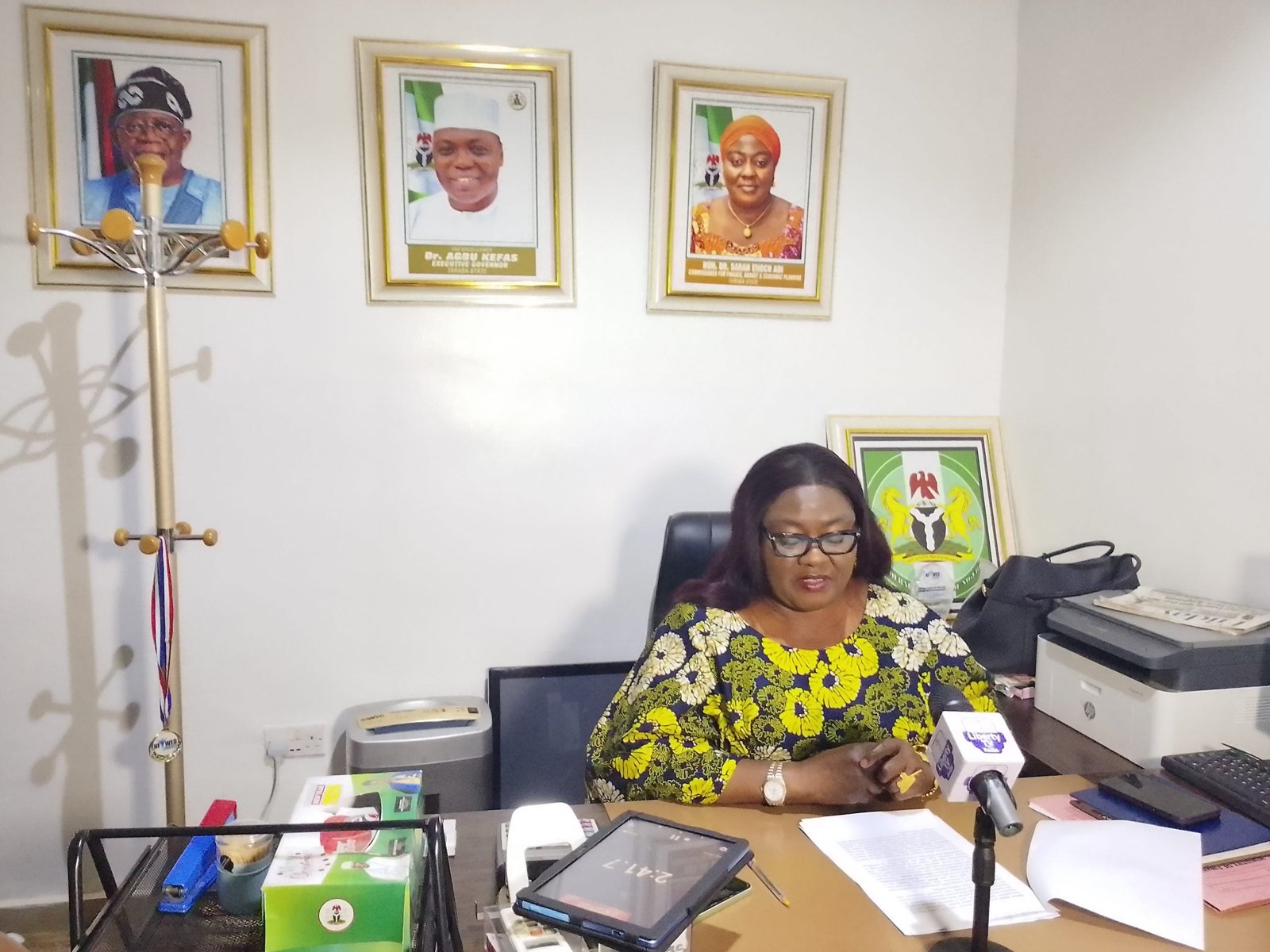
The Taraba State Government has described claims by opposition parties that it currently holds a debt burden of ₦1.2 trillion as fake news.
Dr Serah Adi, the Commissioner for Finance, stated on Sunday in Jalingo that the claims do not reflect the state’s debt stock as reported in the latest records of the Debt Management Office (DMO).
Dr Adi urged Tarabans to disregard the opposition’s claims, describing them as “fake”, misleading and an attempt to attract cheap sympathy ahead of the 2027 elections.
“The claims by opposition parties about the state’s debt profile are fake news. Their reports are blatant lies, misleading and do not reflect the state’s debt stock as reported in the latest records of the Debt Management Office.
“Their claims are a mere attempt to attract cheap sympathy, since they lack facts to criticise the Kefas-led administration.
“I wish to urge Tarabans and all Nigerians to disregard the claims by the opposition that Governor Agbu Kefas’ administration currently has a debt burden of ₦1.2 trillion.
“Under Governor Kefas, the administration is ensuring prudence in all its financial records to ensure that every kobo spent is for the development of the state,” Dr Adi stated.
The commissioner explained that the Kefas administration was instead reducing the state’s debt burden inherited in 2023, contrary to the opposition’s claims.
She disclosed that the state’s domestic debt stock had dropped from ₦87.96 billion to ₦85.51 billion, approximately ₦2.45 billion lower than the figure reported in 2023.
ALSO READ: APC repeating PDP’s mistakes, risks extinction — Hilliard Eta, ex-acting APC chairman
“Available records from the Debt Management Office show that, as of 2023, Taraba State’s domestic debt stock was ₦87.96 billion, while the current data published as of December 31, 2025, showed that the domestic debt stock stood at ₦85.51 billion, approximately ₦2.45 billion lower than the earlier reported figure.
“On the external debt, the Debt Management Office reported that Taraba State’s external debt was approximately US$46.47 million as of December 31, 2022. By December 31, 2025, the state’s external debt stood at approximately US$48.04 million. This represents a relatively modest movement in the state’s external debt position over the period.
“The state government remains conscious of the exchange-rate risks associated with foreign-currency obligations and will continue to ensure that external financing is considered within the limits of fiscal sustainability and repayment capacity.
“I wish to clarify here that in 2023, the Taraba State House of Assembly granted approval for financing facilities of approximately ₦206.78 billion involving Zenith Bank Plc, United Bank for Africa Plc, Fidelity Bank Plc and Keystone Bank.
“The facilities were structured against designated revenue streams, including Federal Account Allocation, Joint Account Allocation Committee proceeds, Value Added Tax receipts and Internally Generated Revenue.
“An important distinction here is that approval or the original facility value is not the same thing as the outstanding liability at a later date. Repayments and restructuring have taken place under the facilities.
“Accordingly, it would be misleading to take the original approved amount of ₦206.78 billion and simply add it in full to the latest DMO debt stock without establishing the amount actually drawn, amounts already repaid and the current outstanding balances.
“The state government has continued to honour its repayment obligations in accordance with the applicable financing arrangements.
“There has also been considerable public discussion about a proposed capital-market financing programme of up to ₦350 billion. I wish to clarify here that Taraba State has not received ₦350 billion from the proposed bond programme. The programme remains subject to applicable regulatory, statutory, market and disclosure processes.
“It is designed as a programme under which financing may be raised in stages, subject to approvals and market conditions. The immediate transaction under consideration is an initial tranche of approximately ₦35 billion.
“It is therefore incorrect to treat the entire ₦350 billion programme size as money already received by the state or as an existing drawn liability.
“On June 26, 2026, the Taraba State Government and the ECOWAS Bank for Investment and Development signed three financing agreements totalling approximately US$268 million.
“The financing package is intended to support:
- Phase I of an integrated industrial park;
- the development of irrigated rice production and processing; and
- the development of a 50-megawatt solar power project in the state,” she continued.
The commissioner cautioned that the signing of a financing agreement must be distinguished from actual disbursement, as the facilities remain subject to applicable conditions precedent, regulatory processes and statutory approvals before drawdown.
“The amounts have not been disbursed and, therefore, should not be represented to the public as money already received and spent by the Taraba State Government.
“The four separate concepts should not be conflated. They are:
Existing debt stock: Liabilities officially recognised and reported as outstanding debt.
Approved facility: An amount authorised for borrowing, which may or may not have been fully drawn.
Outstanding balance: What remains payable after accounting for actual drawdowns, repayments, restructuring and other adjustments.
Proposed or undisbursed financing: Financing arrangements that have not yet translated into funds received by the state.
“It is purely fake news to add the headline values of all these categories together and describe the result as Taraba State’s current debt.
“The Governor Agbu Kefas administration remains guided by three principles: Borrowing must support measurable development.
“Financing undertaken by the state must be linked to productive infrastructure, economic expansion and improvements in the welfare of the people.
“The administration prioritises repayment capacity, which must guide financing decisions. Revenue projections, debt-service obligations and the sustainability of the state’s finances will continue to be considered before new liabilities are assumed.
“I wish to state here that, under Governor Agbu Kefas, transparency and accountability remain essential.
“Government will continue to comply with legislative, regulatory and disclosure requirements applicable to public borrowing and capital-market transactions,” the commissioner clarified.
WATCH TOP VIDEOS FROM NIGERIAN TRIBUNE TV