

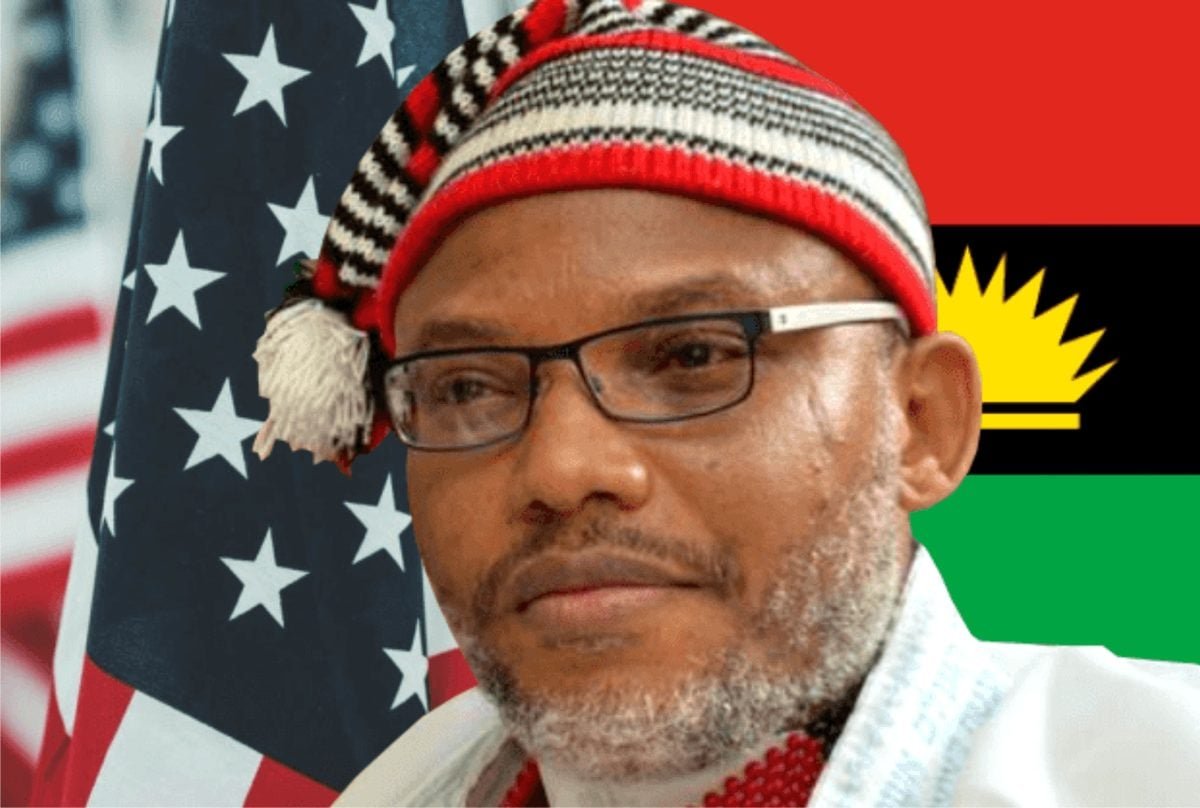
The Leader of the Indigenous People of Biafra (IPOB), Mazi Nnamdi Kanu has declared that the dissolution of the 3rd Administration is constitutionally valid, binding on all IPOB structures worldwide
He maintained that it is not subject to review by any officer, department, or administration within the movement.
The explanation is coming, giving the unnecessary controversy generated among members by the lawful dissolution of the 3rd Administration of the Directorate of State (DOS) by the Supreme Leader of IPOB, Onyendu Mazi Nnamdi Kanu.
In a statement issued by Mazi Nnamdi Kanu, IPOB Leader, through Comrade Emma Powerful the Spokesperson/Media and Publicity Secretary of IPOB, he stated that the 4th Administration of the Directorate of State, headed by Mazi Chris Nwaọgụ, has been duly constituted by the Supreme Leader and is now fully operational.
He directed all IPOB structures worldwide to accord the 4th Administration full recognition and cooperation in the discharge of its responsibilities.
The Spokesperson warned that any individual or group purporting to exercise authority under the dissolved 3rd Administration acts without constitutional authority and outside the framework of IPOB.
According to him such conduct constitutes a disciplinary offence under the Code of Conduct and shall attract appropriate sanctions.
The body therefore call upon all genuine IPOB family members worldwide to remain calm, focused, disciplined, and unwavering in their loyalty to the Constitution of their movement and to the Supreme Leadership of Onyendu Mazi Nnamdi Kanu.
ALSO READ: FG approves N21.2m outbreak response funds for each state
IPOB Spokesperson reminded all IPOB family members worldwide that the IPOB Code of Conduct is the supreme governing instrument of our movement and their Constitution which defines their structure, regulates their conduct, establishes their hierarchy, and binds every member without exception.
He said: “No officer, department, coordinator, representative, or administration exists above the Code of Conduct.The Directorate of State was not the institution that created IPOB.
He explained that the Directorate of State was created by Onyendu Mazi Nnamdi Kanu as an administrative organ of IPOB to assist in the day-to-day management of the movement and to ensure continuity of operations across the world.
Emma Powerful added that DOS derives its existence, authority, and legitimacy from the constitutional authority of the Supreme Leader and the IPOB Code of Conduct and not a sovereign body, no co-equal authority or a self-perpetuating institution.
He said: “An administrative structure created by the Supreme Leader under the Constitution of IPOB cannot lawfully claim independence from the constitutional authority that established it”
He pointed out that to suggest otherwise is to invert the very foundation upon which the Directorate of State was created.
He said that the simple question every IPOB member must ask is this: if Onyendu Mazi Nnamdi Kanu possessed the authority to create the Directorate of State, by what logic does he lack the authority to dissolve, reorganise, or reconstitute it?
According to him, the answer is obvious, stressing that the authority to create necessarily includes the authority to reform, restructure, replace, or dissolve.
He said: “The power to appoint, suspend or dismiss erring Principal officers vest exclusively on the leader of the Indigenous People of Biafra (IPOB) Onyendu Mazi Nnamdi Kanu except and to the extent he clearly and expressly delegates that power to any other principal officer.”
He said: “Once the Supreme Leader exercises the power of appointment, suspension, dismissal, or dissolution, every officer affected by that decision is under an immediate obligation to comply. There is no constitutional mechanism within the IPOB Code of Conduct that permits a dismissed officer to veto, suspend, delay, review, or reject a decision lawfully made by the Supreme Leader pursuant to his exclusive constitutional authority”.
He stated that the moment the dissolution of the 3rd Administration was announced, its tenure came to an end adding that the continued claim to office thereafter ceased to derive from the IPOB Constitution and became a personal act undertaken outside the authority of the movement.
According to him, the issue before IPOB family members worldwide is therefore not whether they agree or disagree with the dissolution. The issue is whether the Constitution of IPOB remains supreme.
The Spokesperson stressed that the movement governed by rules cannot selectively obey its Constitution. The authority of the Code of Conduct must be respected in moments of disagreement no less than in moments of consensus.
He said: “The Code further provides that appointments are temporary and performance-based. Principal officers are appointed for an initial six-month period and may be renewed subject to satisfactory performance. Such appointments are voluntary and carry no salary or financial entitlement. Accordingly, no officer acquires a proprietary interest in any office within IPOB.
He emphasised that the dissolved 3rd Administration appears to have operated under the mistaken belief that its tenure was permanent and that the authority that created it lacked the authority to dissolve it. Nothing could be further from the truth.
He further noted that none of the members of the dissolved 3rd Administration is a founding member of IPOB and none occupied the offices they recently held by right rather they occupied those offices solely by virtue of appointments made under the authority of the Supreme Leader.
He said: “the same authority that appoints, possesses the authority to remove. That is the law of IPOB. That is the Constitution of IPOB’.
The Media and Publicity Secretary said that IPOB is not Nigeria and do not operate according to political ambition, office preservation, factionalism, self-entitlement, or power struggles but rather operate according to rules, discipline and constitutional order.
WATCH TOP VIDEOS FROM NIGERIAN TRIBUNE TV