

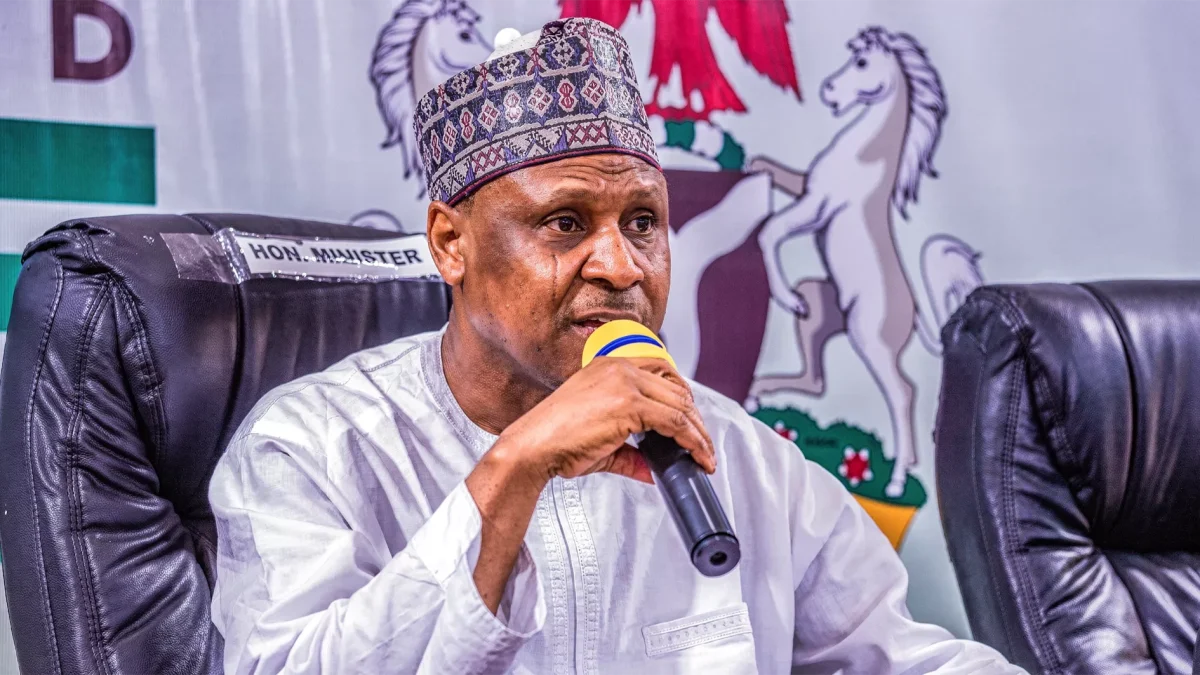
The Minister of Information and National Orientation, Mohammed Idris, has said Nigeria’s economy is on course to grow by more than four per cent in 2026, with inflation declining to about 15 per cent and external reserves rising above $54 billion.
Idris stated this on Monday in Abuja during a media chat with senior editors and journalists at Radio House, where he highlighted the economic, security and social interventions of the Bola Tinubu administration.
He said the government’s economic reforms were beginning to produce measurable results and lay the foundation for sustained growth, while acknowledging that many households continued to face cost-of-living pressures.
According to him, the administration’s priority is to ensure that improved economic indicators translate into more jobs, productive businesses, affordable essential services and increased purchasing power for Nigerians.
“The macroeconomic numbers have turned the corner, and I would ask that we always look at what they mean beyond the headlines,” Idris said.
He disclosed that the economy was projected to grow by more than four per cent in 2026, while Nigeria’s current account surplus increased from $8.6 billion in the first half of 2025 to $12 billion in the corresponding period of 2026.
The minister said inflation had fallen from about 27 per cent in January 2025 to around 15 per cent, although he stressed that the government’s ultimate target remained single-digit inflation.
Idris also said oil theft had declined while crude oil production had increased, generating more revenue for the Federal Government, state governments and local governments.
He disclosed that Nigeria’s external reserves exceeded $54 billion in September, describing the figure as the highest in almost two decades.
He added that the foreign exchange market had stabilised, allowing businesses and investors to plan more confidently for the long term.
The minister further disclosed that Nigeria earned more than $6 billion from non-oil exports in 2025, the highest figure in the country’s history.
He said the earnings benefited businesses and entrepreneurs operating in agriculture, mining, petrochemicals, manufacturing, processing, transportation and logistics.
Idris, however, said the government’s task was to ensure that the macroeconomic recovery was increasingly reflected in the daily lives of Nigerians.
“Our task now is to ensure that this clear macroeconomic recovery is felt even more widely in the lives and households of Nigerians: on the dinner table, in shops and markets, at the petrol station, and in pockets and wallets,” he said.
The minister said infrastructure projects across the country were already creating economic opportunities for contractors, suppliers, engineers, artisans, transporters and food vendors.
He said the government’s four Legacy Projects covered about 3,000 kilometres across the six geopolitical zones, alongside hundreds of other road, rail, port, power, health and education projects.
Idris also highlighted the recently approved N1.5 trillion highway project in Niger State, saying it would strengthen connectivity along an important agricultural and commercial corridor.
On agriculture, he said President Tinubu had placed food security at the centre of national economic policy.
He said government interventions in mechanisation, agricultural inputs, irrigation and financing were aimed at increasing domestic production, improving farmers’ incomes and making food more affordable.
Idris disclosed that the Federal Government had commissioned two additional cancer treatment centres, bringing the number of commissioned centres to five.
He said the government was working towards making a total of 10 oncology centres available to Nigerians.
According to him, the expansion, alongside the revitalisation of primary healthcare, would improve access to treatment and strengthen the country’s healthcare system.
The minister also disclosed that the Presidential CNG and Electric Vehicle Initiative had attracted about $2.5 billion in private investment, in addition to approximately N250 billion in government funding and commitments.
He said more than 120,000 vehicles had been converted, while over 400 certified conversion centres and more than 90 refuelling stations were operational.
Another 180 refuelling stations, he said, were under development. According to Idris, the initiative was not only aimed at providing affordable energy alternatives but was also creating employment and business opportunities.
On education, Idris said the Nigerian Education Loan Fund had supported more than 1.6 million students.
He said NELFUND had paid over N192 billion in fees and N180 billion in upkeep allowances, describing the intervention as significant relief for students, parents and guardians.
He added that the Three Million Technical Talent programme was expanding opportunities for young Nigerians in software development, data science, cybersecurity and other emerging technologies.
Idris said renewed attention to domestic refining, solid minerals, industrial production and innovation was also supporting the government’s economic diversification agenda.
He disclosed that the Federal Government had issued a N758 billion bond to clear pension arrears dating back to 2007, benefiting almost one million pensioners.
Another N1.2 trillion in bonds, he said, had been issued to settle inherited debts owed to power generation and gas companies, with the aim of encouraging new investment in the power sector.
He added that the National Social Register was currently reaching more than 10 million households, while the Consumer Credit Corporation was helping working Nigerians spread the cost of essential purchases.
On national security, Idris said the protection of lives and property remained the first responsibility of government.
He said the administration had strengthened the operational capabilities of the Armed Forces, intelligence services and other security agencies through improved coordination, equipment, logistics and support for frontline personnel.
According to him, security forces had recorded successes against terrorists, bandits, kidnappers and other criminal elements in several theatres of operation.
He said terrorist commanders and criminal kingpins had been neutralised, insurgent networks disrupted, hostages rescued and criminal enclaves dismantled.
The minister also linked intensified operations against crude oil theft, illegal refining and pipeline vandalism in the Niger Delta to increased oil production and the protection of national revenue.
However, Idris acknowledged that serious security challenges persisted in some parts of the country.
“Every incident of terrorism, banditry, kidnapping or communal violence is a matter of grave concern to the President and the Federal Government,” he said.
He assured Nigerians that the government would continue investing in personnel, technology, intelligence and operational capabilities to secure vulnerable communities.
“The security of Nigerians is not negotiable,” Idris said.
The minister also called on state and local governments to take greater responsibility for services under their jurisdiction.
He said the Tinubu administration had sought to strengthen subnational governments through increased fiscal transfers, efforts to secure local government autonomy, proposals for state police and electricity reforms.
Idris noted that services such as urban transport, schools, primary healthcare and waste management largely fell under the responsibility of state and local governments.
He cited a recent World Bank report which, he said, showed that combined capital expenditure by states increased by 151 per cent in real terms between 2023 and 2025.
He urged Nigerians and the media to hold all three tiers of government accountable for their responsibilities.
Addressing concerns over rising fuel prices, Idris said the government was conscious of the pressure higher energy costs were placing on households, businesses and the wider economy.
He said the administration remained committed to its economic reforms while pursuing affordable energy alternatives, increased domestic production and measures aimed at achieving sustainable reductions in the cost of living.
“The President is fully conscious of the challenges Nigerians face, and his Administration remains determined to ensure that the benefits of economic recovery translate into greater affordability, improved purchasing power and better living conditions for our people,” he said.
Idris said the achievements of the Renewed Hope Agenda were evident across the administration’s eight priority areas, including economic growth, national security, agriculture and food security, energy and natural resources, infrastructure and transportation, education and healthcare, industrialisation and innovation, and governance.
He described the initiatives as an interconnected programme of national transformation rather than isolated achievements.
The minister also urged the media to continue scrutinising the government, saying such scrutiny was necessary for accountability and improved governance.
He, however, appealed for greater context in reporting government policies and national challenges.
“We are not asking you to stop scrutinising government. Your scrutiny makes us better. What I ask for is clarity and context: that the pressures Nigerians feel are reported alongside their causes, the progress being made and the work that remains,” Idris said.
WATCH TOP VIDEOS FROM NIGERIAN TRIBUNE TV