

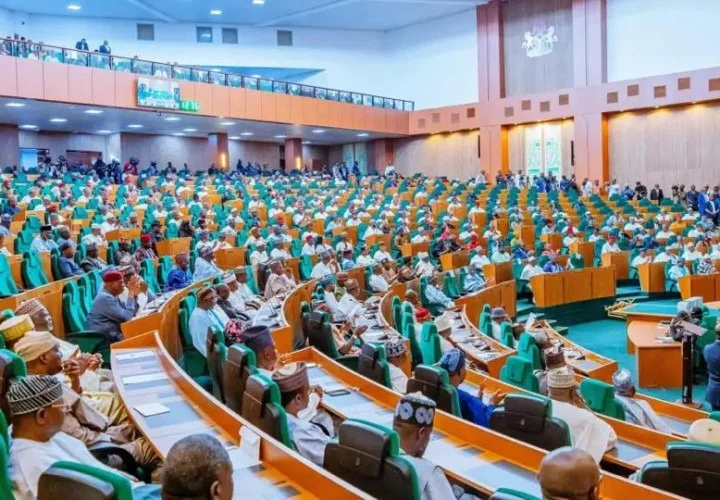
A bipartisan group of members of the House of Representatives has raised the alarm over what it described as the “nosediving” of Nigeria’s democracy, citing alleged constitutional breaches, persistent budget under-implementation, opaque public expenditure, worsening insecurity and growing economic hardship.
The lawmakers, under the platform of the Save Democracy Group, called on the leadership of the National Assembly to immediately reconvene both chambers for an emergency session to address what they described as mounting threats to constitutional governance and public accountability.
The group said the National Assembly could no longer remain away from plenary while critical questions surrounding the economy, security, public expenditure and the rule of law remained unresolved.
“Nigeria’s democracy is nosediving, and silence in the face of repeated constitutional violations and institutional failures can no longer be justified,” the lawmakers said in a statement on Friday, signed on their behalf by Awaji-Inombek Abiante, leader of the group, and two others.
The group, which described itself as a bipartisan platform of members of the 10th National Assembly committed to constitutional governance, legislative independence, accountability and the rule of law, stressed that it was neither an opposition platform nor an instrument of any political interest.
The lawmakers accused public institutions of increasingly subordinating constitutional procedures, due process and citizens’ welfare to political convenience.
A major concern raised by the group was the manner in which it said some constitutional and legislative procedures had been handled in recent months.
The lawmakers cited the National Assembly’s approval of the declaration of a state of emergency in Rivers State in March 2025, alleging that voice votes were used despite the constitutional requirement for a two-thirds majority of all members of each chamber.
They also questioned the reported passage of the Executive State Police Constitutional Alteration Bill by the House on July 23, 2026.
According to the group, although the Speaker announced that 311 members voted in favour of the bill, some lawmakers who were present during the proceedings disputed the figure, arguing that fewer than the constitutionally required number of members were physically present in the chamber when the bill was considered.
The group also alleged that votes transmitted through WhatsApp by members who were absent from the chamber were included in the announced tally.
“The Constitution cannot be altered by presumption, improvisation or undisclosed voting arrangements,” they said.
The lawmakers acknowledged that state police could be a desirable reform but insisted that any constitutional alteration establishing it must follow the procedure prescribed by law.
“State police may be desirable, but a desirable reform must still be established through a lawful process,” the group argued.
The lawmakers also accused the Federal Government of persistently failing to fully implement annual Appropriation Acts, describing repeated budget extensions, rollovers and delays in capital releases as a breakdown of fiscal governance.
They said the 2024, 2025 and 2026 budget cycles had been affected by delays in capital implementation and cited government indications that only about 30 per cent of the 2025 capital budget would be funded, with the remainder carried into 2026.
“Appropriation Acts are not campaign promises, policy suggestions or ceremonial documents. They are laws passed by the National Assembly and assented to by the President,” they stated.
The group demanded comprehensive implementation reports for the 2024, 2025 and 2026 budgets, full disclosure of capital releases to Ministries, Departments and Agencies, reconciliation of government revenues against authorised expenditure, and an explanation for the failure to release appropriated funds.
It also called for a joint parliamentary investigation into chronic under-implementation and appropriate constitutional action where deliberate or unjustifiable non-implementation is established.
The lawmakers referenced comments attributed to Senate Chief Whip, Senator Mohammed Monguno, that the failure to implement an Appropriation Act could amount to an impeachable offence, saying they agreed that persistent refusal to implement duly enacted budgets raised serious constitutional questions.
The group further demanded an independent forensic audit of alleged public expenditure not captured in approved budgets.
The lawmakers cited reports they attributed to the International Monetary Fund, claiming that about two per cent of Nigeria’s Gross Domestic Product, estimated at approximately ₦8.83tn, was not reflected in recent official budgets.
They stressed that the allegation should be subjected to proper investigation rather than settled through political statements or denials.
“Every naira spent by the government belongs to the Nigerian people,” the lawmakers said, demanding that those entrusted with public funds account for how the money was appropriated, released, expended and utilised.
They warned that budgetary opacity was not merely an accounting issue but a threat to constitutional government, public confidence and the country’s economic stability.
The group also raised concerns over the worsening security situation and what it described as inadequate capital funding for some security agencies.
It cited budget performance reports indicating that about ₦20.27bn, representing nearly the entire budgetary provision for the Presidential Air Fleet, had been released, while only a small fraction of the Nigerian Army’s allocation for security equipment was reportedly made available during the period under review.
“The question is not whether the Presidential Air Fleet should be maintained. The question is why the comfort and mobility of public officials should receive more predictable funding than the equipment, logistics, operational vehicles, aircraft maintenance and protective resources required by personnel confronting terrorists and bandits,” the lawmakers said.
They called for the immediate release of duly appropriated capital funds to the Armed Forces, the Nigeria Police Force, intelligence institutions and other security agencies.
The lawmakers also commended the Catholic Bishops’ Conference of Nigeria for speaking out on insecurity, economic hardship, democratic decline and concerns over emerging one-party dominance.
They similarly praised the Supreme Council for Shari’ah in Nigeria for calling for broader consultation and national consensus before the establishment of state police.
According to the group, the interventions demonstrated that criticism of government policies should not be treated as hostility.
“Constructive criticism is not hostility to government. It is a democratic duty,” the lawmakers said.
They urged the Federal Government to listen to concerns raised by religious and civic leaders rather than dismissing them.
The lawmakers’ most immediate demand was for the Senate and House of Representatives to return to plenary for an emergency session.
They urged Senate President Godswill Akpabio and House Speaker Tajudeen Abbas to reconvene the two chambers to consider the budget implementation crisis, the controversy surrounding the Executive State Police Constitutional Alteration Bill, alleged off-budget expenditure, inadequate security funding and the deteriorating security situation.
“The National Assembly is not merely an institution for passing executive bills and approving requests from the presidency,” the group argued.
“It is an independent arm of government, constitutionally empowered to represent the people, defend the Constitution, appropriate public funds, conduct oversight and hold the executive accountable,” it added.
The group insisted that its position should not be interpreted as opposition to state police, economic reforms or legitimate government spending.
“We are opposed to unconstitutional procedures, legislative shortcuts, unimplemented budgets, opaque expenditure and the continuing failure to protect the Nigerian people,” it said.
The lawmakers warned that the 10th National Assembly would ultimately be judged by how it responds to the current challenges.
“Nigeria’s democracy must be protected before it is too late,” they declared.
The statement was signed on behalf of the group by Abiante (PDP, Bayelsa); Abubakar Kusada (APC, Katsina); and Mansur Jega (ADC, Kebbi).