

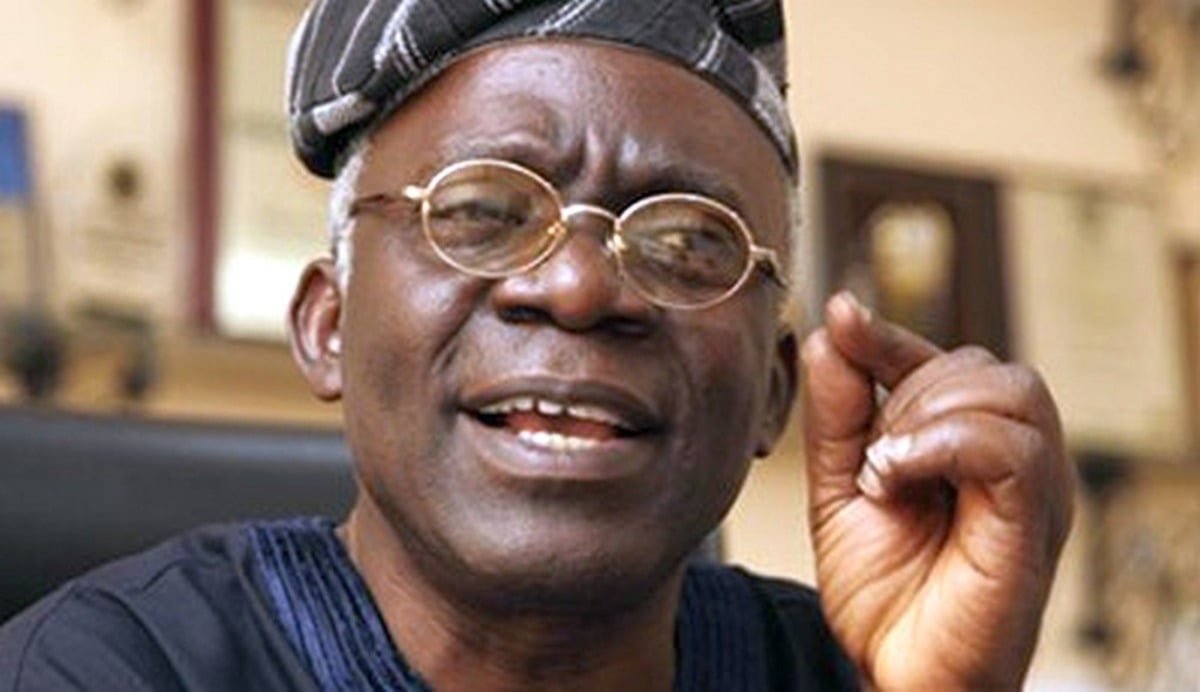
A Senior Advocate of Nigeria (SAN) and human rights lawyer, Femi Falana, on Thursday identified irregularities in the conduct of political party primaries, vote-buying, abuse of state resources, widespread poverty and oppression as major factors undermining electoral integrity in Nigeria’s democratic process.
The legal luminary disclosed this while delivering his keynote address at the 8th Annual Anniversary Lecture of Penpushing Media, with the theme, “Restoring Electoral Integrity: The Path to Good Governance and Public Accountability”, held in Abeokuta, the Ogun State capital.
He posited that Nigeria would continue to struggle to achieve credible elections and genuine democracy until political parties conducted transparent primaries and complied with electoral laws.
The event was chaired by the former Deputy Governor of the Central Bank of Nigeria, Mr Tunde Lemo, and attended by the Osile of Oke Ona Egba, Oba Dr Adedapo Tejuoso; the Olowu of Owu, Oba Professor Saka Matemilola; the Ogun State Governor, represented by his Special Adviser, Hon Kayode Akinmade; the senatorial candidate of the Peoples Democratic Party in Ogun Central, Professor Iyabo Obasanjo; among other eminent Nigerians from all walks of life.
The legal icon argued that democracy had no meaning to millions of Nigerians in the face of security challenges, human rights violations and injustice, among other issues.
He maintained that electoral integrity must begin with transparent political party primaries, lamenting that many parties collected huge nomination fees from aspirants only to impose candidates under the guise of consensus.
Falana said, “For the majority of our people, democracy has become totally irrelevant to their lives. We gather to talk about democracy, but which democracy are we talking about?”
“You cannot talk about electoral integrity when aspirants are prevented from participating in primaries and candidates are imposed. We heard that one aspirant was not allowed into the venue before a consensus candidate was announced in a state in the country.”
He noted that what was being practised in Nigeria was no longer democracy but plutocracy — that is, government of the rich, by the rich and for the rich.
Falana cited recent revelations by the Chairman of the Economic and Financial Crimes Commission (EFCC), Olanipekun Olukoyede, that some governorship aspirants allegedly spent between ₦20 billion and ₦30 billion to secure party tickets.
While condemning the increasing incidence of vote-buying, he described it as a criminal offence that had become normalised.
“If someone spends between ₦20 billion and ₦30 billion on party primaries, imagine what will be spent during the general election. Such money cannot come from legitimate sources.
“Those who manipulate elections and buy votes are celebrated instead of being prosecuted, even though the Electoral Act clearly criminalises such acts,” he said.
He also criticised political parties for violating provisions of the Electoral Act by embarking on campaigns long before the legally approved period.
Falana blamed the worsening poverty across the country for making many voters vulnerable to inducement during elections.
Quoting figures from the National Bureau of Statistics (NBS), he said more than 133 million Nigerians were multidimensionally poor, adding that the figure could rise further.
“Electoral integrity means little to people who do not know where their next meal will come from. When politicians offer them money to vote, they are compelled by hunger to accept,” he said.
The Founder of Penpushing Media, Dimeji Kayode-Adedeji, said the media outfit had, over the years, remained committed to the promotion and growth of journalism in the country, being the first online newspaper in Abeokuta.
He said the annual lecture had recorded many successes and therefore renewed the commitment of the media platform to national development.
The Chairperson of the anniversary committee, Dr Abiola Akiyode-Afolabi, said the theme was carefully selected to address certain issues as the nation approached the next election period.
She emphasised that the media platform remained committed to authentic journalism and would continue to be at the forefront of discussions on national issues.
Oba Professor Matemilola, in his goodwill message, lauded the media platform for standing on the side of truth, lending his voice to that of the legal advocate that there could be no public accountability when the integrity of the electoral process was questionable.
The monarch stressed the need for citizens’ participation in the electoral process to ensure that they were not short-changed in governance.
The former Ambassador to the Netherlands and Chairman of African Newspapers of Nigeria PLC, publishers of the Tribune titles, Dr Olatokunbo Awolowo, who was the Mother of the Day at the event, stressed that restoring electoral integrity was fundamental to achieving good governance, public accountability and sustaining Nigeria’s democracy.
Awolowo-Dosumu, represented by the Editor of Sunday Tribune, Mr Sina Oladehinde, commended the organisers for sustaining a platform that promoted robust public discourse and encouraged reflection on issues shaping the nation’s democratic future.
She described the theme of the lecture as timely, noting that it addressed one of the greatest challenges confronting Nigeria’s democratic process. She said elections were not mere political exercises conducted periodically but the constitutional expression of the sovereignty of the people, making their integrity essential to the legitimacy of governments and the stability of the nation.
She emphasised that good governance and public accountability began with credible elections whose outcomes inspired public confidence, rather than after governments had been inaugurated.
Awolowo-Dosumu expressed optimism that the lecture would move beyond identifying problems to generating practical solutions capable of strengthening democratic institutions and renewing citizens’ commitment to democratic ideals.
WATCH TOP VIDEOS FROM NIGERIAN TRIBUNE TV