

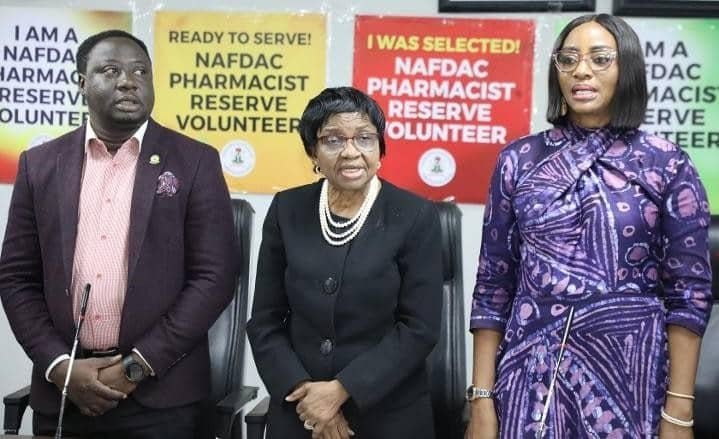
The National Agency for Food and Drug Administration and Control (NAFDAC) is creating a 600-member national reserve of pharmacists to extend regulatory enforcement beyond its traditional offices and respond quickly to fake-drug and public-health emergencies across Nigeria.
Sayo Akintola, NAFDAC’s Resident Media Consultant, disclosed this in a statement on the inauguration of the Agency’s Pharmacists Reserve Volunteer Programme (PRVP), which brings together qualified pharmacists already working in different fields.
The volunteers were drawn from the 36 states of the federation and the Federal Capital Territory, representing the country’s six geopolitical zones.
According to Akintola, the programme is designed to provide NAFDAC with a pool of trained, vetted, and readily deployable pharmacists who can support regulatory operations during product recalls, suspected circulation of falsified medicines, and emergencies in hard-to-reach communities.
The Director-General of NAFDAC, Prof. Mojisola Adeyeye, who inaugurated the programme and administered the oath of allegiance to the volunteers, said the initiative was part of efforts to bring regulation closer to Nigerians.
She said the volunteers would be trained in pharmacovigilance, compliance monitoring, quality assurance, data collection, post-marketing surveillance, and public sensitisation.
Adeyeye said NAFDAC’s long-term goal was to establish a standing pool of trained pharmacists in every state to work alongside the Agency’s state offices.
She said this would extend the Agency’s regulatory presence beyond its laboratories and ports of entry to markets, community pharmacies, patent and proprietary medicine stores, and primary healthcare centres.
“Regulation that lives only in the capital cannot protect a nation of more than two hundred million people. The Programme is how we take regulation to the doorstep of the Nigerian people,” she said.
The Director-General urged NAFDAC directors and state coordinators to take ownership of the volunteers by mentoring them and deploying them meaningfully to strengthen regulatory activities at the state and community levels.
She also charged the pharmacists to maintain integrity, discipline, and confidentiality, warning that they would encounter inducements and pressures designed to compromise their duties.
“The moment a regulator can be bought, the public loses its only protection,” Adeyeye said.
She stressed that information obtained during inspections and investigations belonged to NAFDAC and the Nigerian people and should not be disclosed on social media.
Adeyeye also urged the volunteers to take their training seriously, study regulatory guidelines, document their work properly, and respect the communities they would serve.
“You will enter markets, pharmacies, and health facilities as ambassadors of NAFDAC and of the pharmacy profession. Conduct yourselves accordingly,” she said.
The Director-General said the pharmacists will also gain practical experience in medicines regulation, including pharmacovigilance reporting, laboratory awareness, risk communication, and enforcement procedures.
She said their service would be formally documented through certification and letters of service that could strengthen their professional standing before employers, licensing bodies, and postgraduate institutions in Nigeria and abroad.
The Coordinator of the PRVP and Director of Narcotics and Controlled Substances, Dr Momodu Omamegbe Rametu, said the programme had grown from a call for expressions of interest issued a few weeks earlier into a national pool of 600 pharmacists.
Rametu described the PRVP as an organised reserve system designed to provide additional manpower and specialised support during emergencies, while also increasing citizen participation in regulatory activities, post-marketing surveillance, and drug demand reduction campaigns.
Also speaking, the coordinator of the NAFDAC Training School, Dr Tunde Sigbeku, said the volunteers would receive online training on the Agency’s operations and regulatory responsibilities.
He listed the areas of training to include post-marketing surveillance, pharmacovigilance, prevention of antimicrobial resistance through appropriate use of medicines, veterinary medicines, inspection and enforcement, narcotics and controlled substances, drug abuse prevention, and research.
Sigbeku commended Adeyeye for establishing what he described as the Agency’s first national reserve of pharmacists to provide additional support in the fight against fake and substandard medicines.
WATCH TOP VIDEOS FROM NIGERIAN TRIBUNE TV