

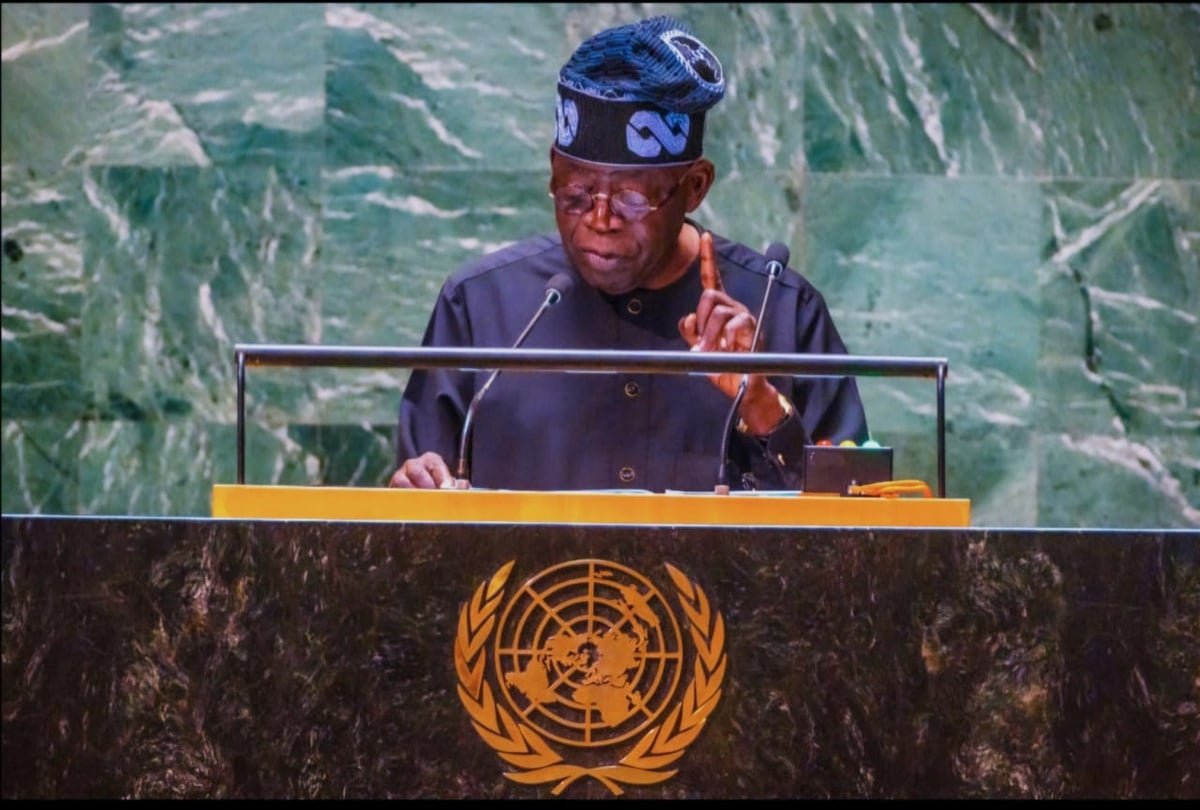
President Bola Ahmed Tinubu has said the economic struggles facing some Nigerian families did not begin with his administration, arguing that the hardship was the result of problems that accumulated over several decades.
Tinubu made the assertion in his Independence Day address to Nigerians, where he acknowledged that millions of citizens still struggle to afford food, school fees, medical bills and transportation.
The president said these difficulties were rooted in years of low productivity, inadequate infrastructure, limited opportunities and institutional weaknesses, rather than being created by the economic reforms introduced by his administration.
According to him, the government could not reverse in four years problems that had accumulated over generations, but it could change the country’s economic direction and create conditions capable of lifting more Nigerians out of poverty.
Tinubu said his administration was therefore combining economic reforms with measures designed to support vulnerable citizens, including strengthening direct assistance to poorer households and improving the National Social Register to ensure support reaches people who need it.
He also highlighted the Nigerian Education Loan Fund, saying it was intended to help students from low-income families pursue higher education despite their parents’ inability to pay tuition.
The president pointed to CREDICORP’s consumer credit scheme as another measure aimed at helping working Nigerians acquire essential assets, including vehicles, solar systems and digital devices without having to save for years before making such purchases.
Tinubu said the government was also working with state and local governments to strengthen primary healthcare, basic education and other essential public services relied upon by poorer Nigerians.
He maintained that the economic reforms introduced since he assumed office in 2023 had been necessary to address longstanding weaknesses in the economy.
By 2023, he said, poverty was rising and the country faced severe economic challenges, leaving the government with little choice but to implement difficult reforms.
Tinubu said the reforms had since produced what he described as measurable improvements, including economic growth of more than four per cent in 2026, lower inflation from its peak, rebuilt foreign reserves and greater stability in the foreign exchange market.
He also said Nigeria recorded more than $6 billion in non-oil export revenue in 2025, describing it as the highest in the country’s history.
The president said the government had now moved beyond the initial phase of economic correction and was focusing on translating the reforms into broader prosperity.
He identified lowering the cost of living as a major priority, with the government seeking to reduce production and transportation costs through agricultural mechanisation, irrigation, improved access to seeds and fertiliser, storage facilities and better transport infrastructure.
Tinubu also said the administration would focus on job creation and industrial expansion by using Nigeria’s gas resources to power industries, reviving factories, expanding digital connectivity and developing skills demanded by employers.
He said Nigeria’s large youth population should become a source of economic production and opportunity rather than despair.
The president further said the government would continue investing in roads, railways and ports to connect farms and factories with markets, arguing that lower production and distribution costs would eventually reduce prices for consumers.
Tinubu said the ultimate goal was to create an economy in which farmers could earn better incomes, businesses could access reliable power and credit, young people could find productive employment, and Nigerian companies could compete in global markets.
He acknowledged that poverty reduction would take time and require sustained economic growth and the creation of millions of productive opportunities.
Tinubu declared that Nigeria had moved beyond the reform phase and entered what he described as an era of prosperity, urging Nigerians to look ahead rather than return to the economic practices he said had contributed to the country’s longstanding challenges.
The statement partly reads, “I am also conscious that millions of our fellow citizens cannot wait for tomorrow. Some Nigerian families still struggle today for the next meal, the next school fee, the next medical bill, or simply enough money to get to work. Their circumstances did not begin with the reforms of the last three years. Their struggle is the accumulated consequence of decades of low productivity, inadequate infrastructure, insufficient opportunity and institutions that too often failed those who needed them most.
“We cannot erase in four years what accumulated over generations. But we can change its course. We can build an economy that steadily lifts people out of poverty while ensuring that those who remain vulnerable are not abandoned along the way.
“That is why we are strengthening direct support for the poorest households and improving the National Social Register so that assistance reaches those who genuinely need it.”
WATCH TOP VIDEOS FROM NIGERIAN TRIBUNE TV