

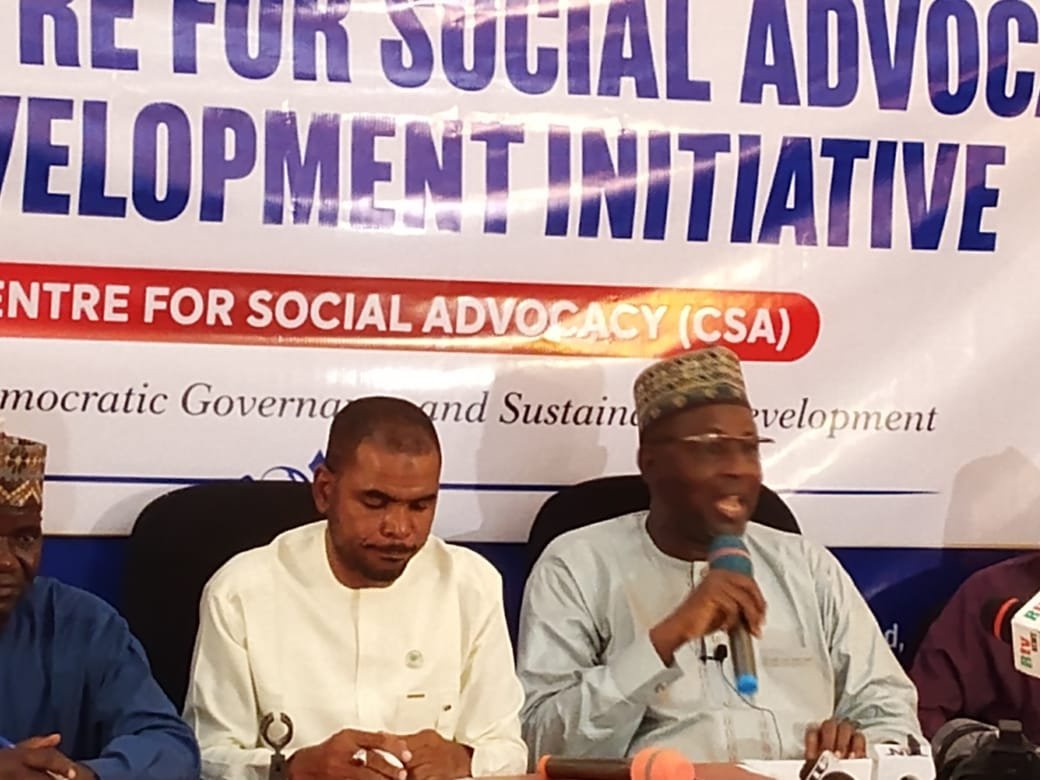
The Aminchi Centre for Social Advocacy and Community Development on Wednesday criticized the 14-day ultimatum issued by the Muslim Rights Concern (MURIC) to the Minister of Defence, Gen. Christopher Gwabin Musa (rtd), over the worsening insecurity in Sokoto State.
MURIC, through its Executive Director, Prof. Ishaq Akintola, had demanded that the Defence Minister “stop the killings” in Sokoto within 14 days or resign.
Reacting in a statement titled “MURIC’s 14-Day Ultimatum: A Call for Responsibility, Not Scapegoating,” the Chairman and CEO of the Aminchi Centre, Brahim Abdullahi Shuni, said while MURIC had every right to demand protection for Nigerians, its decision to single out the Defence Minister failed to recognise the country’s constitutional and institutional security structure.
Shuni said the Federal Ministry of Defence was a complex institution involving civilian administrative structures, Defence Headquarters, the Nigerian Army, Nigerian Navy, Nigerian Air Force, and other defence institutions.
He argued that it was therefore misleading to portray the Minister as personally commanding every soldier or having the unilateral power to prevent every attack across the country.
“National security is a system. It requires the coordinated efforts of the Presidency, Armed Forces, Police, intelligence agencies, state governments, local governments, traditional institutions, communities and citizens,” he said.
According to him, the Minister of Defence is responsible for defence policy, strategic direction, oversight, resource mobilisation, procurement, administration, welfare, and institutional coordination, but is not the Commander-in-Chief of the Armed Forces.
He cited Section 218 of the 1999 Constitution, which, according to the statement, vests the President, as Commander-in-Chief, with the power to determine the operational use of the Armed Forces and to appoint the Chief of Defence Staff and Service Chiefs.
Shuni said the responsibility for tackling insecurity should consequently not be reduced to one individual.
He also challenged MURIC and other civil society organisations to complement their criticism of the government with concrete contributions towards addressing insecurity.
“Criticism must be accompanied by constructive responsibility,” he said, asking what intelligence MURIC had supplied to security agencies, how many criminal networks it had helped expose, and how many communities it had mobilised for early-warning mechanisms.
The group also questioned why MURIC’s ultimatum was directed solely at the Defence Minister rather than the broader security architecture, including the President, Service Chiefs, police, intelligence agencies, state government, local governments, community leaders, and citizens.
“If MURIC genuinely believes that insecurity is a national emergency, then the answer cannot logically be to isolate one member of a much larger security architecture and threaten him with resignation,” Shuni said.
He warned that such an approach could turn a national security crisis into “a political or personality contest.”
ALSO READ: 2027: NASFAT charges politicians on accountability, peaceful campaigns
However, the Aminchi Centre stressed that its position should not be interpreted as opposition to accountability.
Shuni said the Defence Minister, Armed Forces, and other security agencies must be held accountable for responsibilities legally assigned to them, but insisted that such accountability should be based on law, facts, institutional responsibility, and measurable performance.
He also described MURIC’s demand that Sokoto become “impregnable and unassailable” within 14 days as unrealistic.
“No serious security professional can responsibly guarantee that no terrorist, bandit or criminal will ever attack a particular location within a specified period,” he said.
Instead, he said security performance should be assessed by improvements in intelligence gathering, prevention of attacks, degradation of criminal networks, rescue of victims, protection of vulnerable communities, prosecution of offenders, and strengthening of the national security architecture.
The organisation called on MURIC to consider constructive engagement with the Ministry of Defence and other security institutions, including supporting community intelligence, early-warning systems, cooperation between religious leaders and security agencies, victim support, and efforts to discourage the recruitment and glorification of criminals.
Shuni further defended Gen. Musa, describing him as “a son of the soil of the seat of the Caliphate” who spent much of his early life in the area and had contributed to community development.
He said the appropriate response to insecurity was stronger intelligence, better coordination, adequate resources, effective leadership, professional military operations, community cooperation, responsible governance, and citizen participation.
“General Christopher Gwabin Musa should therefore be judged on the responsibilities assigned to his office, the resources available to him, the constitutional chain of command and measurable results—not on an artificial 14-day ultimatum issued by a civil society organisation,” he said.
The centre also maintained that MURIC was entitled to express its opinion but lacked the constitutional authority to determine the tenure of a federal minister.
According to Shuni, the appointment and removal of ministers remain matters for the President and the constitutional processes of the Federal Republic of Nigeria.
He concluded by urging Nigerians to shift the debate from blame to collective responsibility.
“The real challenge before all Nigerians is therefore not ‘Who should we blame?’ It is ‘What can each of us do to help Nigeria defeat terrorism, banditry, kidnapping and violent crime?’”
“Security is everybody’s business,” he added.
WATCH TOP VIDEOS FROM NIGERIAN TRIBUNE TV