

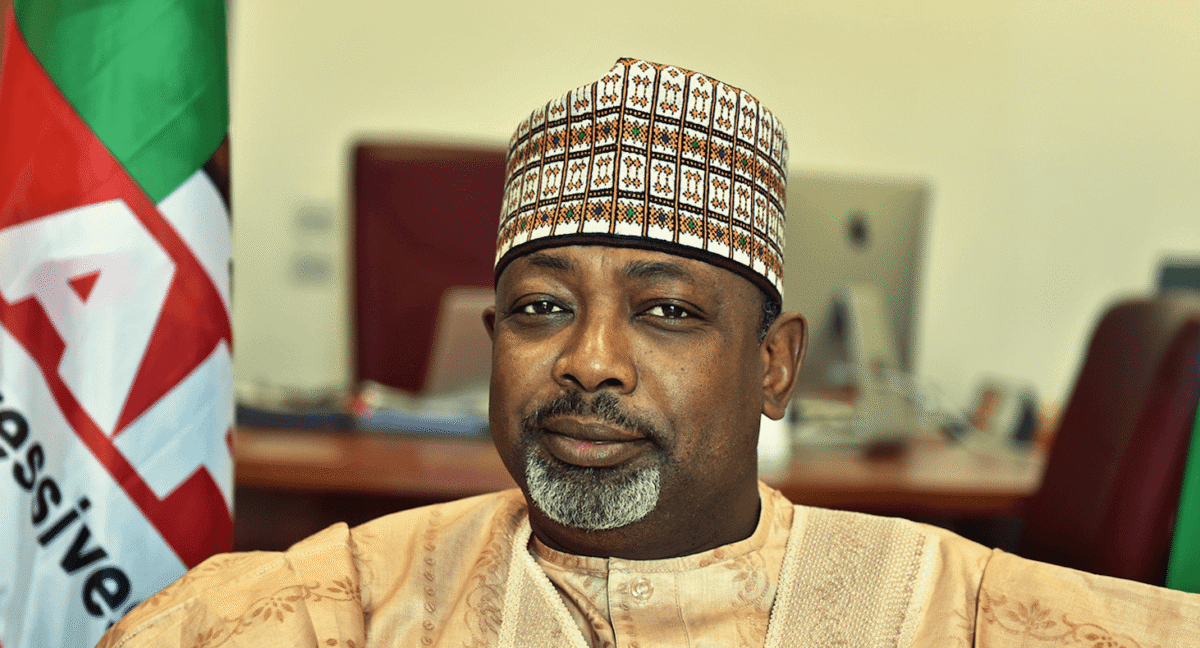
Nigeria’s Minister of Agriculture and Food Security, Senator Abubakar Kyari, has commended the National Agricultural Development Fund (NADF) for its strategic role in advancing the Federal Government’s agricultural mechanisation programme and building the technical capacity required to sustain it.
Kyari spoke at a side event of the 2026 Africa Food Systems Forum (AFSF) in Kigali, Rwanda, attended by the Executive Secretary of NADF, Mohammed Ibrahim.
The event, organised by Heifer International and the Mastercard Foundation, brought together stakeholders to discuss sustainable agricultural mechanisation and strategies for building resilient food systems across Africa.
The Minister said NADF is complementing the Federal Government’s mechanisation drive through the training of 4,000 tractor operators and mechanics, providing the skilled manpower needed to operate, maintain and sustain agricultural machinery being deployed across the country.
“Our shared objective is not simply to put more tractors in the field, but to build a sustainable system of finance, utilisation, maintenance, skills and accountability around them,” Kyari said.
The Federal Government’s mechanisation programme involves the deployment of 2,000 tractors and more than 9,000 agricultural implements and spare parts through a service-provider model designed to expand farmers’ access to mechanisation while ensuring sustainability, efficiency and proper asset management.
Kyari stressed that sustainable mechanisation must go beyond the procurement and distribution of equipment, noting that its long-term impact would depend on appropriate financing, effective utilisation, maintenance systems, skilled operators and strong accountability.
He also highlighted broader Federal Government interventions to boost food production and strengthen resilience, including investments in irrigation, dry-season farming, climate-smart agriculture, soil health and support for displaced farmers returning to agricultural production.
The Minister called for greater private-sector investment and stronger partnerships across the agricultural value chain, saying government must continue to create the conditions necessary for capital to flow into production, processing, technology, logistics and markets.
According to him, Nigeria’s growing population should be viewed not only as a food-security challenge but also as a major economic opportunity, particularly given the country’s youthful workforce, expanding domestic market and vast agricultural potential.
Kyari said unlocking that potential would require stronger alignment between public investment, private capital, technology, infrastructure and human capacity.
He maintained that building a resilient and competitive food system ultimately requires bringing “land, water, technology, finance and markets together” within a coordinated framework capable of withstanding shocks, raising productivity and delivering sustainable prosperity.
NADF’s investment in developing skilled tractor operators and mechanics forms a critical part of a coordinated framework, ensuring that Nigeria’s mechanisation drive translates into lasting improvements in productivity, employment and food security.
WATCH TOP VIDEOS FROM NIGERIAN TRIBUNE TV