

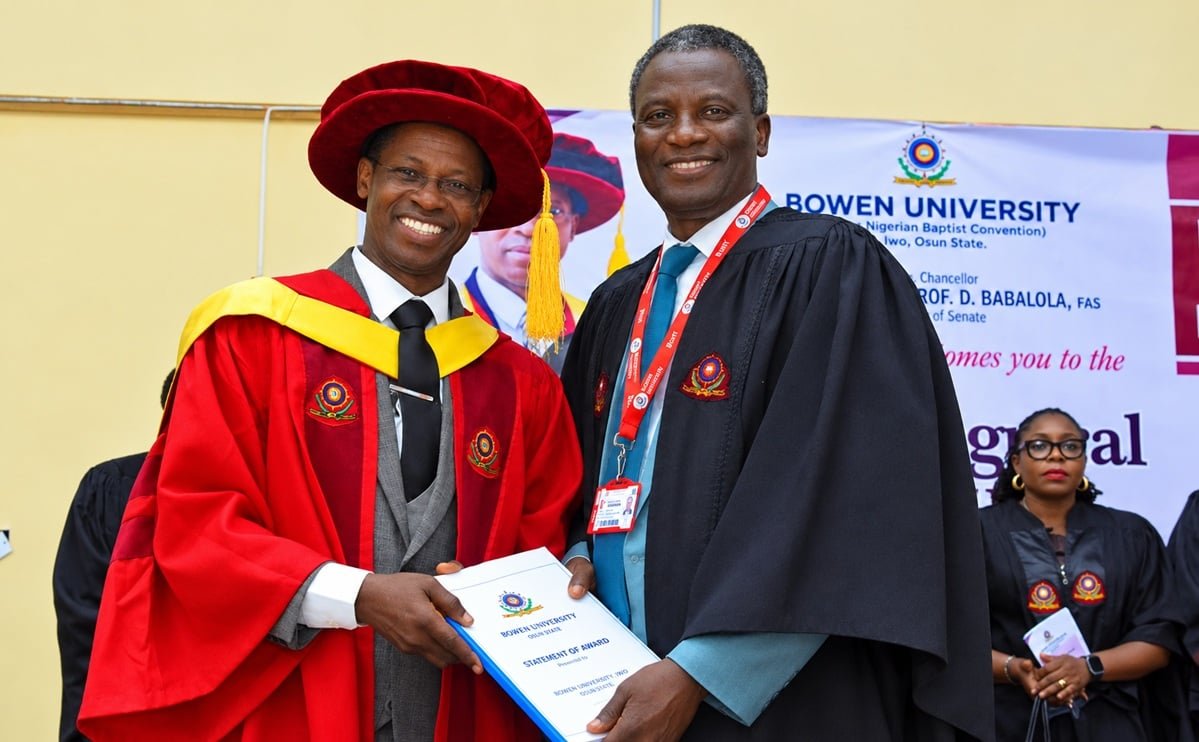
A Professor of Mathematics at Bowen University, Iwo, Osun State, Oladotun Mathew Ogunlaran, has said that knowledge of Mathematics remains essential to building a sustainable nation, particularly in the area of industrial development.
Ogunlaran made the declaration while delivering the 32nd Inaugural Lecture of Bowen University, titled “Beauty in Numbers: My Quest for Reliable Numerical Algorithms,” recently.
The professor stressed the need for Nigerians to acquire the necessary mathematical knowledge to address challenges associated with industrial development.
According to him, Mathematics is indispensable to nation-building because it provides the intellectual and analytical foundation upon which science, technology, engineering, innovation and economic development are built.
He said virtually every aspect of modern national development, particularly industrial development, depends on mathematical principles, whether explicitly or implicitly.
“First, Mathematics is fundamental to engineering, manufacturing and industrial production. The design of buildings, bridges, roads, machines, aircraft, power systems and industrial equipment relies heavily on mathematical modelling, calculations, optimization and numerical analysis. In manufacturing, Mathematics helps determine production efficiency, minimize waste, improve quality control, optimize the use of raw materials and reduce operational costs.
“Without adequate mathematical knowledge, it becomes difficult to design, construct, operate and maintain sophisticated industrial systems.”
Ogunlaran also said Mathematics drives technological innovation and industrial automation, noting that modern industries increasingly depend on computing, artificial intelligence, robotics, data analytics and sophisticated control systems.
According to him, mathematical algorithms enable machines to perform complex operations, analyse large volumes of data, predict equipment failures and improve production processes.
He added that a country that neglects Mathematics education risks becoming a consumer of technologies developed elsewhere rather than a producer and innovator of its own technologies.
On the role of Mathematics in scientific research and indigenous technology, Ogunlaran said scientific discoveries often require mathematical models to explain observed phenomena, make predictions and test hypotheses.
He said, “In my own research, for example, I have demonstrated how approximation theory and numerical methods can be used to develop reliable computational techniques for solving problems arising in engineering, fluid dynamics, biological sciences and other applied fields.
“This illustrates how abstract mathematical ideas can be translated into practical solutions to real-world problems.”
The professor further noted that Mathematics contributes significantly to economic planning and national resource management, as governments and industries require mathematical and statistical tools for forecasting, budgeting, financial analysis, risk assessment, population studies, agricultural planning and the efficient allocation of scarce resources.
ALSO READ: Bowen varsity to churn out 1,443 graduates at 21st convocation
He said sound decisions on infrastructure, energy, transportation, healthcare and industrial investment are strengthened by reliable quantitative analysis.
Ogunlaran added that Mathematics develops intellectual capacities required for nation-building, including logical reasoning, critical thinking, analytical ability, precision, creativity and systematic problem-solving.
“My position, therefore, is that no nation can aspire to meaningful industrialisation, technological independence and sustainable economic development while neglecting Mathematics. Mathematics is not simply a subject to be passed in examinations; it is a strategic national asset and an essential instrument for national transformation.”
He advised the government to treat Mathematics education as a national development priority rather than merely an educational requirement for obtaining certificates.
“If we desire a technologically advanced, industrialized and economically prosperous nation, we must deliberately invest in the teaching and learning of Mathematics at every level of our educational system.”
Among his recommendations, Ogunlaran called for a stronger foundation for Mathematics education at the primary and junior secondary school levels.
“Government should pay particular attention to Mathematics education at the primary and junior secondary school levels because this is where the foundation for mathematical understanding is established.
“Children should be helped to develop numerical sense, logical reasoning, pattern recognition and the ability to solve simple practical problems. Mathematics should be taught in ways that stimulate curiosity and make learning enjoyable, rather than create fear and anxiety.
“According to him,a child who develops confidence in Mathematics at an early age is more likely to appreciate and pursue it at higher levels.”
He also called for improved training, retraining and professional development for Mathematics teachers, saying the quality of Mathematics education cannot be better than the quality of its teachers.
The professor urged the government to periodically review the Mathematics curriculum to reflect contemporary realities, with greater attention given to computational thinking, numerical methods, mathematical modelling, statistics, data analysis, optimization and emerging technologies.
He said students should also be exposed to practical applications of Mathematics in engineering, agriculture, medicine, economics and manufacturing.
“According to professor Ogunlaran one of the challenges in Mathematics education is that students sometimes perceive the subject as abstract and disconnected from everyday life,” he said, adding that teaching approaches should connect mathematical concepts with practical experiences.
“For instance, students can be introduced to mathematical applications in electricity consumption, construction, transportation, agriculture, business transactions and simple engineering problems. This will help them appreciate that Mathematics is not merely about manipulating numbers,or solving equations but also about understanding and solving real-life problems.”
Ogunlaran also advocated investment in digital infrastructure and computational resources, saying Mathematics education must go beyond the traditional classroom and chalkboard in an era of digital transformation.
He suggested that schools and tertiary institutions should be provided with functional computer laboratories, internet facilities, mathematical software and other relevant digital resources.
“Students should progressively acquire computational skills and become familiar with appropriate mathematical and statistical tools. This is particularly important because modern industrial development increasingly depends on computing, artificial intelligence, data science, automation and numerical simulation.”
At the tertiary level, he called for adequate funding for Mathematics departments, research laboratories, postgraduate education and collaborative research.
He also urged universities to strengthen relationships between pure Mathematics, applied Mathematics, computer science, engineering and other disciplines, while ensuring that research findings are translated into solutions to national problems and industrial innovation.
The professor further called for stronger partnerships among universities, polytechnics, research institutes and industries to help students and researchers understand the mathematical challenges confronting industries and develop solutions to them.
He said industrial attachment, internships, collaborative research and problem-based learning should be strengthened to ensure that mathematical knowledge acquired in the classroom translates into productive skills and practical innovations.
Ogunlaran also called for sustained funding, adequate teaching facilities and instructional materials, as well as equitable access to quality Mathematics education, particularly for rural schools and disadvantaged communities.
In his concluding advice to the government, he said, “If I were to emphasize just one thing to the government, it would be this:
“Do not merely teach Mathematics to students; teach them how to think mathematically, how to apply mathematical knowledge and how to use it to solve problems.
“We must move away from an educational culture in which success in Mathematics is measured primarily by the ability to memorize formulas and reproduce procedures in examinations. Instead, we should develop a generation of Nigerians who can reason logically, analyze problems, interpret data, develop mathematical models, use computational tools and create innovative solutions.
“Government must also recognize that investment in Mathematics education is an investment in the nation’s scientific, technological and industrial future. The benefits may not always be immediate, but they are fundamental to sustainable development.
“Ultimately, if Nigeria desires to become a nation that manufactures rather than merely imports, innovates rather than merely imitates, and develops indigenous solutions to its challenges, then Mathematics education must occupy a central position in our national development agenda.
“We cannot build a technologically independent and industrially competitive nation on a weak mathematical foundation.
“The foundation must be laid in our basic schools, strengthened in our secondary schools and advanced in our tertiary institutions,” he concluded.
WATCH TOP VIDEOS FROM NIGERIAN TRIBUNE TV