

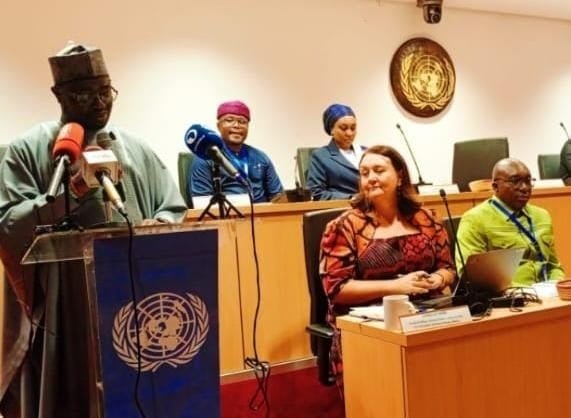
The Minister of Humanitarian Affairs and Poverty Reduction, Dr. Bernard Doro, on Tuesday underscored the need for Nigeria to scale up funding of all humanitarian responses across the country, as United Nations (UN) agencies prepare to scale down all related humanitarian interventions from 1st January, 2027.
Confirming the development, Dr. Doro gave the assurance in Abuja while delivering the keynote address at the opening of the two-day Humanitarian Transition Workshop, aimed at developing a nationally led, sustainable and resilient humanitarian coordination system for the country.
He disclosed that the humanitarian response-related transition “has been on the plan for several months. As you may be aware, there’s a global humanitarian reset. Nigeria is one of the eight countries that will be affected by the reset. And that means that there needs to be more government leadership, government financing of the humanitarian space.
“And so the workshop today is a technical approach to trying to find solutions on how Nigeria can assume greater governance and also greater leadership of the humanitarian transition.
“We have had international leaders compliment government’s efforts towards humanitarian aid. Now that they are scaling down, should we really be scared? Or what do you think we should be looking out for? It is Nigeria’s constitutional mandate, the government’s constitutional mandate, to ensure that our people are properly looked after. So we have nothing to worry, we have nothing to be scared.
“The government has shown empathy and compassion. His Excellency, the President of the Federal Republic of Nigeria, Bola Ahmed Tinubu GCFR, has shown a high level of compassion, a high level of care for those vulnerable people in Nigeria. And I’m sure this is no different.
“The government will continue to lead, will continue to ensure that our constitutional responsibility is taken seriously. Should we expect any withdrawal symptoms? And also, how long will this timeline happen? Well, so the transition is on, and by 1st January 2027, government will assume full leadership of the transition.”
ALSO READ: Why our abductors killed our colleagues – Rescued Oyo principal
In his remarks, UN Resident and Humanitarian Coordinator in Nigeria, Mr. Mohammed Malik Fall, reaffirmed the UN’s commitment to supporting Nigeria’s transition towards a nationally owned humanitarian response system.
He stressed that the transition is about transforming the way humanitarian support is delivered and ensuring that national institutions increasingly lead coordination, planning and implementation while maintaining support for vulnerable populations.
He urged Nigeria to put the necessary measures in place to take up the responsibility, saying: “it’s very important first to have regular, sufficient and predictable funding sources for humanitarian needs in Nigeria, because yes, this transition is about this, it’s about Nigeria taking over the responsibility, still with the support of international donors and the EU in particular will still be here to help and support with humanitarian funding and with technical assistance, but the main responsibility will be for Nigerian authorities.
“And so it’s very important that federal governments, state governments and also the private sector as a complement are here to fund and of course to have strong coordination, to have a clear strategy on how to address the needs in particular in the most vulnerable areas of Nigeria.
“The humanitarian needs unfortunately are not declining, they are growing, so there’s still a lot to do, but it’s very good and it’s very commendable that Nigeria wants to take responsibility and I think it’s a very adjusted strategy to a global context of declining humanitarian funding while global humanitarian needs are on the rise and so are redirected to poorest countries.”
WATCH TOP VIDEOS FROM NIGERIAN TRIBUNE TV