

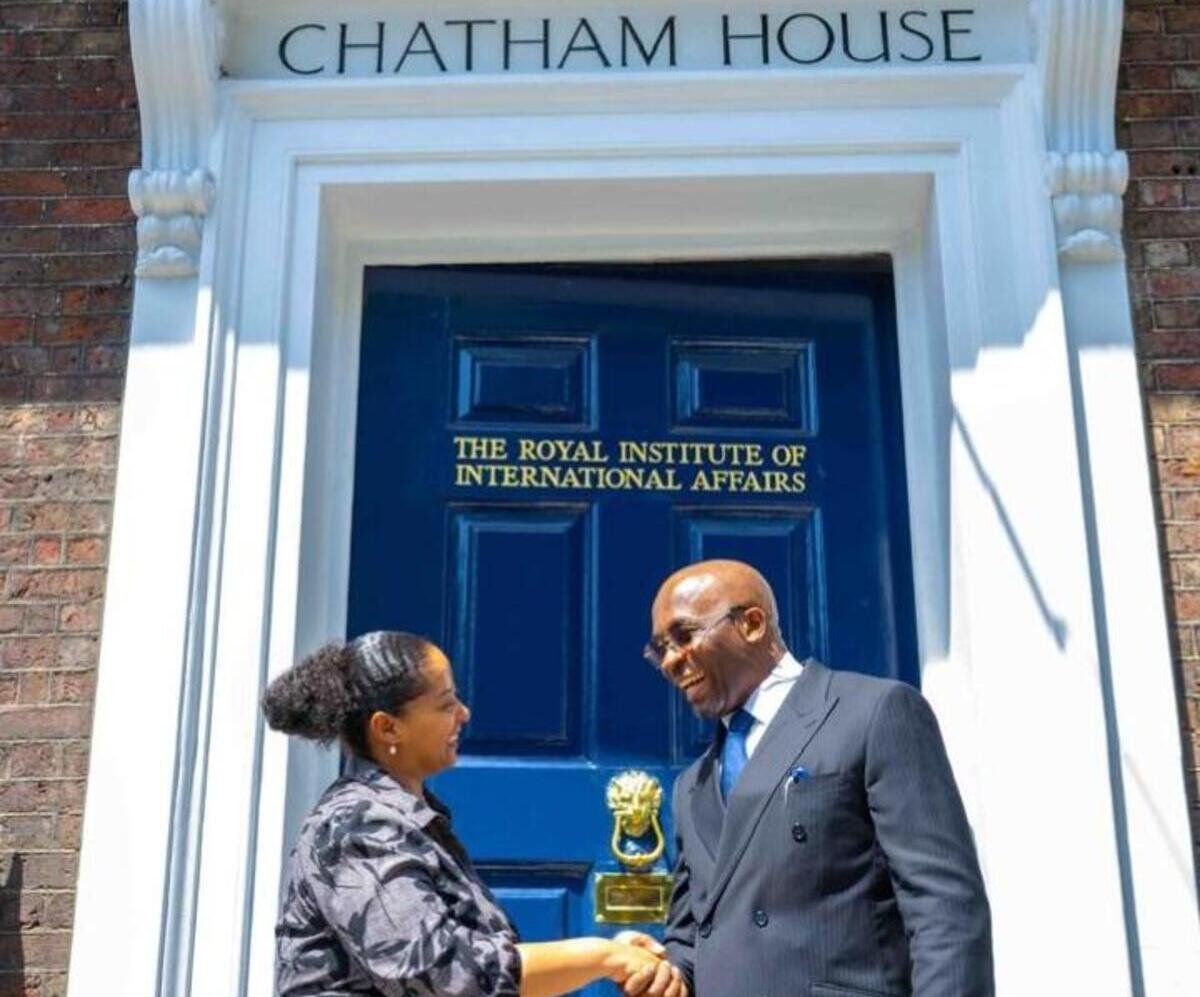
Deputy Speaker of the House of Representatives, Hon. Benjamin Kalu, on Tuesday outlined how the 10th National Assembly is deploying its constitutional powers to confront insecurity across Nigeria, describing increased funding, strict oversight and the State Police Bill as central to the strategy.
Speaking at the Chatham House Africa Programme Roundtable in London, United Kingdom, on Tuesday on the topic, “Nigeria’s 2027 elections: How to ensure electoral integrity amid a deepening security crisis,” Hon. Kalu said security has been treated as the National Assembly’s top priority since the 10th Assembly commenced in June 2023.
He revealed that through appropriation, security and defence allocations increased from ₦2.98 trillion to ₦5.41 trillion in the 2026 budget, representing an 81% rise over three years.
He also said the House is pushing a constitutional amendment to make security funding a “first-line charge” on the national budget.
The Deputy Speaker added that House committees are working with the Executive and security agencies to track spending and implementation.
Under its representative mandate, Hon. Kalu said the House has considered over 1,500 substantive motions between June 2023 and June 2026, noting that about 350 to 400 of them focused on security, banditry, kidnappings, attacks on farming communities and the protection of vulnerable populations.
He said the motions led to concrete actions, including the summoning of security chiefs, mandating the recruitment of forest guards, securing commitments to protect schools in high-risk areas and pushing for permanent security outposts in exposed communities.
He said: “Through its appropriation powers, the National Assembly has ensured that security funding has grown consistently and remains the single largest sectoral allocation in the national budget. Since the 10th Assembly commenced in June 2023, security and defence allocations have risen from N2.98 trillion to N5.41 trillion in the 2026 budget, an increase of over 81% in three years, and the single largest sectoral allocation for three consecutive years.
“We are also advancing a constitutional amendment to make security funding a first-line charge on the national budget, guaranteeing its release before other items and removing it entirely from the uncertainty of discretionary timing. We believe it will pass, because the protection of citizens is not a budget item that should compete for space.
“Through its oversight function, our committees have worked in partnership with the Executive and security agencies to ask the questions that strong institutions must ask of themselves — not to find fault, but to find answers. How are appropriated funds being deployed? Where are the gaps between planning and execution? What does implementation look like on the ground? This is the work of a legislature that takes its constitutional responsibility seriously, and it is work we conduct in the spirit of shared commitment to a more secure Nigeria.
“Resources must translate into results, and Parliament’s role is to help ensure that they do. Through its representative function, the House has considered over 1,500 substantive motions in its first three legislative years, between June 2023 and June 2026, with between 350 and 400 of them specifically focused on security matters.
“The majority addressed issues of urgent public importance, including banditry, kidnappings, attacks on farming communities and the protection of vulnerable populations. These were not procedural gestures. They produced results.
“Resolutions led to the summoning of security chiefs before the House. They mandated the recruitment of forest guards, secured commitments to protect schools in high-risk areas and to establish permanent security outposts in communities that had been left exposed.”
The Deputy Speaker also told his audience, made up of policymakers, diplomats and scholars, that the National Assembly has passed the revised Cybercrimes Act 2024 and the Control of Small Arms and Light Weapons Act 2024, while advancing the Joint Doctrine and Warfare Centre Bill for better coordination among the Armed Forces.
Speaking on the State Police Bill, which he described as the “legacy initiative” of President Bola Ahmed Tinubu, Hon. Kalu said the legislation, which was overwhelmingly passed with 289 votes in the House recently, would enhance the security of the country.
He argued that Nigeria’s centralised police system, designed before independence, cannot respond fast enough for a 923,000 sq km nation of over 230 million people.
“On lawmaking: we have passed the revised Cybercrimes Act 2024 and the Control of Small Arms and Light Weapons Act 2024. We are advancing the Joint Doctrine and Warfare Centre Bill to institutionalise coordination across the Armed Forces.
“The reform I want to speak about most specifically, because it bears most directly on the 2027 elections, is the State Police Bill, the legacy initiative of President Bola Ahmed Tinubu, which the House of Representatives passed with 289 votes. And as I speak here right now, the Senate is in chamber considering this Bill for further legislative action.
“The case for state police begins with a simple question about response time. When a security incident occurs in a Nigerian community today, how long does it take for help to arrive? The honest answer in too many communities is: too long. Studies of centralised policing in large federations consistently demonstrate that response times beyond 15 minutes allow situations to escalate from manageable to irreversible. In communities distant from federal police infrastructure, that window closes long before the response arrives. Nigeria’s current centralised policing architecture was designed before independence. It was not designed for the security complexity of a 923,000-square-kilometre nation or a population of over 230 million people in 2026.
“State police address this directly. The officer who comes from a community knows its roads, its markets, its people and its tensions. The officer who knows the forest will police the forest better than those hired from outside,” he said.
The Deputy Speaker also allayed fears about the possible abuse of state police, saying the Bill inherently carries strong safeguards.
“I am clear about the safeguards. State police is not a licence for political capture. The Bill mandates merit-based recruitment, national minimum standards, independent State Police Service Commissions for oversight, State Assembly accountability, and strict constitutional limits on political interference. The concern about governors weaponising state police is legitimate, and we have legislated against it. What is not legitimate is allowing that concern to perpetuate a policing model that is visibly failing the communities it exists to protect. Currently, it is obsolete and must be done with,” Hon. Kalu said.
Beyond security issues, the Deputy Speaker said the Electoral Act 2026, signed by President Bola Ahmed Tinubu on 18 February this year, forms part of ongoing efforts to improve electoral credibility in Nigeria and carries 15 reforms to close gaps left by the 2022 Act.
He highlighted five key reforms, including making electronic transmission of results to IReV a legal obligation admissible in tribunals, with 10 years’ imprisonment for officers who announce false results; empowering INEC to review declarations made under duress or contrary to procedure within seven days to correct errors before they become court cases; creating a permanent National Electronic Register of Election Results accessible to every citizen as certified documents; keeping voter registration open until 90 days before elections while allowing transfers and downloadable PVCs to reduce disenfranchisement; and requiring parties to submit verified digital membership registers 21 days before primaries, abolishing indirect primaries to enforce “one member, one vote” and transparent candidate selection.
He added that although Nigeria has not yet arrived in its democratic journey, it is making steady progress across all facets of national life.
“We know this better than anyone. Twenty-seven years of democracy is, by the measure of nations, a young journey. We have made mistakes. We have faced security challenges that have tested the limits of our institutions. And we have not always had the answers we wished we had. But we have never stopped asking the right questions. And we have never stopped building. What I have shared today is not a finished story. It is a progress report from a legislature that is working, that is learning, and that believes deeply that the democratic project in Nigeria is worth every difficult reform it demands,” Hon. Kalu said.
WATCH TOP VIDEOS FROM NIGERIAN TRIBUNE TV