

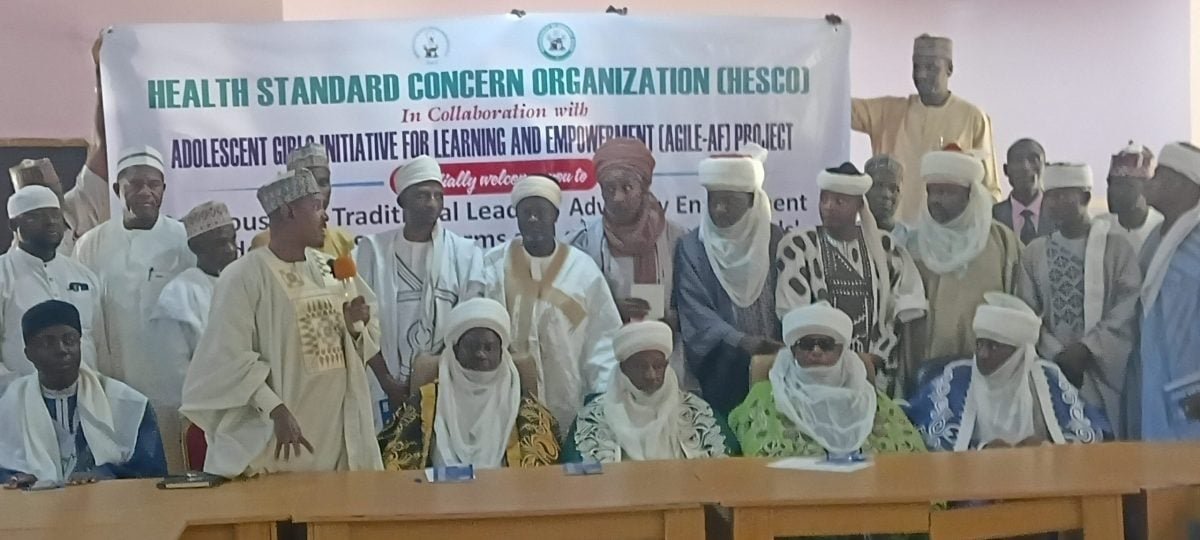
A non-governmental organisation, Health Standard Concern Organization (HESCO), in collaboration with the Adolescent Girls Initiative for Learning and Empowerment (AGILE) Project in Zamfara State, has moved to address barriers to girls’ education in the state.
This was disclosed on Saturday at the Religious and Traditional Leaders’ Advocacy Engagement on Addressing Social Norms and Other Barriers to Girls’ Secondary Education Opportunities, held at Karma Hotel in Gusau.
In his remarks, the Executive Director of HESCO, Abdullahi Lawali Bungudu, said educating girls provides opportunities for improved livelihoods.
He said education remains a fundamental foundation for individual growth, family well-being and societal development.
“Unfortunately, many adolescent girls in our communities continue to face barriers such as poverty, negative social norms, household responsibilities, misconceptions about girls’ education, insecurity and inadequate parental support.
“We therefore appeal to respective platforms, including palaces, mosques, churches and community gatherings, to promote the importance of girls’ education, discourage harmful practices and address misconceptions that prevent girls from accessing and completing secondary education.”
According to him, addressing these barriers requires more than government intervention or the provision of school infrastructure.
“It requires collective action, continuous community engagement and positive behavioural change, particularly at family and community levels,” he stated.
Also, the Zamfara State AGILE Project Coordinator, represented by the Deputy Coordinator, Dr Salisu Dalhatu, said the engagement provided an opportunity to identify the barriers affecting girls’ education, share community experiences and develop practical commitments that would translate discussions into meaningful action.
In his overview presentation, the Executive Director of Voluntary Aid Initiative (VAI), Ambassador Musa Umar Aboki, stated that social norms are shared beliefs, expectations and unwritten rules that influence how individuals behave within their communities.
Aboki disclosed that some of these norms had negatively affected girls’ education.
“The belief that girls’ primary responsibility is marriage and family care, and the perception that educating boys is more valuable than educating girls.
“Other concerns include the belief that secondary education may expose girls to undesirable behaviours and that girls do not need higher education to fulfil their future responsibilities,” he said.
WATCH TOP VIDEOS FROM NIGERIAN TRIBUNE TV