

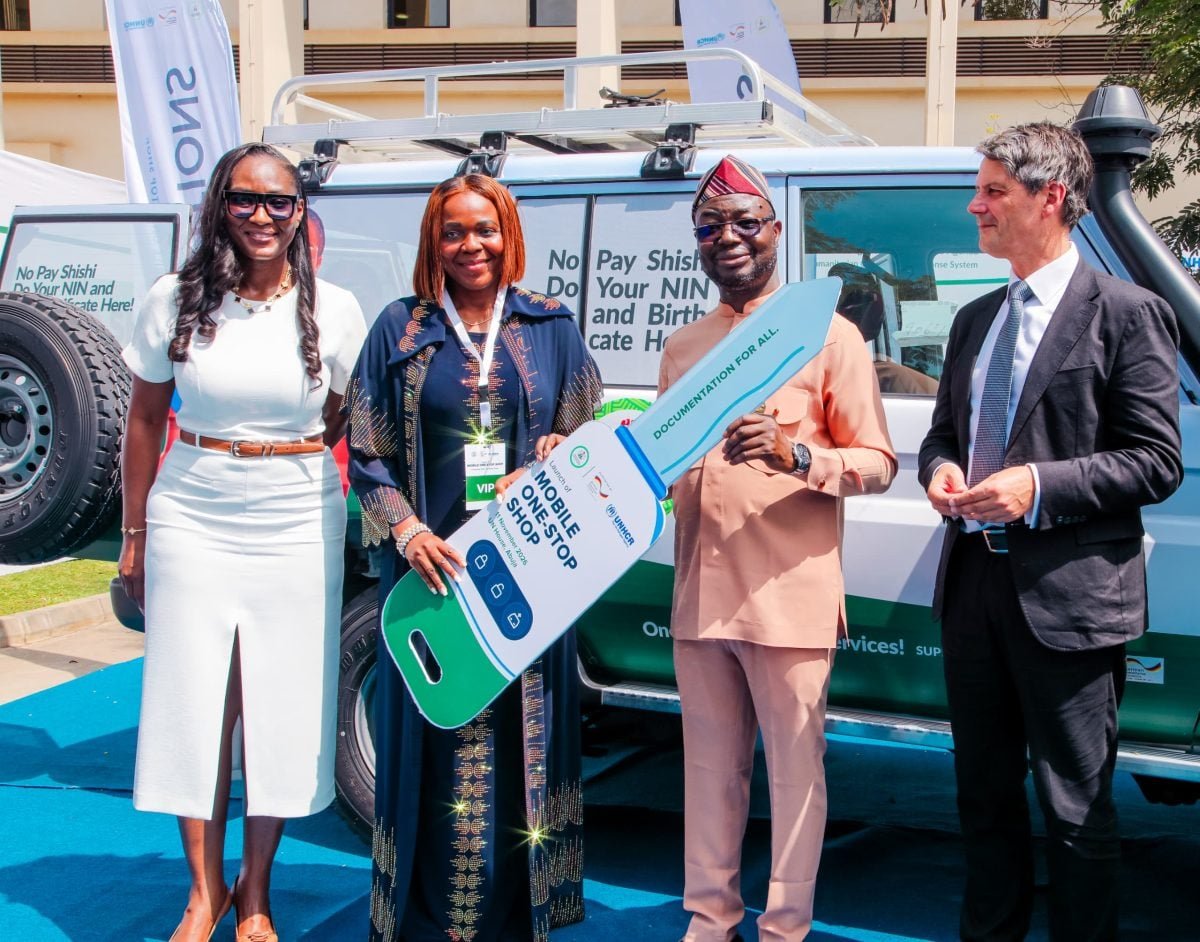
The Government of Germany on Wednesday handed over 10 Mobile One-Stop Shop vehicles to the Federal Government for deployment across 10 states to provide humanitarian services.
The vehicles were formally presented by the German Ambassador to Nigeria and ECOWAS, Mr Stefan Rößel, to the Minister of Humanitarian Affairs and Poverty Reduction, Dr Bernard Doro, during a ceremony held at the United Nations House, Abuja.
The initiative, implemented in partnership with the United Nations High Commissioner for Refugees (UNHCR), was designed to bring essential government services closer to displaced persons and vulnerable communities, particularly those in remote and underserved locations.
Speaking at the event, Ambassador Rößel reaffirmed Germany’s commitment to its partnership with Nigeria, particularly in supporting initiatives aimed at strengthening humanitarian response and improving access to essential services for vulnerable populations.
Doro, who received the vehicles on behalf of the Federal Government, described the intervention as a practical demonstration of international solidarity and a significant investment in improving service delivery to displaced persons and vulnerable communities.
He reaffirmed the Federal Government’s commitment to ensuring that internally displaced persons and other vulnerable Nigerians had access to essential government services, declaring that “no Nigerian should be left behind because of where they live or the circumstances that forced them to flee.”
Doro explained that the mobile facilities would provide birth registration, National Identification Number (NIN) enrolment, SIM registration, Bank Verification Number (BVN) registration, bank account opening and enrolment into the National Social Register.
According to him, the initiative aligns with the ministry’s One Humanitarian, One Poverty Response System, which seeks to move Nigerians from palliatives to sustainable pathways by connecting vulnerable populations to identity documentation, financial inclusion and social protection opportunities in line with President Bola Tinubu’s Renewed Hope Agenda.
He stressed that identity documentation remained fundamental to social and economic inclusion, noting that individuals who could not be identified or registered were often excluded from essential government interventions and other opportunities.
While commending Germany for its continued support for Nigeria’s humanitarian response, as well as UNHCR’s sustained commitment to displaced persons in the country, he urged the 10 beneficiary states to ensure that the vehicles were properly maintained and consistently deployed to reach displaced communities, remote settlements and vulnerable households.
He expressed optimism that the initiative would eventually be expanded beyond the initial 10 states to cover all 36 states and the Federal Capital Territory (FCT).
Also speaking, the Interim United Nations Resident and Humanitarian Coordinator in Nigeria, Ms Vanessa Pala, underscored the importance of sustained collaboration between the Federal Government, UN agencies and development partners in ensuring that displaced persons and vulnerable communities were not excluded from essential services.
She noted that coordinated service delivery was critical to strengthening access to identity documentation, financial inclusion and social protection.
In a symbolic handover, Doro subsequently presented the vehicle keys to the participating state governments through the Dean of the Forum of Commissioners of Humanitarian Affairs of the 36 states and the FCT, Dr Helen Isamoh, who is also the Akwa Ibom State Commissioner for Humanitarian Affairs.
Isamoh appreciated the Federal Government, UNHCR and the Government of Germany for the intervention, describing it as significant support for state-level humanitarian service delivery.
She expressed hope that the programme would be extended to all 36 states and the FCT to enable more displaced persons and vulnerable communities to benefit.
WATCH TOP VIDEOS FROM NIGERIAN TRIBUNE TV