

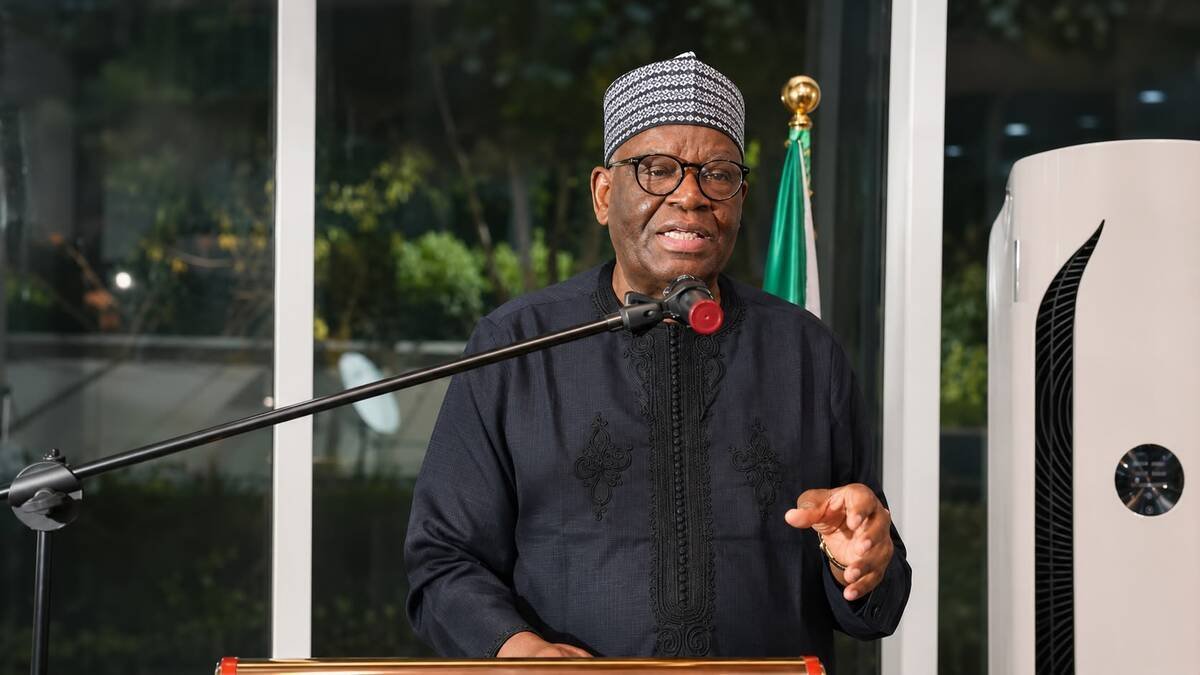
The Former Minister of Foreign Affairs, Prof. Ibrahim Gambari, has called on African countries to take greater financial responsibility for the continent’s security architecture, warning that excessive dependence on external funding could weaken the African Union’s (AU) autonomy and ability to address conflicts.
Gambari said the principle of African solutions to African problems must be supported by adequate domestic resources, stronger political commitment and effective institutions rather than remain a slogan.
He made the call while delivering a keynote address at a roundtable dialogue on Strengthening Africa’s Security Architecture: AU and UN Reforms in Addis Ababa, Ethiopia.
The former minister, who served on the AU High-Level Panel of Eminent African Experts that reviewed the continent’s peace, security and governance architecture, identified poor implementation of collective decisions and weak political commitment as major obstacles to Africa’s progress.
He said that despite developing institutional frameworks, protocols and strategies over the past two decades, the continent continued to face insecurity, political instability, weak governance, economic exclusion and declining public trust.
According to him, Africa’s major challenge was no longer the absence of policies but the failure to implement them.
On the financing of the African Union, Gambari said dependence on external funding limited the organisation’s autonomy, reduced its flexibility and raised concerns about its long-term sustainability.
“For decades, we have advocated African solutions to African challenges. If that aspiration is to become a reality, rather than slogan, it must be underpinned by commitment of African resources,” he said, describing the strengthening of the AU Peace Fund as a strategic imperative.
ALSO READ: Prof Gambari tasks Nigerian youths on peace, nation-building
He, however, noted that financial resources alone would not resolve the continent’s challenges, stressing that leadership and collective political commitment remained essential.
“Resources matter. Leadership matters more. But collective political commitment matters most,” he said.
Gambari also called for governance and security to be treated as interconnected priorities, identifying corruption, political exclusion, weak institutions, inequality and declining public confidence as factors that contribute to conflicts.
He maintained that military operations could not replace political solutions, adding that sustainable peace required justice, inclusion, accountability and economic opportunities.
On conflict prevention, he expressed concern over the gap between early-warning systems and timely interventions, urging African leaders to invest more in preventive diplomacy, mediation and targeted interventions before crises escalate into violence.
The former minister also called for greater investment in Africa’s youthful population through quality education, employment and entrepreneurship opportunities. He warned that unemployment and marginalisation could expose young people to criminal networks and violent extremist groups.
Addressing Africa’s role in resolving conflicts on the continent, Gambari advocated renewed commitment to the principle of African solutions to African problems.
Citing the conflict in Sudan, he cautioned against excessive external influence in African peace processes, insisting that international partnerships should strengthen rather than replace African leadership.
“Partnerships should amplify African leadership, not substitute for it,” he said.
He also advocated renewed Pan-Africanism and stronger coordination among African countries on strategic issues and international negotiations.
Gambari challenged African countries to move beyond exporting raw materials and embrace industrialisation, technology, innovation and value addition.
He cited Dangote Industries, Ethiopian Airlines, M-PESA and OPay as examples of African enterprises demonstrating the potential of indigenous investment and innovation.
On global governance, he called for reforms of the United Nations, particularly the Security Council, to give Africa greater representation in international decision-making.
He also urged stronger coordination between the AU Peace and Security Council and African representation on the UN Security Council, known as the A3.
In addition, he called for the implementation of UN Security Council Resolution 2719 to support sustainable financing for AU-led peace operations.
The roundtable was convened by the Centre for the Advancement of Scholarship at the University of Pretoria, the Konrad-Adenauer-Stiftung and the African Union.
The reform process followed the adoption of AU Decision 920 on Institutional Reforms in February 2025, under the leadership of Kenyan President William Ruto, the AU Reform Champion.
WATCH TOP VIDEOS FROM NIGERIAN TRIBUNE TV