

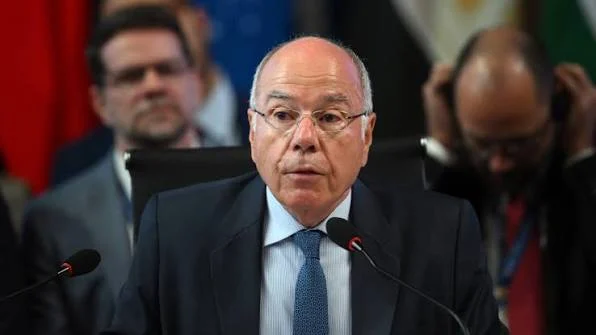
Foreign Ministers of the G4 countries, Brazil, Germany, India and Japan, have thrown their weight behind Africa’s demand for enhanced representation in the United Nations Security Council, including permanent membership.
The ministers made their position known in a joint statement issued after they met in New York on Tuesday, on the margins of the 81st session of the UN General Assembly.
The G4 comprises Brazilian Foreign Minister Mauro Vieira, German Federal Foreign Minister Johann Wadephul, Indian External Affairs Minister Subrahmanyam Jaishankar and Japanese Foreign Minister Motegi Toshimitsu.
According to a statement issued by the German Embassy in Abuja on Wednesday, the ministers welcomed the African Group’s reform model presented during the 80th session of the Intergovernmental Negotiations on Security Council reform and reiterated their support for Africa’s case for enhanced representation, “including in the permanent category of membership.”
The G4 said the current structure of the 15-member Security Council, established eight decades ago, no longer reflected contemporary geopolitical realities.
They stated that the Council’s “representativeness, legitimacy, credibility and efficacy are in question”, arguing that its existing structure had become an impediment to addressing present and future challenges to international peace and security.
The ministers said, “given the increasingly challenging geopolitical environment, UNSC reform is more necessary than ever before.”
They called for the expansion of the Council in both the permanent and non-permanent categories, stressing the need to improve the representation of under-represented and unrepresented regions, particularly Africa, Asia-Pacific and Latin America and the Caribbean.
The G4 further recognised what it described as historical injustices in the representation of those regions and groups in the Council, while calling for greater participation by countries that contribute significantly to maintaining international peace and security.
The development is significant for Africa, which has no permanent seat on the Security Council despite having three non-permanent seats.
The African Union’s Common African Position, anchored in the Ezulwini Consensus and Sirte Declaration, calls for no fewer than two permanent seats for Africa, with the same prerogatives and privileges as existing permanent members, including the veto if it is retained, as well as five non-permanent seats.
The G4 ministers said the Intergovernmental Negotiations had failed to produce concrete outcomes towards substantive reform despite 18 years of discussions.
They expressed “strong concern” over the lack of progress during the previous negotiations and criticised the presentation of a “so-called bridging proposal” before text-based negotiations had commenced.
According to them, the proposal failed to reflect the position of a clear majority of UN member states supporting expansion in both permanent and non-permanent categories.
They said, “consensus is not the benchmark for decision-making on Security Council reform,” citing the UN Charter and the mandate of the Intergovernmental Negotiations.
The ministers said the G4 would now work with other reform-oriented groups to develop a consolidated model reflecting the position of the majority of member states.
They added that commencing text-based negotiations would be treated as a priority in order to achieve “real and impactful UNSC reform.”
The G4 also said discussions on reform should not be restricted to the Intergovernmental Negotiations, indicating its willingness to engage the wider UN membership through other forums, including the General Assembly.
The African Union has continued to maintain that Africa’s permanent exclusion from the Security Council constitutes a historical imbalance. In May 2026, AU Commission Chairperson Mahmoud Ali Youssouf reiterated the continent’s demand for at least two permanent seats and five non-permanent seats.
The G4 ministers, describing their countries as democracies committed to multilateralism, the rule of law and the purposes of the UN Charter, pledged to continue coordinating closely during the 81st General Assembly session.
They tasked officials from their respective countries with following up on the discussions, with progress expected to be reviewed at the next Director General-level meeting in New Delhi.