

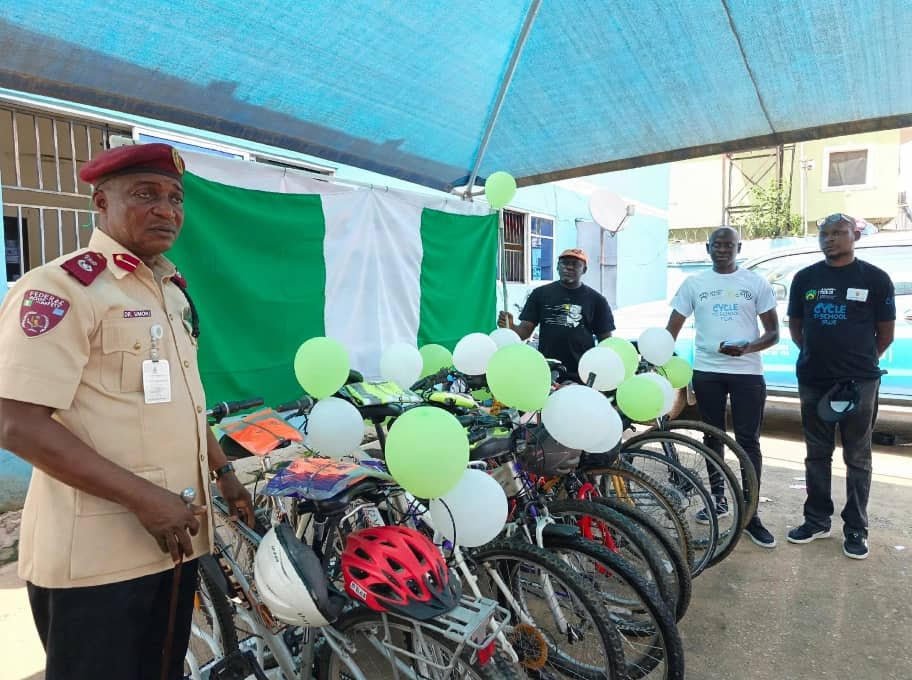
The Gabriel Rotimi Aroge Empowerment Foundation (GRAEF), in partnership with the Federal Road Safety Corps (FRSC), has intensified advocacy for safer bicycle use to promote sustainable transportation and build a healthier Lagos.
The call was made during a safety session themed “Building Citizen Resilience Through Sustainable Mobility: Promoting Safer Bicycle Use in Lagos,” held at the FRSC Lagos State Sector Headquarters.
Speaking at the event, the Lagos Sector Commander of the FRSC, Corps Commander Kehinde G. Hamzat, said sustainable mobility must go beyond faster movement to encompass transport options that are safe, affordable, accessible and environmentally responsible.
He noted that Lagos, with its growing population and expanding economic activities, must explore solutions that protect lives while reducing pressure on existing infrastructure.
Hamzat described bicycles as an important component of sustainable mobility, noting that they require no conventional fuel, produce no direct tailpipe emissions, promote physical fitness and provide affordable transportation.
However, he stressed that the promotion of cycling must be accompanied by a strong focus on safety. “Our objective must therefore be clear: not merely to encourage more people to ride bicycles, but to create an environment in which people can ride safely and confidently,” he said.
He urged cyclists to obey traffic regulations, maintain their bicycles, use protective equipment, remain visible and avoid distractions while riding.
The Sector Commander also appealed to motorists to recognise cyclists as legitimate road users and give them adequate space, warning against dangerous overtaking and other behaviours that endanger vulnerable road users.
“A bicycle may be smaller than a motor vehicle, but behind every bicycle is a human life, a father, mother, son, daughter, brother, sister, friend or colleague,” he said.
Hamzat emphasised that roads are shared public spaces and called for mutual respect among all road users, as well as cycling-friendly infrastructure such as dedicated lanes, markings, signage, lighting and safer junction designs.
Earlier, stakeholders participated in a special edition of Lagos Traffic Radio 96.1 FM’s “Your Side Mirror” programme, themed “Nigeria @ 66: True Independence Beyond Petrol,” where they examined non-motorised transport options.
Speaking on the programme, GRAEF Founder, Rotimi Gabriel Aroge, said the foundation’s bicycle initiative was inspired by the UN Decade of Action for Road Safety 2021-2030, which seeks to substantially reduce road traffic deaths and injuries.
Aroge stressed that changing the attitudes and behaviours of cyclists and motorists through education was as important as providing infrastructure, disclosing that the foundation had introduced bicycle and safety training in five schools across Lagos.
Also speaking, Executive Director of Re-Cycle: Bikes to Africa, Charlotte Ward, said her UK-based charity had distributed over 170,000 bicycles across Africa in nearly three decades.
She announced a partnership with GRAEF to make affordable bicycles available in Nigeria, while emphasising the need for appropriate cycling infrastructure and safe routes.
National Secretary of the Chartered Institute of Transport Administration of Nigeria (CIOTA), Mazi Philip Okonkwo, said cycling and walking should not be regarded solely as transport for the less privileged, noting that they are now key components of modern mobility planning.
Representing Dr Manaseh Shitta, Head of Technical Services at the National Centre for Energy Efficiency and Conservation (NCEEC), Charles Ekwuma said the initiative would encourage residents to consider bicycles, including electric bicycles, as affordable and eco-friendly alternatives.
Ekwuma added that GRAEF was represented at the National Council on Transport (NCT) 2026 in Abuja, where Prof. Emmanuel Chijioke Ogbonna, representing Global Foremost Impressions Ltd, the parent company of GRAEF, presented 21 memoranda on issues including the adoption of cycling in school curricula and the provision of bicycle storage in public facilities.
Stakeholders agreed that cycling could aid first-mile and last-mile connectivity, reduce congestion, lower emissions, improve public health and cut transport costs, underscoring the need for collaboration among government, the private sector, civil society and communities.
Concluding the engagement, Hamzat reiterated that sustainable mobility can only succeed when safety becomes a shared responsibility, adding: “Let us create roads where mobility and safety go hand in hand; where innovation is matched with responsibility; and where no road user is considered too small to matter.”
WATCH TOP VIDEOS FROM NIGERIAN TRIBUNE TV