

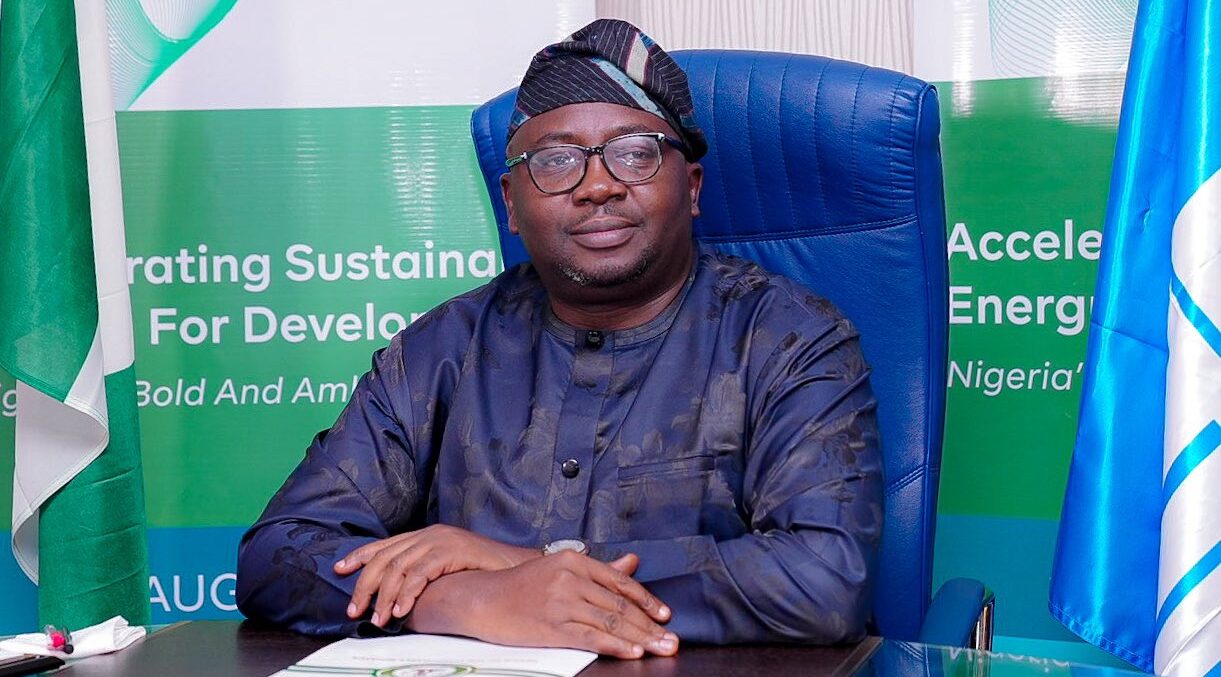
The Federal Government on Thursday unveiled the National Integrated Electricity Policy (NIEP) and Integrated Resources Plan (NIRP) to accelerate energy transition goals.
The documents were put in place by the Ministry of Power in partnership with UK Foreign, Commonwealth and Development Office (FCDO) and the UK Nigeria Infrastructure Advisory Facility (UKNIAF).
Speaking at the Public Presentation and the unveiling of the NIEP and NIRP in Abuja, the Minister of Power, Mr Adebayo Adelabu said that the NIEP would serve as the guiding framework for Nigeria’s power sector. Adelabu said that NIEP would also ensure that the country’s journey towards universal electrification was evidence-based, pragmatic, and aligned with its energy transition goals.
“Today’s occasion is a testament to our unwavering commitment to shaping a power sector that is inclusive, sustainable, and driven by strategic planning.
“Complementing this is the Integrated Resource Plan (IRP), a strategic roadmap that prioritises least-cost electrification and an optimised energy resource utilisation.
“Collectively, the NIEP and the IRP present a unique opportunity to drive the transformation of Nigeria’s power sector through a data-driven and evidence-based approach.”
Adelabu said that beyond strengthening the sector, the NIEP and the IRP frameworks had far-reaching economic implications directly impacting supply reliability to small and medium-sized enterprises (SMEs) as well as large industries, reducing operational disruptions caused by power shortages.
He said the frameworks would foster economic growth and job creation, and accelerate local and regional development.
“This reinforces our commitment to delivering a more reliable, sustainable, and inclusive energy future for all Nigerians. This aligns seamlessly with the Renewed Hope Agenda of President Bola Tinubu which recognises that energy is not merely a commodity but the backbone of economic growth and job creation.”
Adelabu said that as a result of the president’s unwavering support and commitment to advancing the development of the power sector it achieved a lot of milestones in 2024. The minister listed the milestones to include the development of the National Integrated Electricity leveraged on more than one billion dollars investment in the power sector.
“Others are the commencement of the process of transitioning the sector to full commercialisation, achieving an average of about 5, 300 Megawatts (MW) from 4, 200MW recorded in 2023 among others, ‘’ he said.
According to him, the opportunities within the country’s power sector are vast, spanning from closing transmission and distribution gaps to developing hydropower and integrating large-scale renewables into the grid.
“We recognise the critical role of private capital, innovation, and expertise in transforming our electricity landscape, and we are committed to fostering an enabling environment for sustainable investment.
“I would like to extend my gratitude to the UK Foreign, Commonwealth and Development Office (FCDO) and the UK Nigeria Infrastructure Advisory Facility (UKNIAF) and other development partners for their valuable support in this journey.
“Your partnership has been instrumental in helping us develop the robust policy and planning frameworks that will shape the future of Nigeria’s energy landscape,” he said.
He said plans were underway to regularise electricity tariffs of Bands B, C and A customers to ensure a more efficient and reliable power sector.
Under the current structure, customers in Band B, who enjoy 18 to 17 hours of electricity supply, pay N63 per kilowatt-hour. Those in Band A, with only two hours more of supply, are charged N209 per kilowatt-hour
Adelabu said in 2024, the power sector adopted a cost reflective tariff for a portion of electricity consumers about 15 per cent, it might look small but it is a way forward.
“It was a pilot and a proof of concept which I believe it had worked. The people that are enjoying 20 to 24 hours of electricity supply in a day are happy. They are satisfied in spite of the fact that they are paying N209 per kilowatt-hour as they believe they are better off than when using generators. We believe that as we continue to work on revamping our distribution and transmission infrastructure, more and more people will be migrated to Band A.“
Adelabu also said as a result of the migration of some customers to Band A, the power sector recorded a 70 per cent growth in its revenue from N1.05 trillion in 2024 to about N1.7 trillion.
The minister said: “We will look at the tariff again. I am not saying that we’re going to increase the tariff before I am misquoted.
”We are going to look at the tariff and see how we can improve on our modest achievement of 2024 not only to grow the sector revenue. But to also ensure that we are able to invest more in revamping the dilapidated infrastructure in the power sector so that they can carry the kind of reliable electricity we envisage for the power sector.
“We thought the migration of Band B and C customers will be faster than this but the Electricity distribution Companies (DisCos) have refused to invest in the power sector, ” he said.
According to him, a lot of investment was required to achieve accelerated migration of lower-band customers into Band A.
He said that the regularisation of the tariff Band B and C customers to Band A would be done at a slow pace.
Ms Sally Woolhouse, Head of Economic Development, Foreign Commonwealth and Development Office, Nigeria said that the UK and Nigeria enjoyed a longstanding relationship.
Woolhouse said that the UK would continue supporting first class infrastructure development in Nigeria that would lead to sustainable economic growth as this would build mutually beneficial strategic partnerships for both countries.
“Today’s event demonstrates the commitment of the UK and Nigerian governments to addressing Nigeria’s energy sector challenges.
“On policy, it demonstrates Nigeria’s commitment to tech-driven, evidence-based, and sustainable energy planning for the country within a context of policy certainty,” she said.