

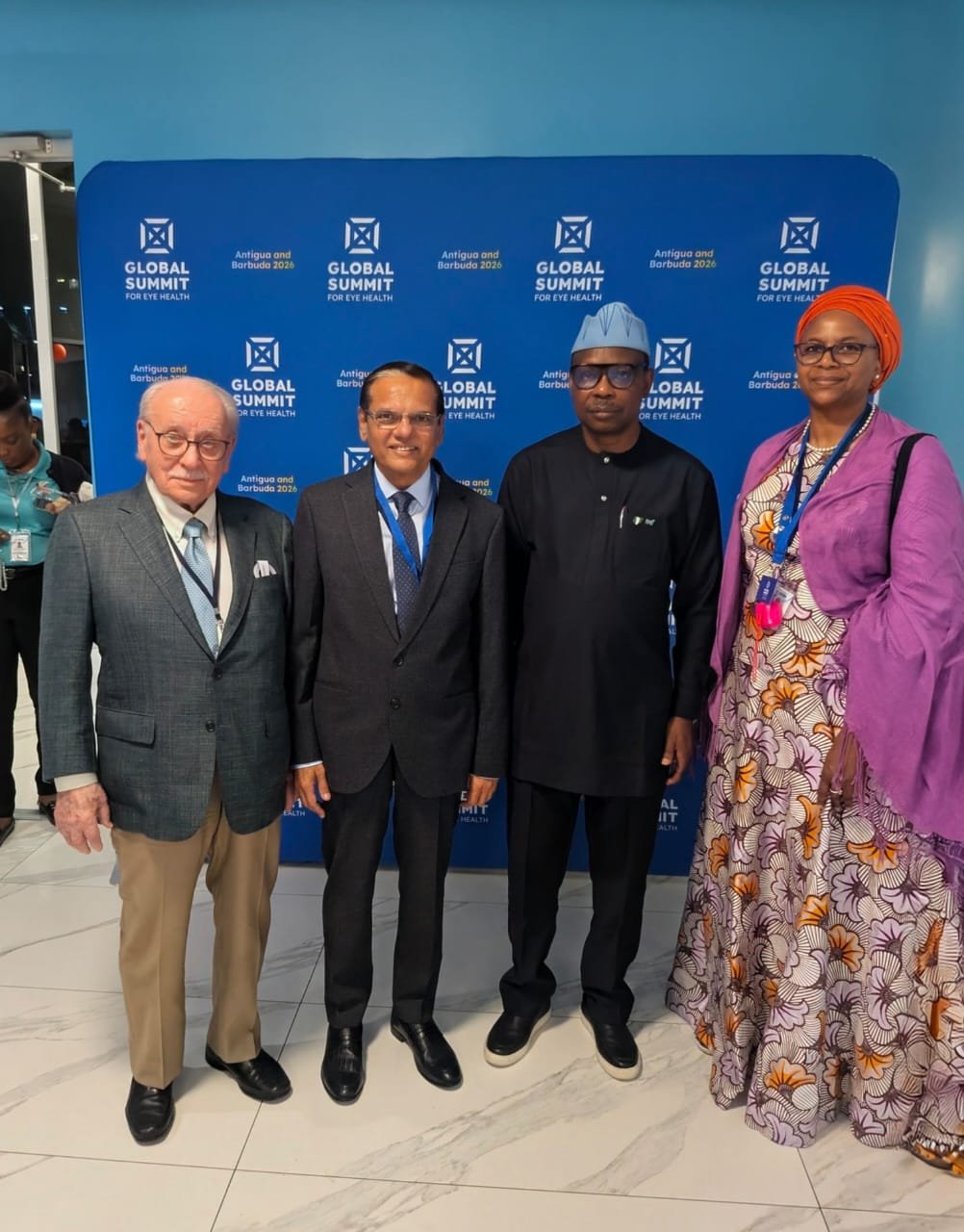
The Federal Government has set a target of increasing Nigeria’s active eye care workforce by 20 per cent by 2030 as part of efforts to expand access to quality eye care services and eliminate avoidable blindness across the country.
The Minister of State for Health and Social Welfare, Dr Iziaq Adekunle Salako, disclosed this at the closing ceremony of the Global Summit for Eye Health held in St John’s, Antigua and Barbuda.
Salako said the government would also train 15,000 primary healthcare workers, distribute five million ready-made reading spectacles and provide 25,000 fully subsidised cataract surgeries by 2027.
He added that Nigeria was targeting a 30-percentage-point increase in its Effective Cataract Surgical Coverage by 2030 to improve access to treatment for people living with cataract-related blindness.
According to him, the commitments were part of the Federal Government’s efforts to expand equitable access to quality eye care for more than 25 million vulnerable Nigerians, particularly women, older people and underserved rural populations.
The minister said the government would sustain efforts to integrate Primary Eye Care into the Basic Health Care Provision Fund (BHCPF), while mobilising domestic public and private sector resources to strengthen service delivery.
ALSO READ: Nigeria requires efficient civil service to achieve $1trn economy by 2030 — FCSC boss
He explained that Nigeria’s eye health commitments were designed to accelerate universal health coverage and address the social and economic consequences of avoidable vision loss.
Salako noted that poor vision affected more than individual health, as it could undermine education, deepen household poverty, compromise road safety and reduce national productivity.
“When a child cannot see the chalkboard, or an artisan or farmer is blinded by cataracts or uncorrected refractive errors, an entire community pays the price,” he said.
The minister also reaffirmed Nigeria’s commitment to the World Health Organisation’s Global Cataract Surgery Initiative, known as SEE 2045, which seeks to eliminate cataract-related blindness.
He said Nigeria was among five countries, alongside Antigua and Barbuda, Bangladesh, Tanzania and China, participating in the initiative to demonstrate how cataract blindness could be eliminated through the equitable expansion of surgical services.
Salako urged participating countries to document their achievements, measure outcomes and share implementation strategies to ensure that surgical backlogs were cleared, rural communities reached and quality standards maintained.
He disclosed that philanthropic partners had pledged $60m to support assistive technology, while 15 private-sector commitments were valued at more than $468m to accelerate eye care implementation.
He added that about 143 other commitments had been made by organisations outside government, describing partnerships as critical to achieving global eye health targets.
Reflecting on Nigeria’s experience, Salako recalled that the JigiBola initiative, introduced in Lagos about 25 years ago, provided free eye screening, eyeglasses and cataract surgeries.
He said he participated in the programme as a young medical officer and noted that the initiative was now being replicated nationally through the Effective Spectacle Coverage Initiative Nigeria, also known as JigiBola 2.0.
According to him, the experience demonstrated how successful interventions at the state level could be expanded into national programmes to improve access to essential healthcare services.
The minister, who spoke on behalf of President Bola Tinubu, said Nigeria would implement the resolutions reached at the summit by working with Commonwealth and international partners to mobilise resources and monitor measurable progress.
He urged participating countries to sustain the momentum generated by the summit, stressing that millions of people needed accessible interventions such as eyeglasses, timely referrals and cataract surgery to restore their sight.
Salako commended the government and people of Antigua and Barbuda for hosting the summit, as well as the WHO, the International Agency for the Prevention of Blindness, fellow co-host countries and other global eye health partners.
WATCH TOP VIDEOS FROM NIGERIAN TRIBUNE TV