

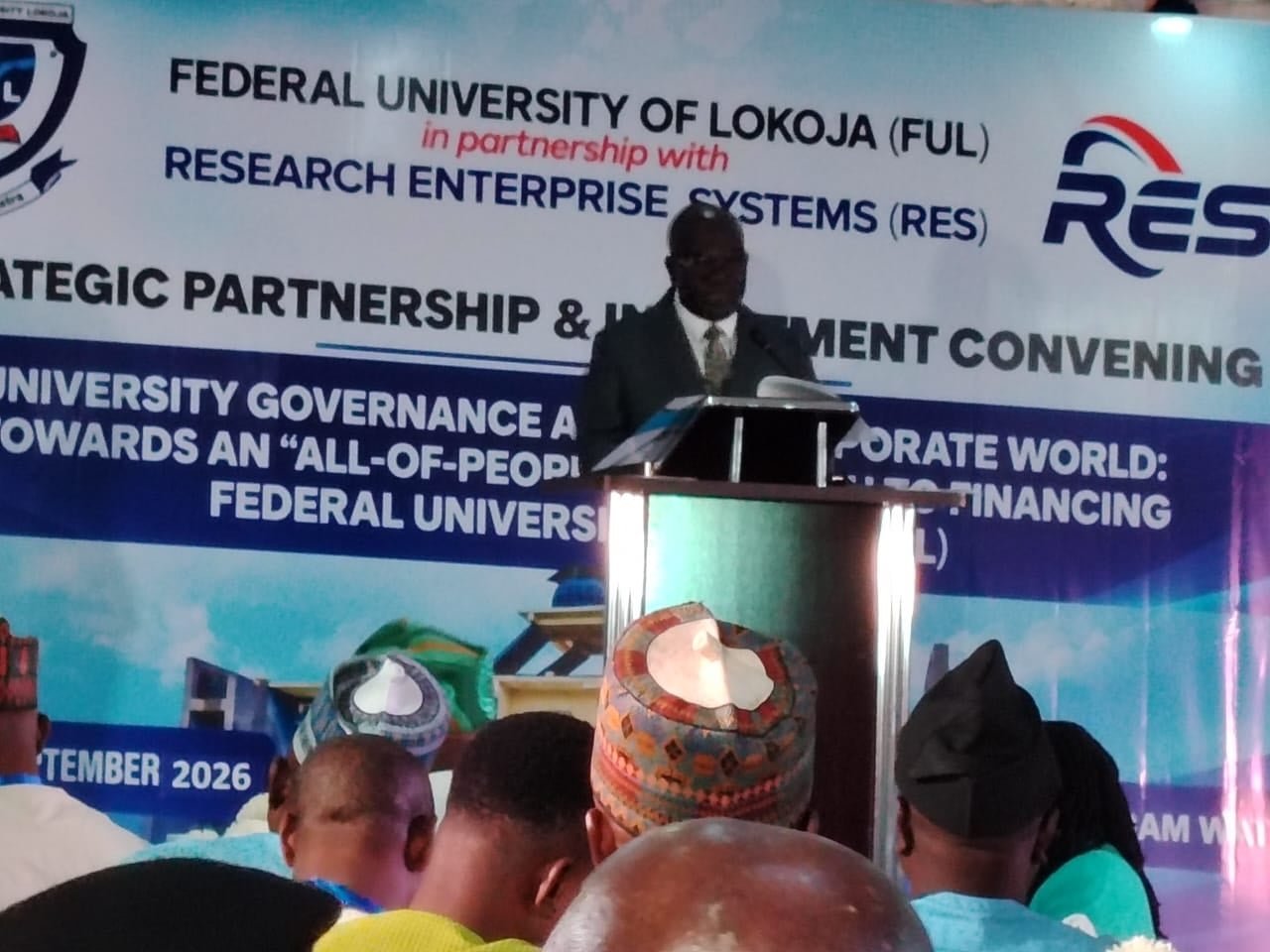
The Chairman of the Federal Civil Service Commission (FCSC), Prof. Tunji Olaopa, has called for a fundamental review of the legal framework governing Nigerian universities to grant institutions greater operational and academic autonomy and enable them to explore innovative funding mechanisms.
Olaopa made the call on Thursday in Abuja while speaking as chairman of the occasion at a special convening on “University Governance and the Corporate World: Towards an ‘All-of-People’ Approach to Financing Federal University Lokoja”.
He said the existing legal and governance framework had created bottlenecks that constrained universities’ ability to mobilise resources, conduct research and respond effectively to the needs of industry and society.
According to him, the National Assembly, the Federal Ministry of Education, the National Universities Commission (NUC) and other stakeholders should collaborate on a fundamental review of the university governance framework.
“This will entail initiating amendment to existing university establishment Acts, to grant full operational and academic autonomy to universities,” he said.
Olaopa, however, stressed that greater autonomy must be accompanied by stronger accountability and a financing framework linked to clearly defined objectives and measurable outcomes.
He advocated an “all-of-people partnership model” that would expand university governance beyond the traditional structures of governing councils and senates to incorporate industry, host communities, alumni, trade unions and other stakeholders.
The FCSC chairman also criticised the separation of strategic planning from budgeting in many universities, saying the practice often resulted in duplication, administrative silos and wastage of scarce resources.
He argued that no new academic programme, building project or recruitment initiative should be approved unless it was aligned with a specific key performance indicator contained in an institution’s strategic plan.
Meanwhile, the Vice-Chancellor of Federal University Lokoja (FUL), Prof. Gbenga Solomon Ibileye, has called on the private sector, development partners, alumni and other stakeholders to invest in the university, describing the institution as an investment opportunity rather than one dependent solely on government funding.
“I am here to invite you to investment, and to speak to you in the language that every serious investor understands, which is the language of returns on investment,” Ibileye said.
He added: “I am here to present Federal University Lokoja not as an institution waiting for charity, but as an institution offering opportunity: viable, high-demand business opportunities within a secure and federally backed institutional environment.”
The vice-chancellor said FUL, established in 2011, had grown to more than 30,000 students, with 17 faculties, a College of Postgraduate Studies and a College of Health Sciences spread across two campuses.
He said the rapid growth in student population and academic programmes had created a corresponding demand for infrastructure and services that government funding alone could no longer adequately meet.
Ibileye identified purpose-built student hostels, faculty and staff accommodation, conference and hospitality facilities, commercial and mixed-use developments, research laboratories, innovation and incubation facilities, cloud and computing infrastructure, agriculture, a hospital and a solar farm as some of the investment opportunities available at the university.
He described student accommodation as one of the immediate opportunities, citing the widening gap between demand and available facilities.
Under the proposed arrangement, he said investors could finance, construct and operate accommodation facilities, recover their investments during an agreed concession period and subsequently transfer the assets to the university.
He also identified staff and faculty housing as another investment opportunity, saying decent accommodation would help the institution attract and retain academic and non-academic personnel as it expanded.
Ibileye said FUL’s location in Lokoja, at the confluence of the Rivers Niger and Benue and about 200 kilometres from Abuja, offered additional commercial, hospitality and real estate opportunities.
On technology, he said the university was positioning itself for the emerging knowledge economy through programmes in artificial intelligence, cyber security, data science and software engineering.
He disclosed that the Tertiary Education Trust Fund (TETFund) had approved a Centre of Excellence in Artificial Intelligence, Robotics and Cyber Sciences for the university, creating opportunities for corporate investment in research laboratories, innovation hubs, computing infrastructure, scholarships, faculty development and technology commercialisation.
The vice-chancellor said the university would operate three broad partnership models: Build-Operate-Transfer (BOT), Public-Private Partnership (PPP), and Lease and Joint Venture.
Under the BOT model, he explained that investors would finance, construct and operate projects, recover their investments during the concession period and transfer the assets to the university at the expiration of the agreement.
The PPP model, he said, would involve the university and investors sharing development responsibilities, risks and returns, while the lease and joint venture arrangement would allow investors to develop and operate projects on university land.
Ibileye assured prospective investors that the university would provide a regulated framework, clearly defined agreements, transparent risk allocation and mechanisms for investment recovery.
He urged real estate developers, financial institutions, technology companies, telecommunications firms, energy companies, development partners, alumni and high-net-worth individuals to take advantage of the opportunities.
Earlier, the Director of Alumni Relations and Linkages, Prof. Abel Joseph, said the initiative was designed to change the longstanding perception that funding a federal university was exclusively the responsibility of government.
Joseph said FUL’s rapid expansion had created urgent needs in infrastructure, research funding, student support and innovation, making alternative sources of financing necessary to complement government support.
He said the “All-of-People” approach recognised the shared interest of government, alumni, corporate organisations, host communities, parents and other stakeholders in the development of the university.
Joseph called for stronger collaboration between universities and the corporate sector, noting that while industry required research, innovation and skilled manpower, universities could benefit from industry’s practical knowledge, mentorship and financial resources.
He said such collaboration could transform FUL from a conventional degree-awarding institution into a solutions-oriented university capable of responding directly to national and industrial challenges.
The initiative, he added, formed part of the university’s Vision Plan 2026–2031.
The Abuja convening brought together university officials, members of the governing council, corporate representatives, alumni, development partners and other stakeholders to examine FUL’s investment prospectus and possible partnership models.
WATCH TOP VIDEOS FROM NIGERIAN TRIBUNE TV