

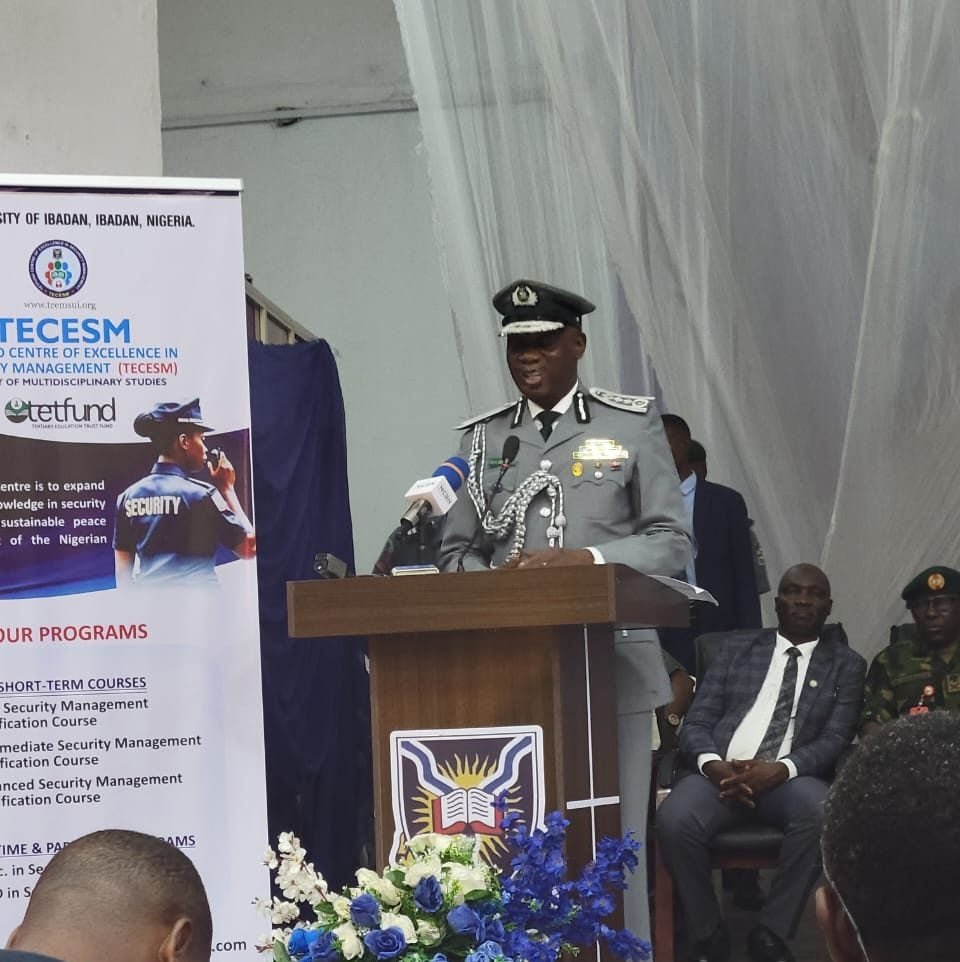
The Comptroller-General of the Nigeria Customs Service (NCS), Bashir Adewale Adeniyi, has described Customs as critical to Nigeria’s revenue generation, national security and sovereignty, saying its role has become increasingly important in an interconnected world.
Adeniyi stated this on Tuesday, October 20, while delivering the third distinguished personality lecture organised by the TETFund Centre of Excellence in Security Management (TECESM), University of Ibadan, at Trenchard Hall.
The lecture was themed, “Why Customs Matters: Revenue, Security and Nationhood in a Borderless World.”
He argued that despite the expansion of global trade and digital commerce, national borders remained relevant, stressing that Customs was a key institution at the intersection of trade facilitation, revenue collection and security.
The Customs boss described the belief that borders were becoming irrelevant as a misconception, noting that countries needed smarter and more efficient border management systems to respond to emerging challenges.
On revenue generation, Adeniyi disclosed that the Service collected N3.2 trillion in 2023, N6.105 trillion in 2024 and N7.28 trillion in 2025, exceeding its target of N6.58 trillion for that year.
He said the Service was targeting N11.07 trillion in 2026 and had generated approximately N4.03 trillion in the first half of the year.

According to him, improved valuation procedures, digital platforms, risk management and stronger enforcement contributed to the increase in revenue, beyond the impact of exchange-rate adjustments.
He explained that Customs revenue contributed to the Federation Account, which federal, state and local governments relied on to fund essential services, including education, healthcare and infrastructure.
On national security, Adeniyi cited the interception of 399 pump-action rifles and hundreds of firearm components from a container aboard the vessel MV Velika at Tin Can Island Port, Lagos, in July 2026.
He also recalled the seizure of 844 rifles and 112,500 rounds of ammunition at Onne Port in June 2024, saying such operations helped prevent weapons from reaching criminal groups and threatening public safety.
The Comptroller-General identified counterfeit medicines, illicit drugs, wildlife trafficking, fuel smuggling and the illegal movement of food commodities as other security challenges requiring effective border controls.
He said the Service worked with agencies such as the National Drug Law Enforcement Agency (NDLEA), the National Agency for Food and Drug Administration and Control (NAFDAC) and the Economic and Financial Crimes Commission (EFCC) to tackle the threats.
Addressing the relationship between Customs and nationhood, Adeniyi said border communities needed a system that enforced the law without disregarding longstanding family, cultural and economic ties across neighbouring countries.
He advocated practical trade arrangements to encourage small-scale traders to use legal channels rather than resort to smuggling, adding that effective border management required intelligence, data and cooperation instead of indiscriminate closures.
Adeniyi also outlined reforms introduced under the Nigeria Customs Service Act 2023, including advance rulings, post-clearance audits and stronger cooperation with foreign customs administrations.
ALSO READ: Kingmakers with limits: How far can the outgoing governors go in installing their successors?
He said the Service was expanding digital cargo clearance through its B’Odogwu platform and the National Single Window initiative, with a long-term target of reducing cargo clearance time to 24 hours.
He added that the Authorised Economic Operator (AEO) programme had helped participating companies reduce clearance time from 168 hours to 41 hours.
The Customs chief called on the University of Ibadan, TECESM and the Tertiary Education Trust Fund (TETFund) to partner with the Service on research into border economies, data analytics fellowships, an illicit trade observatory, postgraduate studies on borders and independent evaluation of Customs reforms.
He said collaboration between researchers and practitioners would promote evidence-based policies, strengthen institutional accountability and improve border security and trade facilitation.
In his welcome address, the Director of TECESM, Professor Benjamin Aluko, said the lecture followed previous editions delivered by former Inspector-General of Police, Kayode Egbetokun, in 2024 and former Chief of Defence Staff, General Christopher Musa, in 2025.
Aluko explained that TECESM was established in November 2020 as one of 12 TETFund Centres of Excellence in Nigerian universities, with a mandate to advance knowledge in early warning systems and security management.
He disclosed that the centre commenced its MSc programme in Security Management in the 2024/2025 academic session with about 40 students, largely drawn from security agencies, while its PhD programme was expected to admit its first students in the next academic session.
Describing the participation of the TETFund Executive Secretary as significant to the centre’s activities, Aluko expressed the belief that the lecture would strengthen collaboration between academia and security institutions, promote evidence-based research and support practical solutions to security challenges.
He also announced plans to develop a specialised curriculum in collaboration with the Institute for Peace and Strategic Studies and other university departments to train senior Customs officers.
The TECESM director appealed to Adeniyi to provide a 30-seater bus to facilitate students’ field research and support the construction of a training and research facility to be named the Bashir Adewale Adeniyi Research and Training Hub.
He expressed confidence that the partnership would strengthen the centre’s capacity to fulfil its mandate and contribute to improved security management and sustainable national development.
The outgoing Vice-Chancellor of the University of Ibadan, Professor Adebowale, also described effective Customs administration as critical to Nigeria’s revenue generation, national security and nationhood.
He said the lecture addressed a major national concern as countries sought to balance trade facilitation with threats such as smuggling, arms proliferation, drug trafficking and cross-border terrorism.
Adebowale commended Adeniyi for driving reforms in the Nigeria Customs Service, citing the increase in revenue collection from N6.105 trillion in 2024 to N7.28 trillion in 2025.
He also highlighted the AEO programme and the indigenous B’Odogwu digital platform as measures helping to improve cargo clearance, reduce operational costs and strengthen data-driven administration.
He stressed that Customs was not merely a revenue collection agency but also a frontline institution responsible for protecting national sovereignty, the economy and citizens.
The vice-chancellor urged students and security professionals to develop skills in data analysis, intelligence, trade monitoring and the understanding of criminal networks, noting that effective security governance required smarter institutions rather than simply greater force.
He also commended TETFund for supporting TECESM, describing its investment in research and professional training as essential to strengthening Nigeria’s security institutions.
A highlight of the event was the investiture of Adeniyi as a Fellow of TECESM.
The programme also featured the presentation of the 54-chapter book, Perspectives on Security Management in Nigeria, and the first edition of the Ibadan Security Review, published in May 2026.
Among those who attended were the incoming Vice-Chancellor of the University of Ibadan, Professor Peter Olapegba; former Vice-Chancellor, Professor Abel Idowu Olayinka; TETFund Executive Secretary, Arc. Sonny Echono; former Chief of Army Staff, Lieutenant-General Tukur Yusuf Buratai (retd.); and the Lead of the TECESM Research/Technical Team, University of Ibadan, Professor Isaac Olawale Albert.
Others included heads of security agencies, including the Nigerian Army, Nigeria Police Force, Nigeria Security and Civil Defence Corps, Department of State Services, Nigeria Customs Service, NDLEA and Amotekun Corps.
The Olubadan of Ibadanland, Oba Rashidi Ladoja, was also represented at the event.
WATCH TOP VIDEOS FROM NIGERIAN TRIBUNE TV