

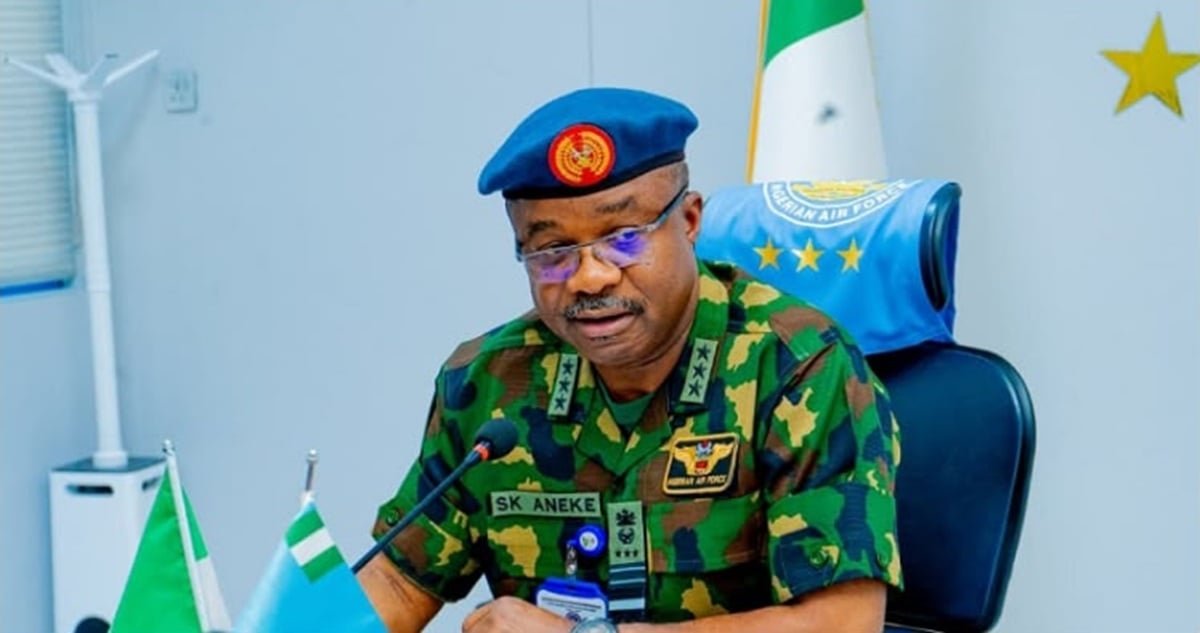
The Nigerian Air Force (NAF) has recorded more than 6,100 flying hours and 2,900 sorties in support of national security operations between November 2025 and September 2026, as the Chief of the Air Staff (CAS), Air Marshal Sunday Kelvin Aneke, approaches his first anniversary in office.
The figures were contained in a statement made available to defence correspondents in Abuja on Sunday by the NAF spokesperson, Air Commodore Ehimen Ejodame, highlighting the Service’s performance under Aneke’s leadership.
The statement also disclosed that the NAF received five helicopters, approved 284 infrastructure projects and expanded personnel training as part of efforts to improve operational effectiveness and modernise its fleet.
According to the statement, the Service consumed nearly 10 million litres of Jet A-1 aviation fuel during the period to support precision air strikes, armed reconnaissance, surveillance, close air support and other missions.
It said the operations were aimed at degrading hostile elements, restricting their freedom of action and improving the effectiveness of ground forces.
“Between November 2025 and September 2026, the NAF recorded over 6,100 flying hours and more than 2,900 sorties, consuming close to 10 million litres of Jet A-1 fuel in support of national security operations.
“These missions encompassed precision air strikes, armed reconnaissance, surveillance, close air support and other tasks designed to degrade hostile elements, disrupt their freedom of action and enhance the effectiveness of surface forces. Central to this effort has been intelligence-led mission planning, with operations guided by actionable intelligence, defined objectives and assessments of mission outcomes.
“The emphasis remains on ensuring that every sortie serves a clear operational purpose and contributes meaningfully to national security,” the statement said.
On personnel welfare, the NAF said Aneke had made it a priority under the principle of “Welfare for Enhanced Warfare”.
It said the approach recognised that adequately supported, professionally developed and motivated personnel were essential to sustained operational effectiveness.
The Service said it had pursued improvements in personnel allowances and medical support, alongside the provision of accommodation and supporting infrastructure to improve living and working conditions across its formations.
It added that the reactivation of welfare airlift services for personnel in frontline operational theatres was part of efforts to boost morale, improve the wellbeing of personnel and their families, and strengthen operational readiness.
The statement also disclosed that 57 senior officers were promoted to the ranks of Air Vice Marshal and Air Commodore, while 1,534 senior non-commissioned officers and 1,936 non-commissioned officers advanced to higher ranks.
It added that more than 550 personnel participated in international training and professional engagements, while over 6,000 received local training to improve their technical skills, specialised competencies and leadership capacity.
On fleet modernisation, the NAF said it received five helicopters in September 2026 — three AW-109 Trekker Type B helicopters and two H125 helicopters — to expand its operational flexibility and support capacity.
It said the Service was also pursuing an acquisition programme that included 12 AH-1Z attack helicopters and other planned aircraft and unmanned aerial systems to strengthen airlift, combat, training, intelligence, surveillance and reconnaissance capabilities.
Maintenance and fleet regeneration efforts included the reactivation and upgrade of six L-39ZA aircraft in Slovakia and Nigeria, as well as ongoing Periodic Depot Maintenance of a C-130 aircraft in Portugal.
The statement said these efforts were complemented by investments in technical support, indigenous upgrades and emerging aviation technologies.
On safety and accountability, the NAF said it had established an Operational and Safety Audit Committee to support independent assessments of operational, engineering and armament units.
It added that a strengthened Safety Management System was intended to promote leadership engagement, proactive risk management and a data-driven safety culture.
The Service was also advancing Civilian Harm Mitigation and Response through dedicated structures, standardised training and improved assessment and investigation capabilities.
Plans to establish an Open-Source Intelligence Centre were also underway to improve situational awareness and operational planning through better use of available information and emerging technologies.
On infrastructure development, the NAF said it had approved 284 projects, with 145 completed and 139 ongoing.
The projects cover residential accommodation, academic and medical facilities, administrative and operational infrastructure, roads, power, water supply and recreational facilities.
According to the statement, the projects were designed to improve personnel welfare and strengthen the Service’s operational and institutional capacity.
It added that local production initiatives included Aircraft Release Device 863 impulse release cartridges, a 250-kilogram bomb-loading trolley, and the development and ground testing of locally produced 57-millimetre rockets.
The NAF said community-focused healthcare, educational and other special projects had also continued to strengthen civil-military relations and public confidence.
President Bola Ahmed Tinubu appointed Aneke and other service chiefs on October 24, 2025. Aneke assumed office as Chief of the Air Staff on October 30, 2025.
WATCH TOP VIDEOS FROM NIGERIAN TRIBUNE TV